Last summer I volunteered to help tile a friend's sunroom. The room was mostly rectangular, but one corner angled inward where it met the roofline, creating a triangular section about 6 feet across. I measured the two straight walls, multiplied them together, and ordered tile for the full rectangle. When I laid the last row, I had nearly 20 square feet of extra tile stacked against the wall. The triangular corner held roughly half the area I had estimated. A triangle square footage calculator would have given me the correct number in seconds and saved me close to 40 dollars in wasted material.
Triangular areas appear more often than most people expect. Gable walls, attic floors, corner garden beds, and angled roof sections all form triangles. A dedicated calculator removes the guesswork by applying the correct formula to your measurements and returning the area in square feet. If you need a quick answer right now, the square footage calculator handles triangles instantly.
What Is a Triangle Square Footage Calculator?
A triangle square footage calculator is a digital tool that computes the interior area of any triangle and reports the result in square feet. You enter your known measurements, the tool selects the matching formula, and you receive an accurate area value without performing any manual arithmetic.
What Does Triangle Square Footage Mean?
Triangle square footage is the flat area enclosed by three sides of a triangle, expressed in square feet. One square foot equals a 12-inch-by-12-inch square. When you say a gable wall covers 120 square feet, you are describing how many of those one-foot squares fit inside the triangular shape. The concept applies to every triangle regardless of whether the sides are equal, the angles are acute, or one corner forms a right angle.
What Does the Calculator Determine?
The calculator determines the total interior area of the triangle. It does not measure perimeter, side lengths, or angles on its own. You provide the raw measurements, and the calculator returns a single number: the area in your chosen unit. Most calculators also offer conversion to square feet, square meters, or square yards so you can match the unit your supplier or contractor requires.
Who Can Use a Triangle Square Footage Calculator?
Homeowners use it to estimate flooring, paint, or siding for triangular surfaces. Roofers and contractors use it to calculate material quantities for gable ends and hip roof sections. Students use it to check geometry homework. Landscapers use it to measure triangular garden beds and patio sections. Anyone who encounters a three-sided shape in a measurement task benefits from the tool.
How Does a Triangle Square Footage Calculator Determine Area?
The calculator follows the same geometric principles taught in every high school math class. The difference is speed and accuracy. It eliminates arithmetic mistakes and handles decimal measurements that would be tedious to process by hand.
How Base and Height Determine Triangle Area
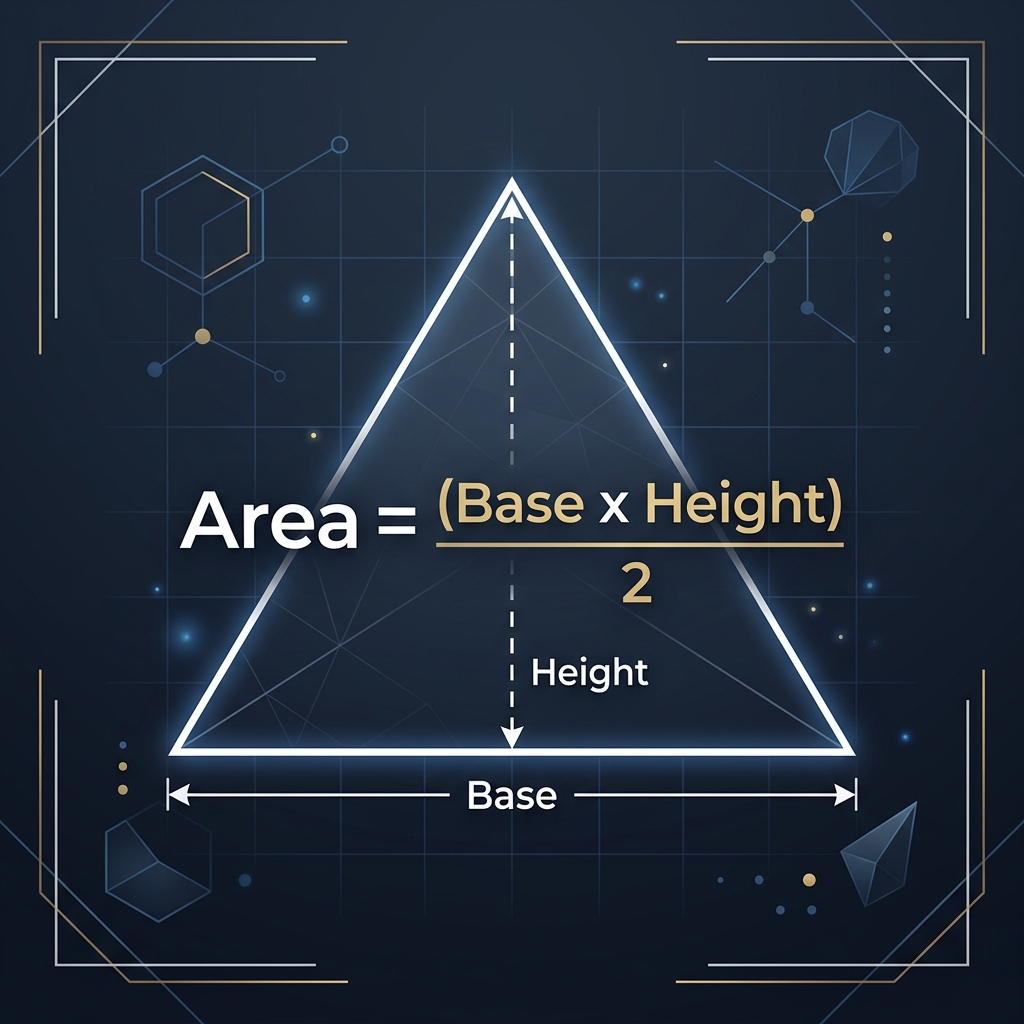
Every triangle can be viewed as exactly half of a rectangle. Draw a rectangle around any triangle so that the base of the triangle matches one side of the rectangle and the apex touches the opposite side. The triangle fills precisely half of that rectangle. That geometric relationship produces the foundational formula: multiply the base by the height and divide by two. A triangle with a 10-foot base and a 6-foot height occupies half of a 10-by-6 rectangle, giving an area of 30 square feet.
How the Calculator Uses Triangle Measurements
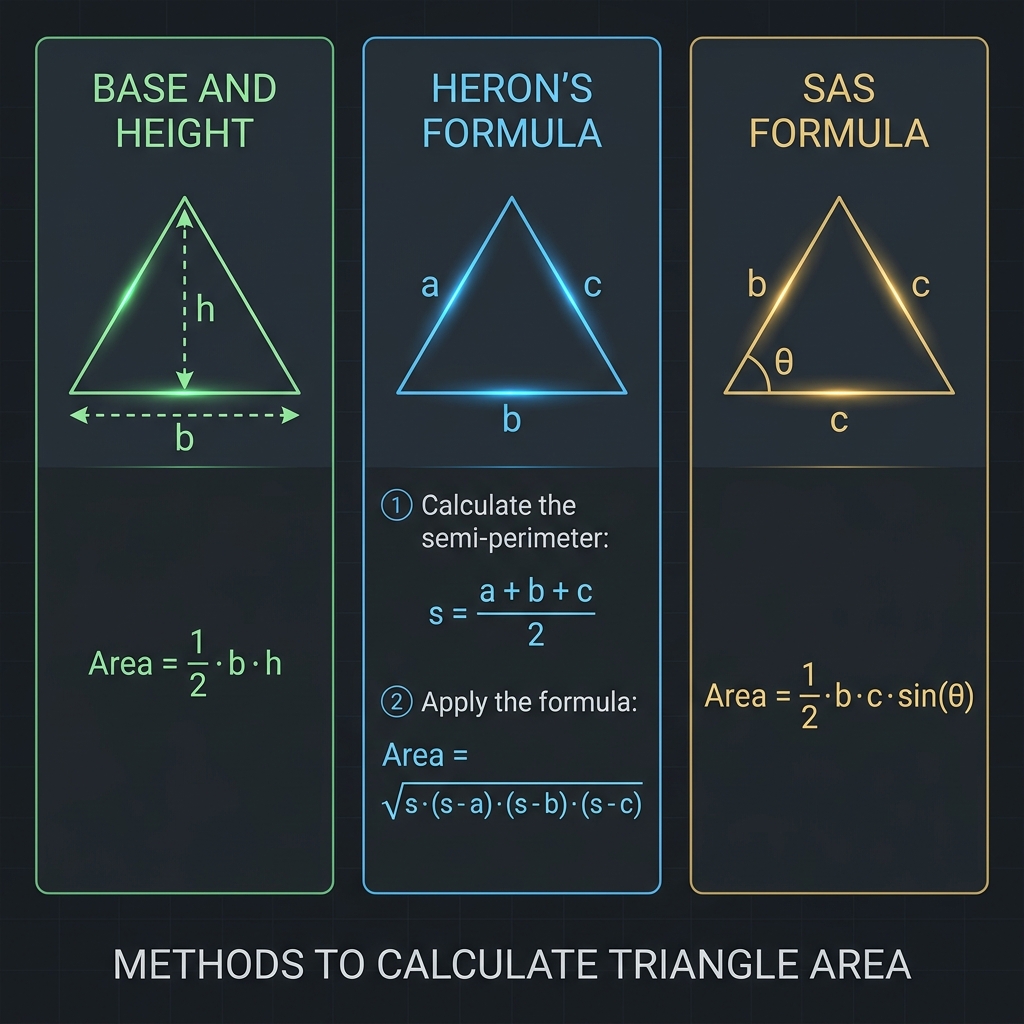
You enter your known values into the calculator fields. If you provide a base and height, the tool multiplies and divides by two. If you provide three sides, it applies Heron's formula internally. If you provide two sides and an included angle, it uses the SAS sine-based formula. The calculator selects the correct path automatically based on which fields you fill in. You never need to choose the formula yourself. For a broader look at area formulas for all common shapes, see the guide on how to calculate square feet for any shape.
How the Result Is Converted to Square Feet
If your input measurements are in feet, the output is already in square feet. When you enter values in inches, the calculator divides each dimension by 12 before applying the formula, or it computes the area in square inches and divides by 144 to convert. For metric inputs in meters, the calculator multiplies the result by 10.7639 to produce square feet. The conversion happens automatically so you never need a separate step.
What Measurements Can You Enter Into a Triangle Square Footage Calculator?
A good calculator accepts multiple measurement combinations because real-world situations rarely give you the exact set of values you would prefer to have.
Base and Perpendicular Height
This is the most common input pair. The base is any one side of the triangle. The height is the perpendicular distance from that base to the opposite vertex. On a gable wall, the base runs horizontally across the top of the rectangular wall, and the height extends vertically to the roof peak. This pair works for every triangle type and produces the fastest calculation.
Three Side Lengths
When you can measure all three edges but cannot easily determine the perpendicular height, enter the three side lengths. The calculator uses Heron's formula to compute the area. This situation is common on irregular land plots where you can pace or tape each boundary but the height would require trigonometry to find manually.
Two Sides and the Included Angle
If you know two side lengths and the angle between them, the calculator applies the SAS formula. Surveyors frequently work with this data set because transit instruments and total stations measure angles directly. The included angle must be the angle formed where the two known sides meet, not an angle at a different vertex.
Triangle Area Formula
FormulaWhat Formula Does a Triangle Square Footage Calculator Use?
Three formulas cover every possible triangle measurement scenario. Each formula is mathematically proven and produces the same area result when applied to the same triangle.
Base and Height Formula
Area equals one-half multiplied by the base multiplied by the height. Written numerically: Area = (b x h) / 2. A triangle with a 14-foot base and a 9-foot perpendicular height has an area of (14 x 9) / 2 = 63 square feet. This formula requires the least computation and should be your first choice whenever you can measure both values directly.
When to Use the Base and Height Formula
Use this formula when you can physically measure one flat side and the perpendicular distance to the opposite point. Gable walls, A-frame ceilings, and right triangles under staircases all offer easy base and height access. If you are working on a roofing project, the companion guide on calculating triangle square footage for roofing walks through field measurement techniques for elevated surfaces.
Heron's Formula for Three Sides
When you know all three side lengths (a, b, and c), first compute the semi-perimeter: s = (a + b + c) / 2. Then calculate the area as the square root of s(s-a)(s-b)(s-c). For a triangle with sides of 13, 14, and 15 feet, the semi-perimeter is 21. The area equals the square root of 21 x 8 x 7 x 6, which is the square root of 7,056, which equals 84 square feet.
When to Use Heron's Formula
Use Heron's formula when measuring the perpendicular height is impractical. Irregular land parcels, fenced property corners, and oddly shaped floor areas are common scenarios. You can tape all three edges without needing to find the perpendicular drop, which often requires a plumb bob or laser level.
SAS Formula for Two Sides and an Included Angle
When you know two sides and the angle between them, the area equals one-half multiplied by side a, multiplied by side b, multiplied by the sine of the included angle. For two sides of 10 feet and 8 feet with an included angle of 30 degrees, the area is 0.5 x 10 x 8 x sin(30) = 0.5 x 10 x 8 x 0.5 = 20 square feet.
When to Use the SAS Formula
Use this formula when surveying equipment gives you angle readings along with distance measurements. It is also useful when two walls meet at a known angle and you can measure the length of each wall but cannot reach the opposite side or the perpendicular height.
How Do You Choose the Right Triangle Measurements?
The best measurement set depends on what you can access physically. Choosing wisely saves time and reduces the chance of measurement error.
When You Know the Base and Height
If you can lay a tape along one side and measure straight up or across to the opposite point, use the base and height formula. This method is fastest, simplest, and least prone to error. Most indoor triangular areas, such as under-staircase alcoves and gable walls viewed from inside the attic, give you easy access to both measurements.
When You Know All Three Sides
If the triangle is on the ground and you can walk each edge with a measuring wheel or tape, Heron's formula is your best option. The extra computation is handled entirely by the calculator, so the only field work is measuring the three edges. Double-check each measurement once before entering values. A small error in any single side cascades through the square root calculation.
When You Know Two Sides and an Angle
If you have a transit, digital angle finder, or protractor reading for the angle where two measured sides meet, use the SAS formula. Make certain the angle you enter is the one between the two sides you measured. Entering an angle from a different vertex will produce an incorrect area.
What Types of Triangles Can the Calculator Handle?
A triangle square footage calculator works with every triangle type. The formula adapts to the shape automatically as long as you provide valid measurements.
Right Triangles
A right triangle has one 90-degree angle. The two sides forming that angle serve directly as the base and height. No extra measurement is needed. Area equals one-half times leg one times leg two. Under-staircase spaces, corner shelving areas, and many roof sections form right triangles.
Equilateral Triangles
All three sides are equal and all three angles measure 60 degrees. If each side is 10 feet, the height is approximately 8.66 feet (side multiplied by the square root of 3, divided by 2). The area works out to about 43.3 square feet. Equilateral triangles appear in decorative architecture and landscape design.
Isosceles Triangles
Two sides are equal and the base differs. Measure the base and the perpendicular height from the base to the apex. Many gable walls are isosceles triangles because the two roof slopes have equal length.
Scalene Triangles
All three sides are different lengths. Heron's formula is often the most practical approach for scalene triangles because finding the perpendicular height requires trigonometry. Irregular land corners and angled room intersections frequently produce scalene triangles.
What Units Can You Use for Triangle Square Footage?
Flexibility with input units makes the calculator practical across different trades, countries, and measurement systems.
Feet and Inches
Feet are the standard input for most U.S. construction and real estate measurements. If your tape reads feet and inches, convert the inches to a decimal fraction first. Six inches becomes 0.5 feet. Three inches becomes 0.25 feet. The calculator then returns the area directly in square feet.
Square Feet
When both input dimensions are in feet, the output is automatically in square feet. No additional conversion is required. One square foot equals a flat area measuring 12 inches by 12 inches, or 144 square inches.
Square Yards
Carpet and some landscaping materials are sold by the square yard. To convert the calculator result from square feet to square yards, divide by 9. A triangular area of 135 square feet equals 15 square yards.
Square Meters
For metric projects, enter measurements in meters and the calculator returns square meters. Multiply the square meter result by 10.7639 to convert to square feet. A 10 square meter triangle equals 107.64 square feet. For a thorough conversion reference, see the guide on common square meters to square feet conversions.
How Do You Interpret the Calculator's Square Footage Result?
The number the calculator returns is only useful if you understand what it represents and how to verify it.
Understanding the Area Result
The result tells you the total flat area enclosed by the three sides of the triangle. It does not include thickness, slope correction, or material waste. For a gable wall showing 120 square feet, that means 120 one-foot-by-one-foot squares would fit inside the triangular boundary if you could cut them to match the edges.
Checking the Calculation
A quick verification: the triangle area should always be less than the area of a rectangle with the same base and height. If your triangle base is 20 feet and the height is 10 feet, the area must be less than 200 square feet. The correct answer is 100 square feet. If the calculator returns a number equal to or greater than the rectangle area, recheck your inputs.
Converting the Result to Other Area Units
Divide square feet by 144 to get square inches. Divide by 9 to get square yards. Multiply by 0.0929 to get square meters. Always convert the final area result, not the individual measurements. Converting individual dimensions and then computing the area can introduce rounding errors when done in the wrong order.
Triangle Area Calculator
InteractiveTriangle Square Footage Calculation Examples
Concrete examples build confidence faster than abstract explanations. Here are three worked problems covering each formula type.
Example Using Base and Height
A gable wall measures 24 feet across the base and 8 feet from the base to the peak. Area = (24 x 8) / 2 = 96 square feet. You need 96 square feet of siding to cover this gable, plus 10 to 15 percent for cutting waste on the angled edges.
Example Using Three Side Lengths
A triangular garden bed has sides of 9, 12, and 15 feet. Semi-perimeter = (9 + 12 + 15) / 2 = 18. Area = square root of 18 x (18-9) x (18-12) x (18-15) = square root of 18 x 9 x 6 x 3 = square root of 2,916 = 54 square feet. You need 54 square feet of mulch or sod for this bed.
Example Using Two Sides and an Included Angle
Two fence lines meet at a 45-degree angle. One fence runs 10 feet and the other runs 14 feet. Area = 0.5 x 10 x 14 x sin(45) = 0.5 x 10 x 14 x 0.7071 = 49.5 square feet. That tells you exactly how much ground cover to order for the corner planting area.
Common Triangle Areas
Reference| Surface | Base (ft) | Height (ft) | Area (sq ft) |
|---|---|---|---|
| Small Gable Wall | 16 | 5 | 40 |
| Standard Gable | 24 | 8 | 96 |
| Large Gable | 36 | 12 | 216 |
| Under-Stair Alcove | 7 | 5 | 17.5 |
| Corner Garden Bed | 10 | 8 | 40 |
| Dormer Face | 6 | 4 | 12 |
| Hip Roof End | 20 | 14 | 140 |
When Is a Triangle Square Footage Calculator Useful?
A triangle calculator earns its keep on any project where triangular surfaces affect material quantities or cost estimates.
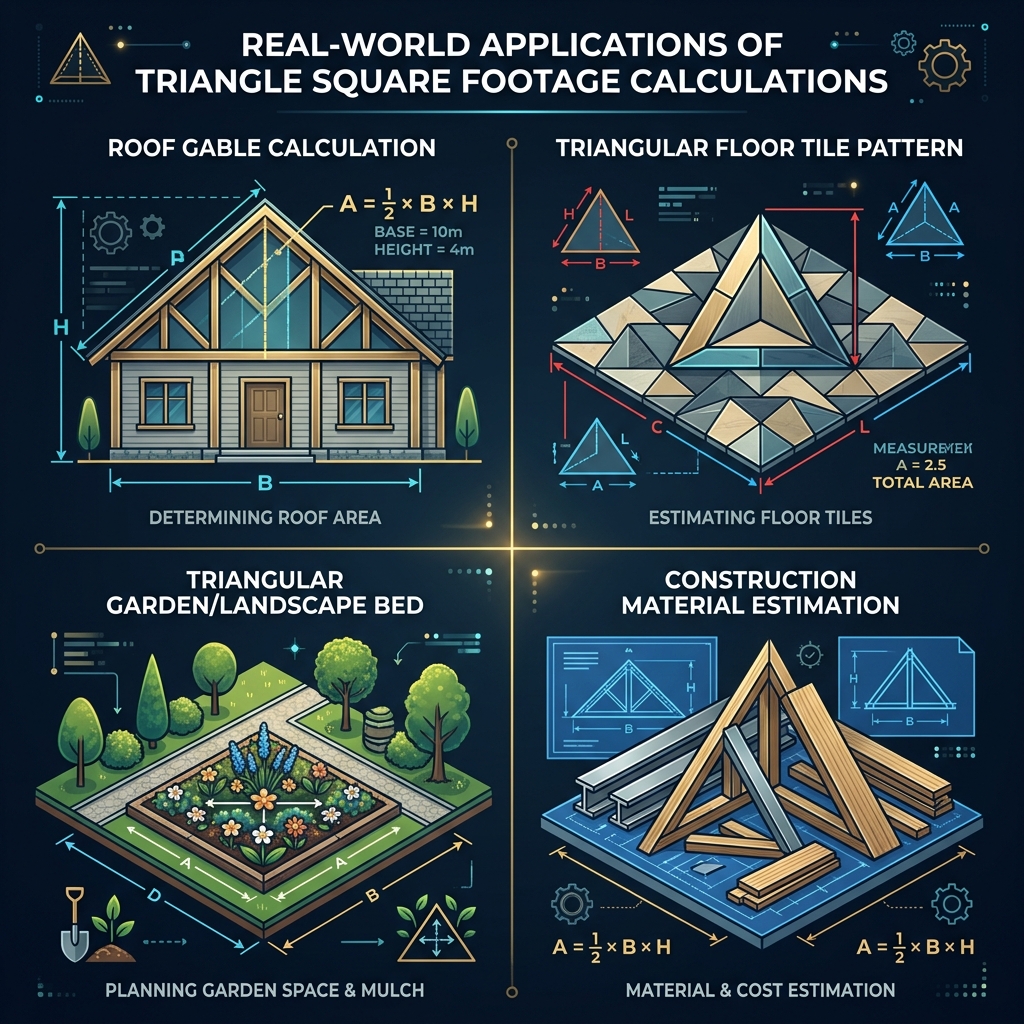
Home Improvement Projects
Painting a gable wall, tiling a corner nook, or installing wainscoting on an angled wall all require triangle area calculations. The calculator gives you the exact coverage area so you order the right amount of paint, tile, or panel material on the first trip to the store.
Roofing and Gable Measurements
Gable ends and hip roof triangles determine how many bundles of shingles or squares of roofing material you need. Underestimating by even 20 square feet can mean an extra delivery charge. The calculator prevents those costly shortfalls.
Flooring and Tiling
Bay window alcoves, entryway transitions, and rooms with angled walls create triangular floor sections. Calculating these separately from the rectangular main area and then adding the results gives you an accurate total for your flooring order. Our guide on how much flooring you need covers the full process including waste allowances.
Landscaping and Outdoor Projects
Corner garden beds, triangular patio sections, and angled retaining wall footprints all need area calculations for mulch, gravel, pavers, or sod. The calculator tells you exactly how many square feet of material to purchase.
Construction and Material Estimates
Contractors calculate triangle areas for siding, insulation, drywall, and structural sheathing on gable walls and angled surfaces. Accurate area measurements translate directly into accurate cost proposals and fewer change orders during construction.
What Are the Benefits of Using a Triangle Square Footage Calculator?
The tool offers four practical advantages over manual calculation that compound on every project.
Faster Area Calculations
Entering two or three numbers and reading the result takes about five seconds. Working the same calculation by hand, especially Heron's formula with its square root step, can take two to three minutes and still produce keystroke errors. On a project with multiple triangular sections, the time savings multiply quickly.
Reduced Calculation Errors
The calculator never forgets to divide by two, never confuses feet with inches, and never makes a decimal point error. Human arithmetic, particularly under job site pressure, is far less reliable. A single division mistake can inflate or deflate your area by 100 percent.
Easier Unit Conversion
Most calculators convert the result to square feet, square yards, or square meters with one click. Manual conversion between area units requires remembering that square feet to square yards uses a factor of 9, not 3. The calculator handles those details silently.
Convenient for Different Triangle Measurements
Whether you have base and height, three sides, or two sides and an angle, the calculator accepts all three input types. You do not need to derive missing measurements or perform trigonometry. Enter what you have and let the tool select the correct formula.
Common Mistakes When Using a Triangle Square Footage Calculator
Even with a calculator, the results are only as good as the data you enter. These five mistakes account for nearly every triangle area error I have encountered on real projects.
Entering the Wrong Measurements
Swapping the base for a side length or entering the hypotenuse instead of a leg will produce an incorrect area. Label each measurement clearly before entering it into the calculator. If you measured the sloped side of a roof, that is not the base unless you specifically intend to use it as such with the correct perpendicular height.
Using Sloped Length Instead of Perpendicular Height
This is the single most common and most costly mistake. The sloped rafter or angled wall edge is always longer than the perpendicular height. Using the slope inflates the calculated area by 10 to 40 percent depending on the angle. Always measure or compute the true perpendicular distance. For more measurement pitfalls, read about common square foot calculation mistakes.
Mixing Measurement Units
Entering the base in feet and the height in inches without converting produces a wildly incorrect area. A 10-foot base with a 96-inch height should be entered as 10 feet and 8 feet, not 10 and 96. Convert all measurements to the same unit before entering them.
Using an Incorrect Angle
With the SAS formula, the angle must be the one between the two measured sides. Using an angle from a different vertex of the triangle returns a wrong area. If your angle finder reads the corner where the two measured sides meet, you have the correct angle. If it reads a different corner, you do not.
Misinterpreting the Square Footage Result
The calculator returns the net geometric area. It does not include material waste, overlap, or cutting loss. For material ordering, add 10 to 20 percent on top of the calculated area. For roofing shingles on triangular sections, 15 percent is a safe starting buffer because every angled edge produces offcuts.
Frequently Asked Questions
It calculates the area inside a triangle and expresses the result in square feet. You enter measurements such as base and height, three side lengths, or two sides and an included angle, and the calculator returns the area using the appropriate geometric formula.
It applies a geometric formula to your measurements. For base and height, it multiplies the two values and divides by two. For three sides, it uses Heron's formula. For two sides and an angle, it uses the SAS formula with the sine function.
You need one of three measurement sets: the base and perpendicular height, all three side lengths, or two side lengths and the angle between them. Any one set is sufficient to calculate the area.
Yes. The calculator applies Heron's formula. It computes the semi-perimeter from the three sides and then uses the square root formula to find the area without requiring the height.
Yes. Use either Heron's formula with all three side lengths or the SAS formula with two sides and the included angle. Both methods bypass the need for a perpendicular height measurement.
Yes. A right triangle is simply a triangle where one angle is 90 degrees. The two legs serve as the base and height, so the basic formula applies directly. All three formula methods also work.
Yes. Enter your measurements in any consistent unit. If you enter inches, the result will be in square inches, which you can convert to square feet by dividing by 144. For meters, multiply the result by 10.7639 to get square feet.
The calculator is mathematically exact. Its accuracy depends entirely on the precision of the measurements you enter. Accurate field measurements produce accurate area results.
Yes, when the area is expressed in square feet. Triangle area is a general term that applies to any unit. Triangle square footage specifically means the area measured in square feet.
If your measurements are in feet, the result is already in square feet. For inches, divide the area by 144. For meters, multiply each dimension by 3.28084 before calculating, or multiply the final square meter area by 10.7639.
Final Thoughts
A triangle square footage calculator does one thing exceptionally well: it turns your field measurements into an accurate area figure without manual arithmetic, formula memorization, or unit conversion headaches. Whether you enter a base and height, three side lengths, or two sides and an angle, the calculator applies the correct geometric formula and delivers the result in square feet. The tool works for right triangles, equilateral triangles, isosceles triangles, and scalene triangles without any adjustment on your part. Measure carefully, enter the correct values, verify that your area is less than the equivalent rectangle, and add a waste buffer for material orders. That workflow keeps every triangular surface on every project accurate, on budget, and free of costly surprises.