A few months ago I helped my neighbor estimate siding for the triangular gable above his garage. He measured the sloped edge of the roofline at 17 feet, multiplied by the horizontal span of 28 feet, and declared he needed 476 square feet of material. The real area was 112 square feet. He had used a sloped side instead of the perpendicular height and skipped the division by two. That single mistake would have tripled his siding order. The correct calculation took about ten seconds once he understood which two measurements the formula actually needs.
Finding the square footage of a triangle when the base and height are known is one of the most practical geometry skills you can have. It applies to gable walls, roof sections, garden beds, tile work, and dozens of other everyday projects. This guide walks through the formula, the measurement process, worked examples in multiple units, and the mistakes that trip people up most often. If you need an instant answer, the square footage calculator handles triangles in seconds.
What Is the Square Footage of a Triangle?
The square footage of a triangle is the flat area enclosed by its three sides, measured in square feet. Every triangle, regardless of shape or size, has a calculable area that can be expressed in square feet for construction, landscaping, and material estimation purposes.
What Do Base and Height Mean in a Triangle?
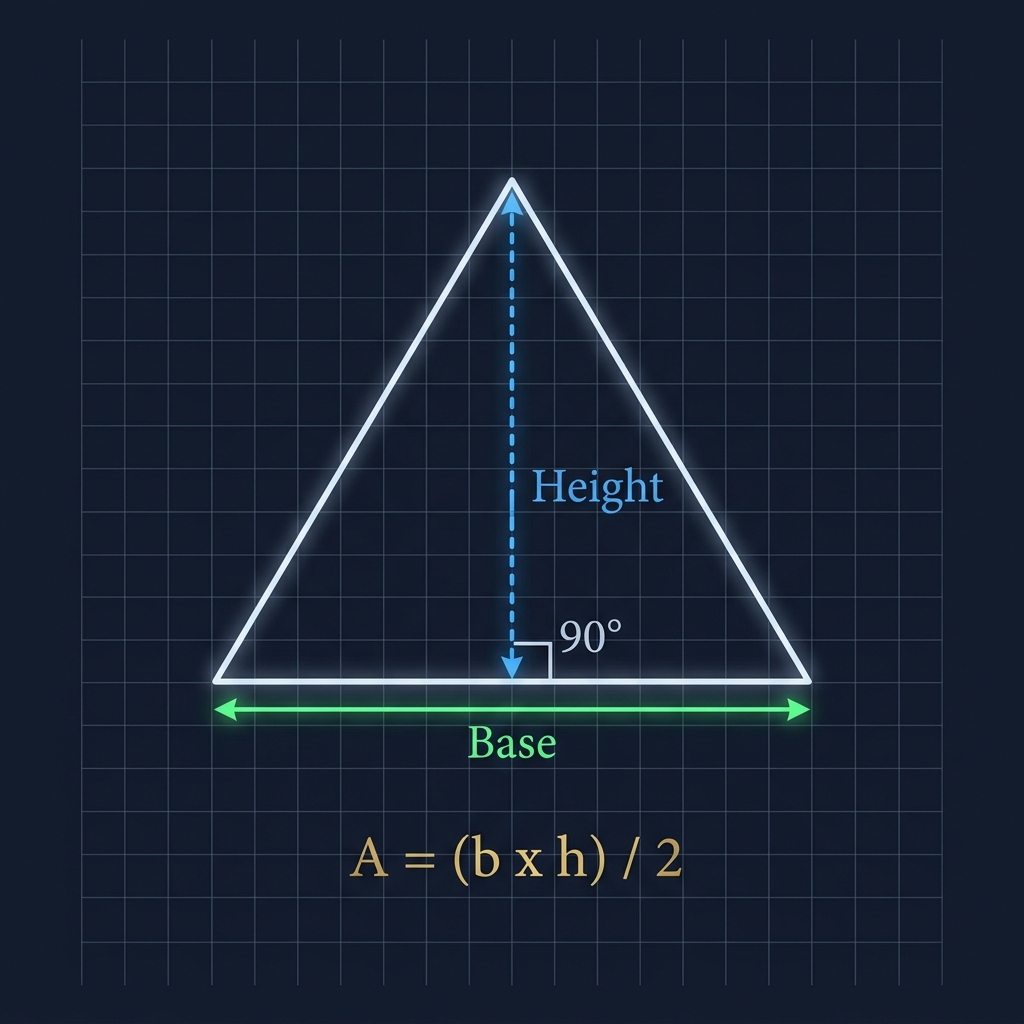
The base is any one side of the triangle that you choose as the reference edge. The height is the perpendicular distance from that base to the opposite vertex (the point across from the base). In practical terms, if you lay a triangle flat on the ground, the base is the edge touching the ground and the height is how far the top point rises straight above that edge. Any side can serve as the base. The area result stays the same no matter which side you pick.
Why Must the Height Be Perpendicular to the Base?
The formula only works when the height forms a 90-degree angle with the base. A sloped measurement from one corner to another gives you a side length, not the height. The perpendicular height represents the true vertical distance that defines how much space the triangle occupies. Using a sloped side inflates the result because the sloped distance is always longer than the true perpendicular drop. This distinction is the single most important concept in triangle area calculation.
How Is Triangle Area Expressed in Square Feet?
When both the base and the height are measured in feet, the calculated area is automatically in square feet. One square foot represents a flat area measuring 12 inches on each side. A triangle area of 80 square feet means that 80 of those one-foot squares would fit inside the triangular boundary if you could trim them to match the edges.
What Is the Formula for Finding Triangle Square Footage?
One formula handles every triangle when you know the base and the perpendicular height. It is the fastest, most reliable method for calculating triangle area.
The Base x Height Formula
Triangle Area Formula
FormulaMultiply the base length by the perpendicular height. Then divide that product by two. The result is the triangle area. A triangle with a 20-foot base and a 12-foot height produces (20 x 12) / 2 = 120 square feet. The formula works for right triangles, equilateral triangles, isosceles triangles, and scalene triangles without any modification.
Why You Divide the Base x Height by Two
A triangle is exactly half of a rectangle that shares the same base and height. Imagine drawing a rectangle around the triangle so the base lines up with one side and the apex touches the opposite side. The triangle fills precisely half of that rectangle. That geometric fact is why you divide by two. Forgetting this step gives you the rectangle area, which is double the correct triangle area.
When to Use the Base x Height Formula
Use this formula whenever you can measure or determine both the base and the perpendicular height. It is the preferred method for gable walls, A-frame ceilings, right-triangle floor sections, and any situation where you can access the base edge and drop a perpendicular measurement to the opposite point. For a deeper look at calculating area for multiple shapes, see the guide on how to calculate square feet for any shape.
How Do You Measure the Base and Height of a Triangle?
Accurate measurements are the foundation of every reliable area calculation. Knowing where to place the tape makes the difference between a correct result and a costly error.
How to Measure the Base
Select one side of the triangle as the base. Run a tape measure or laser meter along the full length of that edge from one corner to the other. Pull the tape tight and level. On a gable wall, the base is the horizontal span across the top of the rectangular wall. On a floor triangle, the base is any straight edge you can measure end to end. Record the measurement to the nearest quarter inch.
How to Find the Perpendicular Height
From the vertex opposite the base, measure straight down (or straight across) to the base line at a 90-degree angle. Use a plumb bob, a carpenter square, or a laser level to confirm the angle. On a gable wall, hold a level at the roof peak and measure vertically down to the base line. The resulting distance is the perpendicular height.
How to Identify the Correct Height
The correct height is always the shortest distance from the opposite vertex to the base line. It is never one of the triangle sides (unless the triangle is a right triangle and the side happens to be perpendicular to the base). If you are uncertain, place a carpenter square along the base. The height line must run parallel to the square arm that points away from the base. If your measurement line angles away from 90 degrees, it is not the true height.
What If the Height Falls Outside the Triangle?
In obtuse triangles (those with one angle greater than 90 degrees), the perpendicular height can drop outside the triangle boundary. Extend the base line beyond the triangle edge. Then measure from the opposite vertex down to that extended line at 90 degrees. The formula works the same way. The height simply happens to land outside the physical shape. This situation is common with shallow roof angles and irregular land parcels.

How Do You Calculate Triangle Square Footage Step by Step?
Follow these five steps in order. Each step builds on the previous one. The entire process takes less than a minute.
Step 1: Measure the Base
Choose one side of the triangle. Measure from one end to the other. Record the length. For this example, assume the base measures 18 feet.
Step 2: Measure the Perpendicular Height
Find the vertex opposite the base. Measure the perpendicular distance from that vertex to the base line. For this example, assume the height measures 10 feet.
Step 3: Multiply the Base by the Height
18 feet multiplied by 10 feet equals 180. This intermediate product represents the area of a rectangle with the same base and height as the triangle.
Step 4: Divide the Result by Two
180 divided by 2 equals 90. This division accounts for the triangle being exactly half of the rectangle. The number 90 is your triangle area.
Step 5: Express the Result in Square Feet
Because both measurements were in feet, the result is already in square feet. The triangle covers 90 square feet. If your measurements were in inches or meters, you would need a conversion step (covered in the next section).
Base x Height Calculator
InteractiveHow Do You Calculate Triangle Square Footage in Different Units?
Field measurements do not always arrive in feet. Knowing how to handle inches and meters prevents conversion errors that compound through the final result.
When Measurements Are Given in Feet
When both base and height are in feet, apply the formula directly. The result is in square feet with no conversion needed. A 14-foot base and a 9-foot height gives (14 x 9) / 2 = 63 square feet.
When Measurements Are Given in Inches
Apply the formula using inches. The result is in square inches. Divide by 144 to convert to square feet. A base of 96 inches and a height of 72 inches gives (96 x 72) / 2 = 3,456 square inches. Dividing 3,456 by 144 yields 24 square feet. Alternatively, convert each measurement to feet first (96 / 12 = 8 feet, 72 / 12 = 6 feet) and then apply the formula: (8 x 6) / 2 = 24 square feet.
When Measurements Are Given in Meters
Apply the formula using meters. The result is in square meters. Multiply by 10.7639 to convert to square feet. A base of 5 meters and a height of 3 meters gives (5 x 3) / 2 = 7.5 square meters. Multiplied by 10.7639, that equals 80.73 square feet.
Converting the Final Area to Square Feet
Always convert the final area rather than individual dimensions when possible. Square inches to square feet: divide by 144. Square meters to square feet: multiply by 10.7639. Square yards to square feet: multiply by 9. For a comprehensive reference, see the guide on common square meters to square feet conversions.
Triangle Square Footage Examples Using Base and Height
Working through specific numbers builds confidence and reveals the small details that abstract explanations miss.
Example With Measurements in Feet
A gable wall spans 30 feet at the base with a peak height of 9 feet. Area = (30 x 9) / 2 = 135 square feet. You need 135 square feet of siding material plus a 10 to 15 percent waste buffer for the angled cuts along the roofline edges.
Example With Measurements in Inches
A triangular tile accent behind a bathroom vanity has a base of 48 inches and a height of 36 inches. Area = (48 x 36) / 2 = 864 square inches. Divide by 144 to get 6 square feet. Add 20 percent for tile cutting waste, bringing the order total to 7.2 square feet of tile.
Example With Measurements in Meters
A triangular patio section measures 4 meters at the base and 2.5 meters in height. Area = (4 x 2.5) / 2 = 5 square meters. Multiply by 10.7639 to get 53.82 square feet. That tells you how many square feet of pavers to order for the triangular section.
Example of a Right Triangle
An under-staircase storage area forms a right triangle with legs of 8 feet (horizontal) and 6 feet (vertical). Because the two legs are perpendicular to each other, one leg serves as the base and the other as the height. Area = (8 x 6) / 2 = 24 square feet. No additional height measurement is needed for right triangles.
Quick Reference: Triangle Areas
Reference| Description | Base | Height | Area (sq ft) |
|---|---|---|---|
| Small Gable Wall | 16 ft | 5 ft | 40 |
| Medium Gable Wall | 24 ft | 8 ft | 96 |
| Large Gable Wall | 36 ft | 12 ft | 216 |
| Under-Stair Alcove | 8 ft | 6 ft | 24 |
| Tile Accent (inches) | 48 in | 36 in | 6 |
| Garden Corner Bed | 12 ft | 9 ft | 54 |
| Dormer Face | 6 ft | 4 ft | 12 |
How Does a Triangle Square Footage Calculator Use Base and Height?
A dedicated calculator automates the formula so you can focus on measuring rather than arithmetic.
Entering the Base Measurement
Type the base length into the first input field. Most calculators accept decimal values, so you can enter 14.5 feet without converting to inches first. Make sure the number represents the full length of the chosen base edge.
Entering the Height Measurement
Type the perpendicular height into the second field. Double check that this value is the perpendicular distance, not a sloped side length. The calculator cannot distinguish between a correct height and an incorrect sloped entry. It trusts whatever number you provide.
Selecting the Correct Unit
Choose feet, inches, or meters from the unit selector. If both measurements are in the same unit, the calculator returns the area in the corresponding square unit. Some calculators auto-convert the result to square feet regardless of input unit.
Interpreting the Square Footage Result
The displayed number is the net geometric area. It does not include waste, overlap, or cutting loss. For material ordering, add 10 to 20 percent on top. For cost estimation, multiply the area by the price per square foot of your chosen material.
How Do You Find the Square Footage of Different Triangles Using Base and Height?
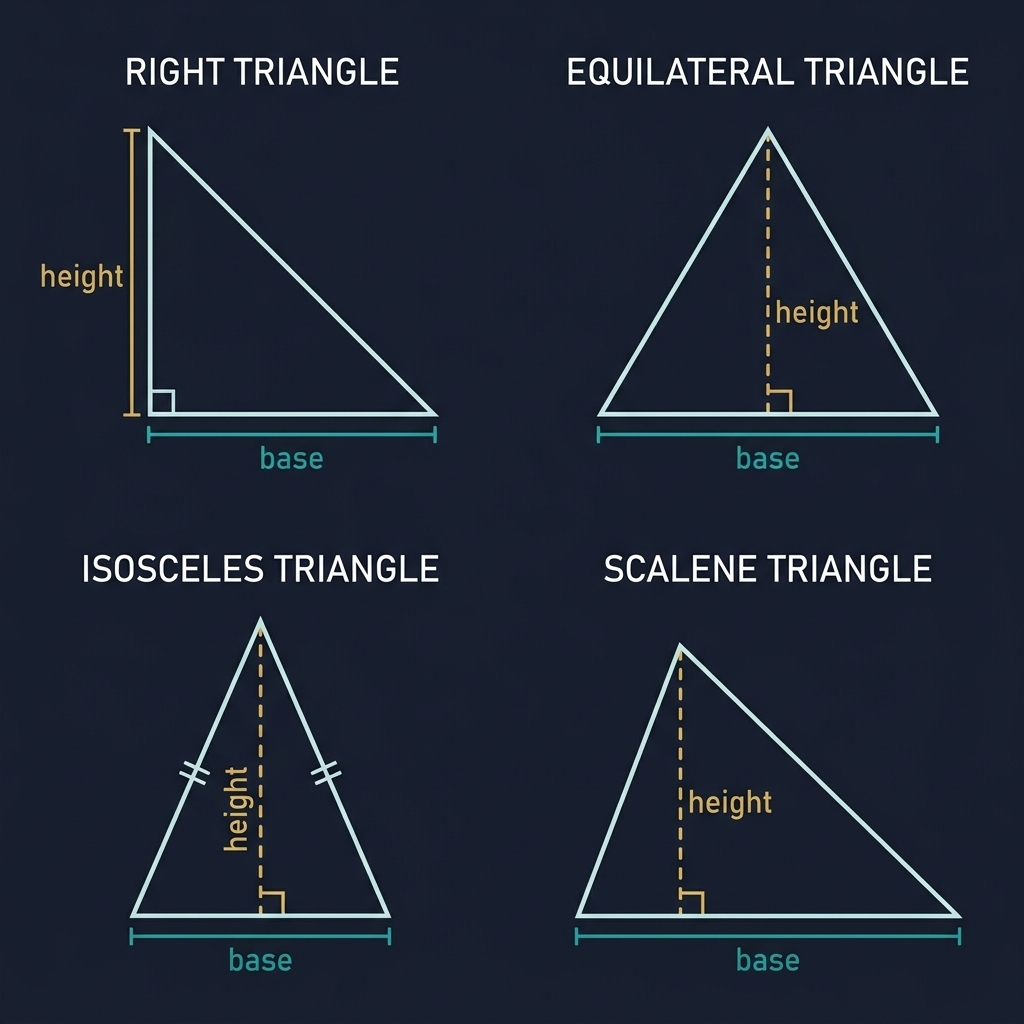
The formula is identical for every triangle type. What changes is how you identify and measure the base and height.
Right Triangle
A right triangle has one 90-degree angle. The two sides forming that angle (called legs) are automatically perpendicular to each other. Use one leg as the base and the other as the height. No extra measurement is needed. Area = (leg 1 x leg 2) / 2.
Isosceles Triangle
An isosceles triangle has two equal sides. The unequal side is typically the most natural base. The perpendicular height drops from the apex (where the two equal sides meet) straight down to the midpoint of the base. Measure that vertical distance for the height.
Equilateral Triangle
All three sides are equal. Any side can be the base. The height runs from the opposite vertex to the midpoint of the base. For a side length of s, the height equals s multiplied by the square root of 3, divided by 2. For a 10-foot equilateral triangle, the height is approximately 8.66 feet and the area is (10 x 8.66) / 2 = 43.3 square feet.
Scalene Triangle
All three sides differ in length. Choose any side as the base and measure the perpendicular height from the opposite vertex to that base. On scalene triangles, the perpendicular height may fall outside the triangle boundary if one angle is obtuse. The formula still works. For cases where measuring the height is difficult, the triangle square footage calculator guide covers alternative formulas using three sides or two sides and an angle.
What If You Do Not Know the Triangle's Height?
Sometimes the perpendicular height is impossible to measure directly. Two alternative methods bypass the height requirement entirely.
Finding the Height From Other Measurements
If you know the area and the base, you can solve for the height: Height = (2 x Area) / Base. If you know a side length and the angle it makes with the base, you can compute the height using trigonometry: Height = Side x sin(angle). Both approaches give you the perpendicular height needed for the base-height formula.
When All Three Side Lengths Are Known
Use Heron's formula. Compute the semi-perimeter: s = (a + b + c) / 2. Then the area equals the square root of s(s-a)(s-b)(s-c). This method requires no height measurement at all. It is especially useful for irregular land parcels where you can tape each boundary edge.
When Two Sides and an Angle Are Known
Use the SAS formula: Area = 0.5 x side a x side b x sin(included angle). The included angle must be the angle formed where the two measured sides meet. Surveyors commonly work with this data set because their instruments measure angles directly.
Common Mistakes When Calculating Triangle Square Footage
These five errors account for nearly every triangle area miscalculation on real job sites and homework assignments alike.
Using the Wrong Height
Measuring from a vertex to the wrong point on the base gives an incorrect height. The height must terminate on the base line at a 90-degree angle. If you measure from the apex to a corner of the base instead of straight down, the resulting distance is a side length, not the height. Always confirm the 90-degree angle with a square or level. For a full list of measurement pitfalls, see common square foot calculation mistakes.
Using a Sloped Side as the Height
This is the costliest mistake in triangle calculations. On a gable wall with a 30-foot base and a 10-foot perpendicular height, the correct area is 150 square feet. If you accidentally use the 16-foot rafter length as the height, you get 240 square feet. That 60 percent overcount translates directly into wasted material and wasted money.
Forgetting to Divide by Two
Multiplying base times height without dividing by two gives the rectangle area, not the triangle area. A 20-by-10 calculation returns 200 instead of 100. This doubles your material order. The division by two is the single step that separates the triangle formula from the rectangle formula. Never skip it.
Mixing Feet and Inches
A base measured as 12 feet 6 inches is 12.5 feet, not 12.6 feet. Entering 12.6 instead of 12.5 adds a small but real error that compounds through the calculation. Convert all measurements to the same unit before applying the formula. When in doubt, work entirely in inches and convert the final area to square feet by dividing by 144.
Confusing Linear Feet With Square Feet
Linear feet measure a single dimension (length). Square feet measure area (two dimensions). A 10-foot base is 10 linear feet. The triangle area computed from that base is in square feet. Ordering 100 linear feet of baseboard is different from ordering 100 square feet of tile. Make sure your material supplier knows which unit you mean.
Frequently Asked Questions
Multiply the base by the perpendicular height and divide by two. If a triangle has a 16-foot base and a 10-foot height, the area is (16 times 10) divided by 2, which equals 80 square feet.
The formula is Area = (Base times Height) divided by 2. Both the base and the height must be in the same unit. If both are in feet, the result is in square feet.
Yes. The height must form a 90-degree angle with the base. Using a sloped side instead of the perpendicular height produces an inflated and incorrect area.
Yes. In obtuse triangles, the perpendicular height drops outside the triangle boundary. The formula still works the same way. Extend the base line, drop a perpendicular from the apex to that extended line, and use that distance as the height.
Apply the formula using inches. The result will be in square inches. Divide by 144 to convert to square feet. Alternatively, convert each measurement to feet first by dividing by 12, then apply the formula.
If the area is in square inches, divide by 144. If it is in square meters, multiply by 10.7639. If it is in square yards, multiply by 9. Always convert the final area, not the individual measurements.
Yes. Most triangle calculators accept base and height as the primary input pair. Enter the base, enter the perpendicular height, and the calculator returns the area in square feet instantly.
No. Any side of a triangle can serve as the base. Once you choose a base, the height is the perpendicular distance from that base to the opposite vertex. The area result is the same regardless of which side you select.
The area will be incorrect. Using a sloped side instead of the perpendicular height inflates the result by 10 to 40 percent depending on the triangle shape. Always verify that your height measurement forms a 90-degree angle with the base.
Final Thoughts
Finding the square footage of a triangle when the base and height are known comes down to one reliable formula: multiply the base by the perpendicular height and divide by two. The formula works for right triangles, equilateral triangles, isosceles triangles, and scalene triangles without any modification. Measure carefully, confirm that your height forms a 90-degree angle with the base, convert all dimensions to the same unit before calculating, and always divide by two. Add a 10 to 20 percent waste buffer when ordering materials for triangular surfaces. Follow those steps and every triangle area on every project will be accurate, efficient, and free of the costly mistakes that catch so many people off guard.