Last spring, my wife and I were browsing apartment listings in Lisbon. Every property description listed the living area in square meters. A charming two-bedroom flat in Alfama was advertised at 85 square meters. Without a reliable conversion in my head, I guessed that 85 square meters was roughly 280 square feet. That seemed impossibly tiny for a two-bedroom. I nearly skipped the listing entirely. When I finally ran the correct formula, the apartment measured 914 square feet. That is a roomy, comfortable home by any standard. My faulty mental math almost cost us the best deal on the trip.
Knowing the formula for converting square meters to square feet protects you from exactly that kind of misjudgment. Whether you are comparing overseas property listings, reviewing imported building materials, or translating architectural drawings for a local contractor, one clean multiplication gives you the answer. This guide walks through the exact formula, the reasoning behind it, and every practical detail you need to apply it with confidence. If you need an instant result right now, the square footage calculator handles this conversion in seconds.
What Is the Square Meter to Square Feet Conversion Formula?
Area conversion between the metric system and the imperial system comes down to one dependable multiplier. There is no addition step, no division chain, and no temperature-style offset. You multiply, and you are done.
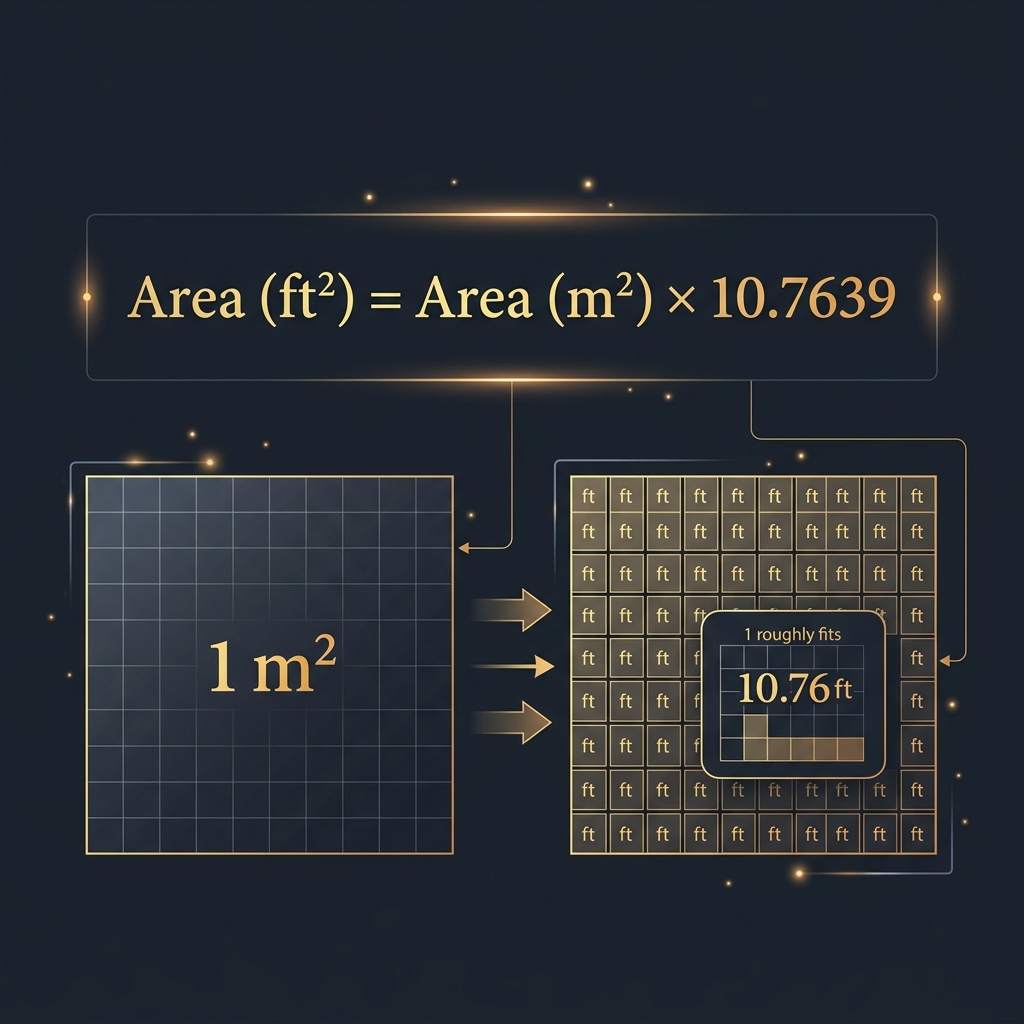
Square Meters to Square Feet Formula
The Core Conversion Formula
FormulaTake your known area in square meters. Multiply that number by 10.7639. The product is your area expressed in square feet. A 30 square meter kitchen becomes 322.92 square feet. A 120 square meter apartment becomes 1,291.67 square feet. For rough estimates when you are standing on a job site without a phone, multiplying by 11 will land you within about 2 percent of the true figure. For purchase agreements or material orders, always use the precise four-decimal multiplier.
Conversion Factor for Square Meters to Square Feet
The number 10.7639 is called the conversion factor. It is the fixed ratio between one square meter and one square foot. Laboratory-grade precision extends this to 10.76391041671, but that level of detail only matters in aerospace or geodetic surveying. For residential real estate, commercial leasing, and every standard construction application, four decimal places deliver accuracy that exceeds practical need. Even rounding to 10.76 introduces less than a 0.01 percent error on most room-sized calculations.
What Does the 10.7639 Conversion Factor Mean?
In physical terms, 10.7639 tells you how many one-foot-by-one-foot tiles you would need to cover a one-meter-by-one-meter floor section. Lay down ten full tiles, and you still have a sliver of exposed floor on two edges. That leftover strip accounts for the 0.7639 fraction. The number originates from the linear relationship between the two length units. One meter equals 3.28084 feet. Area is a squared measurement, so you multiply 3.28084 by itself: 3.28084 × 3.28084 = 10.7639. That squaring step is exactly why the area factor is so much larger than the length factor. Confusing the two is the single most expensive mistake people make with this conversion, and the square feet to square meters converter eliminates that risk entirely.
How Does the Square Meter to Square Feet Formula Work?
Breaking the formula into its individual moving parts reveals why it works so reliably and why no alternative shortcut can replace it.
Starting With the Area in Square Meters
Your starting value is the total area measured in square meters. This figure already captures two dimensions (length multiplied by width). You do not need to know the shape of the room or the individual side lengths. Whether the space is a perfect square, a long rectangle, or an oddly shaped loft, the total square meter figure is your only required input. A property listing that says "72 m²" gives you everything you need.
Multiplying by the Conversion Factor
When you multiply by 10.7639, you are rescaling the area from a larger unit to a smaller one. Because each square foot covers less ground than each square meter, the numerical result must grow. Think of it like exchanging currency: trading one euro for dollars gives you a larger number of dollars, even though the purchasing power has not changed. The physical room stays the same size. Only the label and the count change.
Canceling the Units in the Calculation
Dimensional analysis confirms the formula is structurally correct. The conversion factor carries hidden units: 10.7639 ft² per 1 m². When you write 72 m² multiplied by (10.7639 ft² / 1 m²), the m² in the numerator and the m² in the denominator cancel each other out. The only unit remaining is ft², which is exactly what you want. If units do not cancel cleanly, you have set up the conversion backwards.
Visualizing the Formula Workflow
InteractiveEnter a value below to see the exact calculation process.
How to Calculate Square Meters to Square Feet Manually
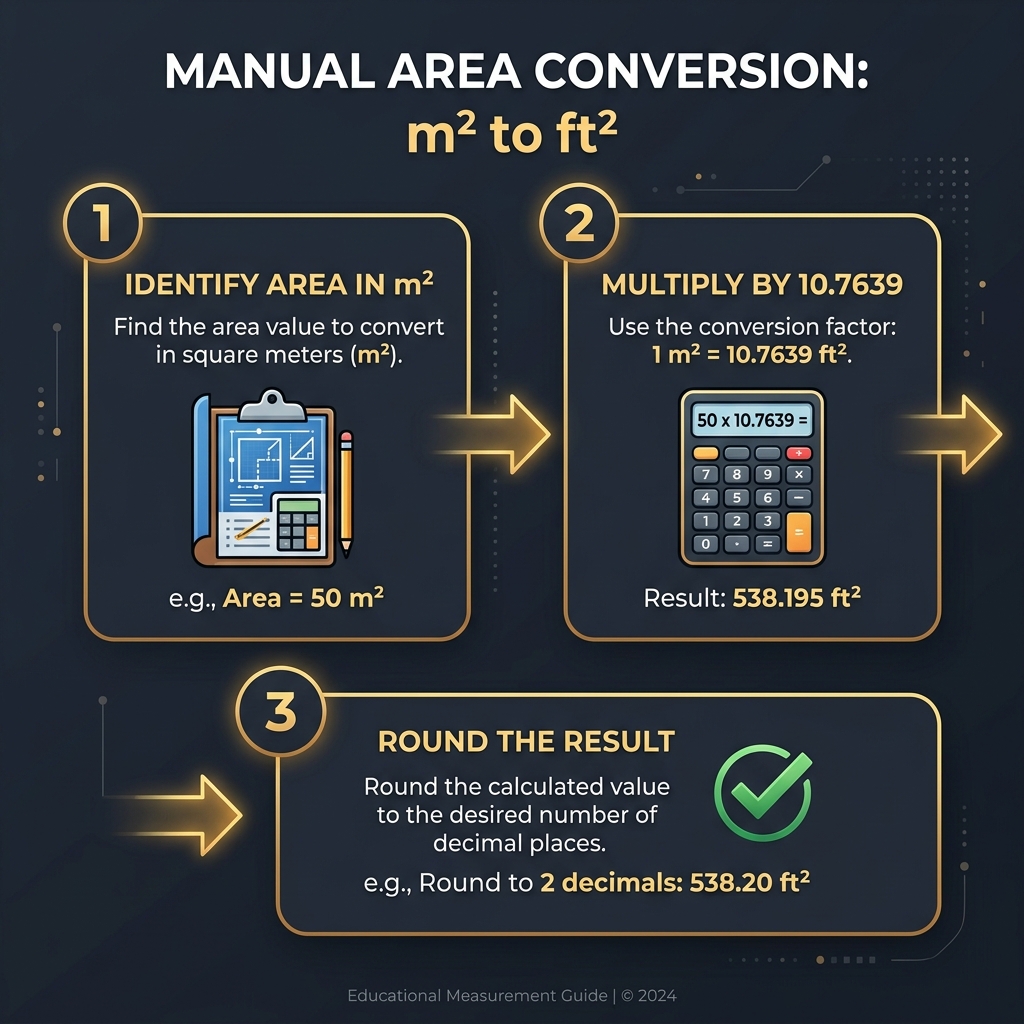
Digital tools like the square footage calculator deliver instant results, but understanding the manual process builds confidence. Here is a clean three-step method that works with nothing more than a basic calculator or a pencil and paper.
Step 1: Identify the Area in Square Meters
Find the square meter value you need to convert. On a European floor plan, this might appear as "Salon: 22 m²." If the plan only gives you room dimensions in meters (say, 5.5 m long and 4 m wide), multiply those first to get the area: 5.5 × 4 = 22 square meters. That product becomes your starting number for the conversion.
Step 2: Multiply by 10.7639
Enter 22 on your calculator and multiply by 10.7639. The screen reads 236.8058. That is your converted area. If you need a quick sanity check on site, multiply by 10 and then add roughly 8 percent. For 22 square meters, that mental shortcut gives 220 + 17.6 = 237.6, which is close enough to spot-check a supplier quote. For final documentation, use the full four-decimal multiplier.
Step 3: Round the Result When Needed
Your raw output will often have four or more decimal places. Round only the final answer, never the conversion factor itself. For material purchasing, one decimal place (236.8 ft²) is standard. For real estate listings, two decimals (236.81 ft²) works well. For multi-room projects where you sum individual room conversions, carry full precision through every intermediate step and round only the grand total at the end.
Square Meters to Square Feet Calculation Examples
Running through a set of common conversions builds the kind of muscle memory that prevents mistakes under pressure. Here are five benchmarks worth committing to memory.
How to Convert 1 Square Meter to Square Feet
Calculation: 1 × 10.7639 = 10.7639 ft²
Real-world reference: This is the area of a standard office desk surface, roughly the footprint of a small shower stall. Remembering that 1 m² is about 10.76 ft² gives you a reliable mental anchor for every other conversion.
How to Convert 10 Square Meters to Square Feet
Calculation: 10 × 10.7639 = 107.639 ft²
Real-world reference: A cozy home office or a compact nursery. European micro-apartments sometimes list bedrooms at this size. In American terms, 108 square feet is tight but functional for a single-purpose room.
How to Convert 25 Square Meters to Square Feet
Calculation: 25 × 10.7639 = 269.10 ft²
Real-world reference: A generous master bedroom or an entry-level studio apartment in cities like Paris or Tokyo. At 269 square feet, you can comfortably fit a queen bed, a wardrobe, and a reading chair.
How to Convert 50 Square Meters to Square Feet
Calculation: 50 × 10.7639 = 538.20 ft²
Real-world reference: The median size of a one-bedroom apartment across most European capital cities. At 538 square feet, the space typically includes a separate kitchen, a living area, a bedroom, and a bathroom.
How to Convert 100 Square Meters to Square Feet
Calculation: 100 × 10.7639 = 1,076.39 ft²
Real-world reference: A comfortable family home with two or three bedrooms in many global markets. This conversion crosses the psychologically important 1,000 square foot threshold, which often changes buyer perception in American listings.
| Square Meters (m²) | Calculation | Square Feet (ft²) |
|---|---|---|
| 5 m² | 5 × 10.7639 | 53.82 ft² |
| 20 m² | 20 × 10.7639 | 215.28 ft² |
| 40 m² | 40 × 10.7639 | 430.56 ft² |
| 75 m² | 75 × 10.7639 | 807.29 ft² |
| 150 m² | 150 × 10.7639 | 1,614.59 ft² |
| 200 m² | 200 × 10.7639 | 2,152.78 ft² |
| 500 m² | 500 × 10.7639 | 5,381.95 ft² |
How to Convert Square Feet to Square Meters Using the Reverse Formula
The conversion works in both directions. When an American seller needs to present a property to a European buyer, the reverse formula translates familiar square footage into the metric equivalent.
Square Feet to Square Meters Formula
You have two mathematically identical options. Divide the square footage by 10.7639, or multiply by 0.0929 (the reciprocal of 10.7639). Division is marginally more precise because the 0.0929 multiplier involves its own rounding. For everyday work, both paths produce results that differ by less than a hundredth of a square meter.
OR
Area (m²) = Area (ft²) × 0.0929
Example of Converting Square Feet to Square Meters
Consider a ranch-style house listed at 1,800 square feet in Dallas.
- Division method: 1,800 ÷ 10.7639 = 167.23 m²
- Multiplication method: 1,800 × 0.0929 = 167.22 m²
The negligible difference in the last decimal comes from the rounded 0.0929 factor. For contracts and appraisals, the division method is standard. For a quick comparison on a property search website, either approach is perfectly reliable. Our detailed guide on the difference between square meters and square feet explores when each unit is preferred across different countries and industries.
How Should You Round Square Meter to Square Feet Results?
Rounding is where many conversions go subtly wrong. The goal is to match your precision to the task at hand without introducing compounding errors along the way.
When to Use Exact Results
Preserve four or more decimal places whenever your calculation feeds into another calculation. If you are converting five separate rooms and then summing the totals, keep every decimal through the additions. Round only after the final summation. Legal property filings, land registry documents, and high-precision architectural blueprints also demand unrounded figures because tiny errors at the unit level compound across large structures.
When to Round to Two Decimal Places
Two decimal places (for example, 376.74 ft²) is the professional standard for real estate listings, contractor estimates, and interior design specifications. It communicates precision without cluttering a document with meaningless micro-fractions. When ordering materials like tile, hardwood, or carpet, you will add a 10 to 15 percent waste buffer on top of the converted figure anyway, so rounding to two decimals introduces zero practical risk.
Why Rounded Results May Differ Slightly
Multiplying 20 m² by the shortened factor 10.76 yields 215.2 ft². Using the full factor 10.7639 yields 215.278 ft². On a single room, that 0.078 ft² gap is invisible. But scale it to a 5,000 m² commercial development, and the gap balloons to 19.5 square feet. That is roughly the size of a walk-in closet. Always apply the precise factor (10.7639) during the math, and save rounding for the final displayed result.
The Impact of Rounding the Factor
VisualConverting a 3,000 m² retail space to square feet:
32,280 ft²
32,291.7 ft²
Difference: 11.7 square feet vanish when you round the factor too aggressively.
Common Mistakes When Converting Square Meters to Square Feet
After reviewing measurement disputes on dozens of cross-border property transactions, the same three errors appear with alarming frequency.
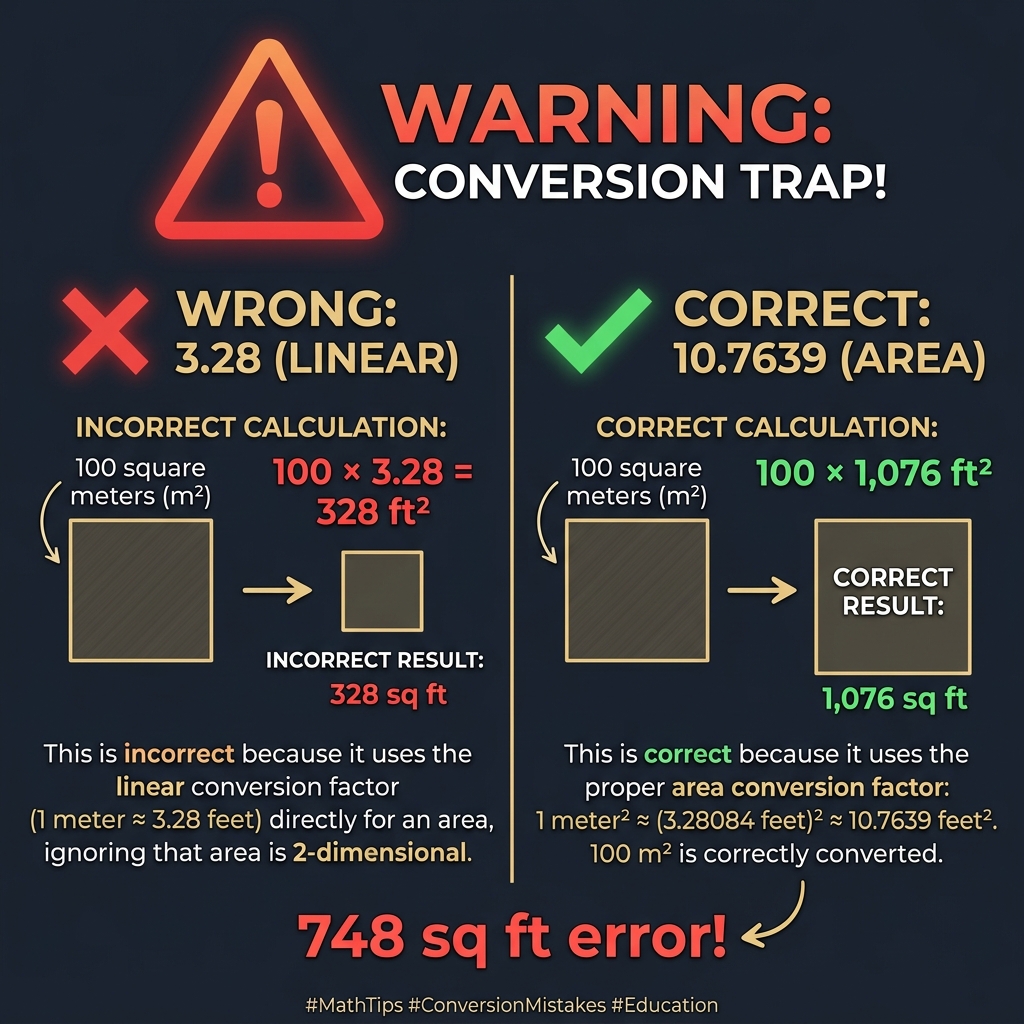
Using the Linear Meter-to-Foot Conversion Instead of the Area Conversion
This is the most damaging mistake in the entire conversion space. Because 1 meter equals 3.28 feet, people instinctively reach for 3.28 as their multiplier. Applying 3.28 to a 100 m² property returns 328 ft². The true answer is 1,076 ft². That 748 square foot shortfall would mean under-ordering enough flooring to cover three bedrooms. Area demands a squared conversion factor. Always use 10.7639, never 3.28, when converting between square meters and square feet.
Multiplying by the Wrong Conversion Factor
Memory mix-ups are common under deadline pressure. People swap the area factor (10.7639) with the volume factor (35.31 for cubic feet per cubic meter), or they accidentally multiply by 0.0929 when they should be multiplying by 10.7639. A simple guard rail: if your converted square feet number is smaller than your starting square meter number, you have gone the wrong direction. Square feet always produces a larger numerical result than square meters for the same physical space.
Rounding Too Early in the Calculation
Truncating a room dimension from 4.735 meters to 4.7 meters before computing the area creates a cascading error. That 0.035 meter reduction shrinks the width by almost 1.4 inches. On a room that is 6 meters long, the area drops from 28.41 m² to 28.2 m², and the converted square footage shifts from 305.8 ft² to 303.5 ft². On a single room, 2.3 square feet seems trivial. Across a 12-room house, the cumulative error can exceed 25 square feet.
How Can You Check a Square Meter to Square Feet Calculation?
Every professional conversion workflow should include a verification step. Two methods stand out for speed and reliability.
Checking the Result With the Reverse Conversion
The round-trip test is the fastest manual check available. Take your converted square feet result and divide it by 10.7639. If you land back on your original square meter figure (within minor rounding), the conversion is valid. If the numbers do not match, retrace your multiplication. This three-second sanity check has saved more purchase orders than any software tool I know of.
Checking the Result With a Square Meter to Square Feet Converter
Manual calculator work is vulnerable to keystroke errors. Pressing a 4 instead of a 7 changes a result by thousands of square feet on large properties. Running your numbers through a dedicated conversion tool removes that human-error layer entirely. The square feet vs square meters comparison guide on this site includes a built-in live converter that cross-references your manual math against algorithmic precision in real time.
Frequently Asked Questions
One square meter contains 10.7639104 square feet. Most professionals round this to 10.7639 or 10.76 depending on the precision their project requires. The value comes from squaring the linear meter-to-foot ratio of 3.28084.
Multiply your square meter value by 10.7639. For example, 15 square meters multiplied by 10.7639 produces 161.46 square feet. This single multiplication is the entire conversion process.
The mathematically exact factor is 10.76391041671, derived from squaring 3.280839895 (the precise number of feet in one meter). For construction, real estate, and interior design, rounding to 10.7639 provides more than sufficient accuracy.
Divide the square feet value by 10.7639, or multiply by 0.092903. Dividing by 10.7639 is slightly more precise because the 0.092903 multiplier itself is a rounded figure. Both approaches yield results within a fraction of a square meter of each other.
A meter measures roughly 3.28084 feet in length. Area requires multiplying two linear dimensions, so the conversion factor is 3.28084 squared, which equals 10.7639. The squaring step is why the area ratio is much larger than the simple length ratio.
Yes. Both units measure the identical physical quantity. A living room that spans 40 square meters also spans 430.56 square feet. The room does not change. Only the unit of measurement and the associated number change.
Final Thoughts
The entire formula for converting square meters to square feet fits in a single line: multiply by 10.7639. That simplicity is deceptive, though, because the consequences of getting it wrong cascade through budgets, timelines, and professional credibility. Memorize the factor. Understand that it comes from squaring the linear meter-to-foot ratio. Never confuse it with the length-based 3.28 multiplier. Round only the final result, never the factor itself. And when the stakes are high, verify your math with a reverse conversion or a digital tool. Whether you are analyzing property listings across continents or converting architectural plans for a local builder, this one formula is all you need to move between the metric and imperial worlds with total confidence.