A colleague of mine recently tried to order 150 square meters of porcelain tile for a renovation project in Houston. The supplier shipped enough material to cover 150 square feet instead. That mix-up left him with barely 14 square meters of tile, roughly one-tenth of what he actually needed. The project stalled for two weeks while the correct order arrived. That single unit confusion cost him time, money, and a frustrated client. If he had understood the exact difference between square meters and square feet before placing that order, none of it would have happened.
Square meters and square feet both measure area. They both tell you how much flat surface a space covers. But they come from different measurement traditions, represent different scales, and dominate different parts of the world. This guide breaks down every meaningful difference between these two units so you can avoid costly mistakes and communicate measurements accurately across any border or industry. If you need an instant conversion right now, the square feet to square meters converter handles the math in seconds.
What Is a Square Meter?
A square meter is the base unit of area in the International System of Units (SI), which is the modern form of the metric system. Over 180 countries have adopted the metric system, making square meters the dominant area unit on the planet. Understanding what a square meter represents in physical terms is the first step to distinguishing it from a square foot.
Square Meter Definition
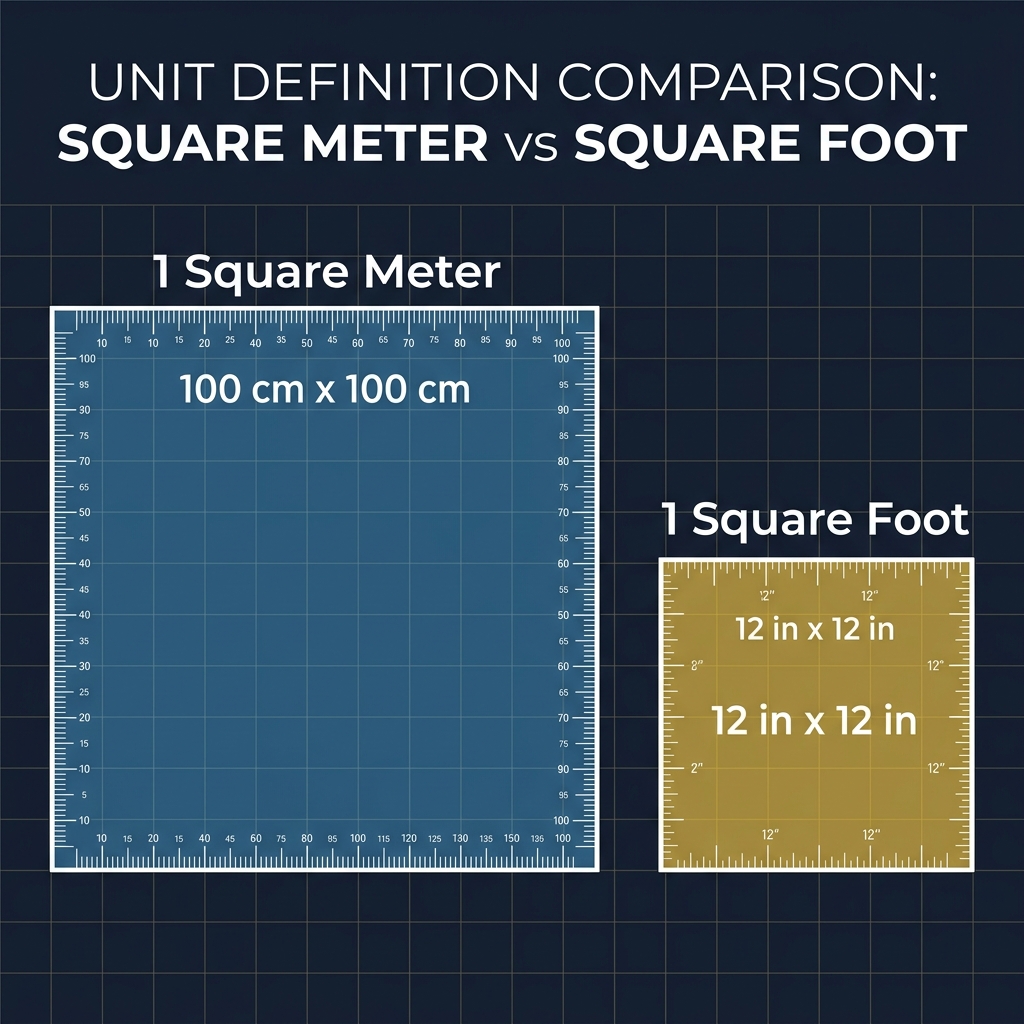
A square meter is the area of a square whose sides each measure exactly one meter in length. Since one meter equals 100 centimeters, one square meter equals 10,000 square centimeters. The meter itself was originally defined in 1791 as one ten-millionth of the distance from the North Pole to the equator along a meridian passing through Paris. Today, the International Bureau of Weights and Measures defines the meter based on the speed of light, making it one of the most precisely calibrated units in existence. When you square that length, you get a stable, universally recognized area measurement.
Square Meter Symbol and Abbreviations
The internationally recognized symbol for square meter is m2 (with the 2 as a superscript). In everyday writing, you will also see "sq m" and "sq. m." used interchangeably. Scientific papers, engineering documents, and ISO-compliant technical specifications always use m2. Real estate listings in Europe and Asia use m2 almost exclusively. When reading international property websites like Idealista (Spain), Immobilienscout24 (Germany), or Domain (Australia), every listing displays area in m2.
How Large Is One Square Meter?
One square meter is roughly the size of a standard interior door laid flat on the ground. Picture a space 3 feet 3 inches long by 3 feet 3 inches wide. A typical office desk surface covers about 0.7 to 1.0 square meters. A single bed occupies approximately 1.6 square meters of floor space. A yoga mat takes up around 1.5 square meters. These everyday comparisons help you visualize the unit without needing a tape measure. The square footage calculator on this site can convert any dimension into both units instantly.
What Is a Square Foot?
A square foot is the standard unit of area in the imperial measurement system, which traces its roots to British colonial standards. While only three countries officially use the imperial system, square feet remains deeply embedded in real estate, construction, and daily life across the United States and several South Asian markets.
Square Foot Definition
A square foot is the area of a square whose sides each measure exactly one foot in length. One foot equals 12 inches, so one square foot equals 144 square inches. The foot as a unit of length has ancient origins, roughly approximating the length of an adult human foot. The United States formalized the foot through congressional acts in the 1800s, and it remains the legal standard for land surveys, property descriptions, and building codes throughout the country. Unlike the meter, the foot was not designed around a mathematical relationship to natural constants, which is why imperial conversion factors (12 inches per foot, 3 feet per yard, 5,280 feet per mile) appear irregular compared to the base-10 metric system.
Square Foot Symbol and Abbreviations
The most common abbreviations for square foot are ft2, sq ft, sq. ft., and sqft. The square feet abbreviation guide on this site covers every accepted variation and when to use each one. In real estate listings on Zillow, Realtor.com, and Redfin, you will see "sq ft" most often. Construction blueprints and architectural drawings tend to use "SF" or "ft2." Academic and technical documents prefer ft2 with the superscript notation. All forms refer to exactly the same unit.
How Large Is One Square Foot?
One square foot is about the size of a standard ceramic floor tile. Picture a space 12 inches long by 12 inches wide. A standard sheet of letter paper (8.5 by 11 inches) covers approximately 0.65 square feet. A large pizza box is close to 1.8 square feet. A single sofa cushion is roughly 3 to 4 square feet. These references help you develop an intuitive sense of the unit. Once you can picture one square foot in your mind, estimating room sizes in square feet becomes second nature.
Square Meter vs Square Foot: Size Comparison
VisualWhat Is the Difference Between Square Meters and Square Feet?
Now that you know what each unit represents individually, here is where the real distinctions emerge. The differences go beyond simple size. They span measurement philosophy, geographic adoption, professional usage, and symbolic conventions.
Difference in Measurement Systems
Square meters belong to the metric system, which was developed in France during the 1790s and is now governed by the International Bureau of Weights and Measures near Paris. The metric system was designed around base-10 relationships. One kilometer equals 1,000 meters. One meter equals 100 centimeters. One square meter equals 10,000 square centimeters. Every conversion is a simple power of 10. Square feet belong to the imperial system, which evolved organically from body-based measurements across centuries of British history. The imperial system uses irregular conversion factors: 12 inches in a foot, 3 feet in a yard, 5,280 feet in a mile. This fundamental design difference means metric conversions are inherently simpler, while imperial conversions require memorization of unique ratios for each unit pair.
Difference in Size
One square meter is approximately 10.764 times larger than one square foot. Expressed the other way, one square foot equals roughly 0.0929 square meters, which is less than one-tenth of a square meter. The linear relationship is more modest: one meter equals 3.281 feet. But because area is a two-dimensional measurement, you square the linear ratio. That squaring effect is why the area conversion factor (10.764) is so much larger than the length factor (3.281). Many people mistakenly assume that because a meter is about 3.3 times longer than a foot, a square meter must be about 3.3 times larger than a square foot. That assumption leads to errors of nearly 70 percent.
| Property | Square Foot (ft2) | Square Meter (m2) |
|---|---|---|
| Measurement System | Imperial / US Customary | Metric (SI) |
| Base Length Unit | 1 foot = 12 inches | 1 meter = 100 centimeters |
| Area in Sub-Units | 144 square inches | 10,000 square centimeters |
| Relative Size | 1 ft2 = 0.0929 m2 | 1 m2 = 10.764 ft2 |
| Design Philosophy | Body-based, irregular ratios | Base-10, decimal ratios |
| Official Countries | USA, Myanmar, Liberia | 180+ countries worldwide |
Difference in Common Usage
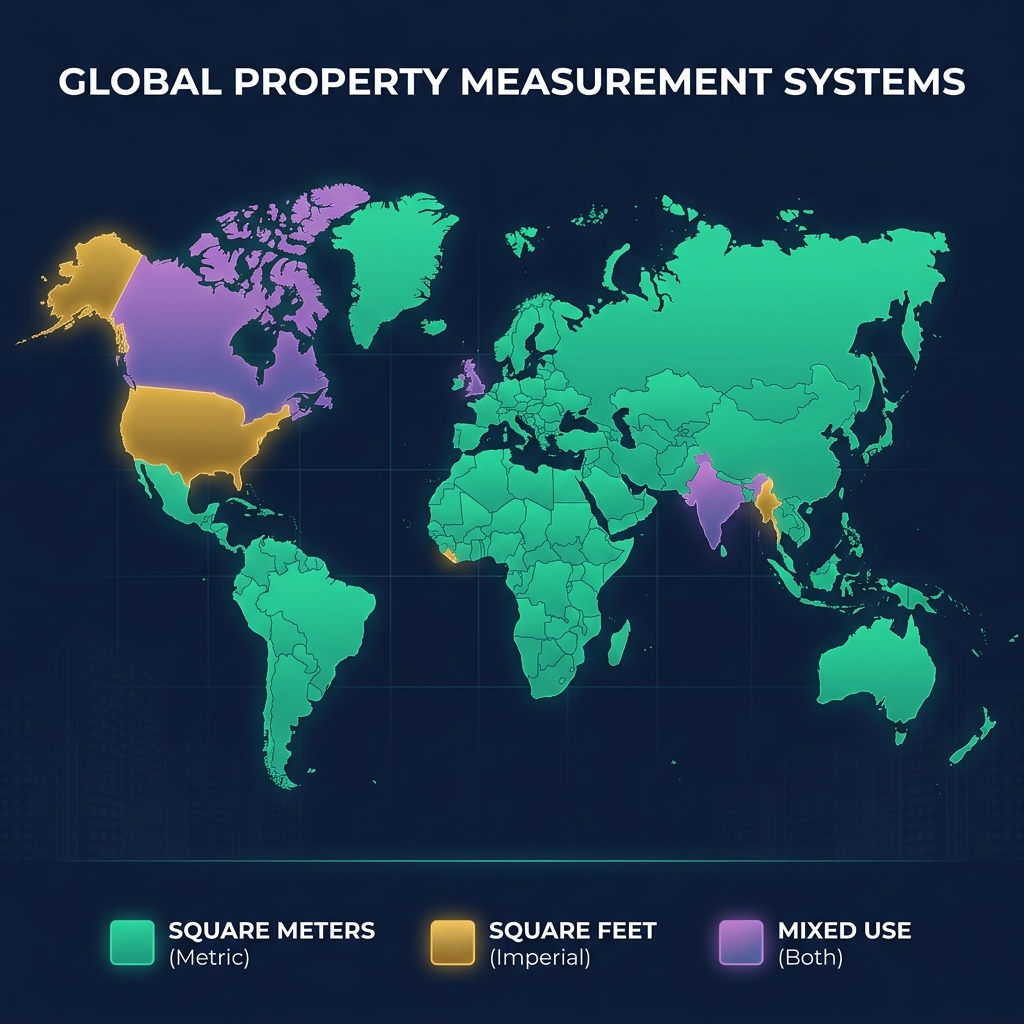
In the United States, square feet is the language of real estate, home renovation, and construction. Every MLS listing, every paint coverage label, every flooring quote, and every building permit references square feet. In Europe, Asia, Africa, South America, and Oceania, square meters serves the same purpose. Some countries straddle both systems. India officially adopted metric in 1958 but still uses square feet extensively in residential real estate across Mumbai, Delhi, Bangalore, and other major cities. Canada uses metric for government and science but frequently lists residential real estate in square feet, especially near the U.S. border. The United Kingdom shows both units in many property listings. Knowing which unit your audience expects prevents miscommunication in every transaction.
Difference in Symbols and Abbreviations
Square meters uses the symbol m2 (with a superscript 2) as its international standard. Informal alternatives include sq m and sq. m. Square feet uses ft2 as its formal symbol, with sq ft, sq. ft., sqft, and SF as common alternatives. In digital contexts where superscript is not available, you will often see "sq m" and "sq ft" as the default representations. Scientific and engineering documents worldwide favor the superscript notation for both units. The critical point: never confuse "m" (linear meter) with "m2" (square meter), or "ft" (linear foot) with "ft2" (square foot). That distinction separates a length measurement from an area measurement, and mixing them up leads directly to ordering errors like the tile situation I described earlier.
Which Is Bigger: a Square Meter or a Square Foot?
A square meter is significantly larger. This section puts exact numbers and visual context behind that statement so the size relationship becomes intuitive rather than abstract.
Understanding the Size Difference
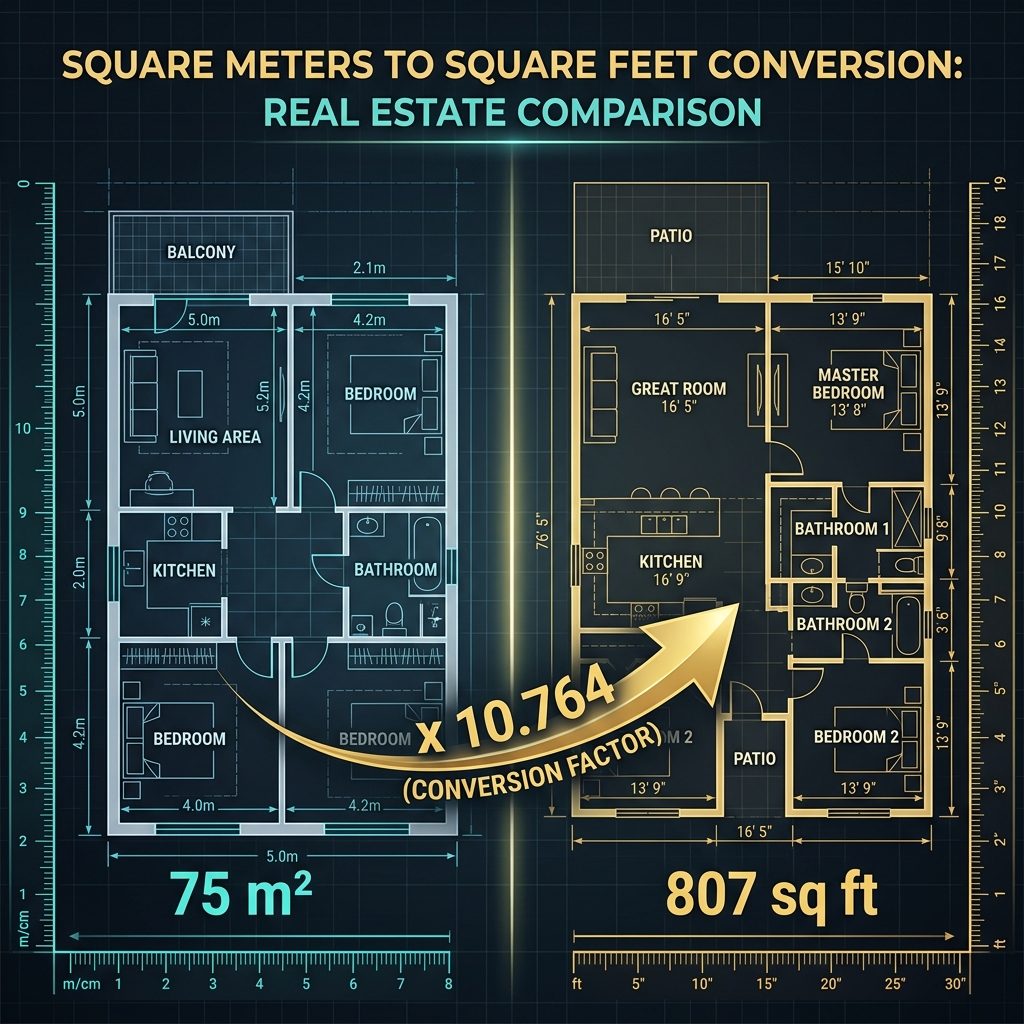
One square meter contains 10.764 square feet. You would need nearly 11 one-foot-by-one-foot tiles to cover the same area as a single one-meter-by-one-meter tile. The conversion factor comes from the linear relationship: 1 meter equals 3.28084 feet. Squaring 3.28084 gives 10.76391, which is the area conversion factor. This means a room measured at 50 square meters actually spans 538.2 square feet. A property listed at 200 square meters covers 2,152.78 square feet. The meters to square feet converter handles these calculations with full decimal precision for any value you enter.
Visualizing One Square Meter vs. One Square Foot
How Many Square Feet Fit Inside One Square Meter?
InteractivePicture a large dinner table. The surface area of a standard six-person dining table is close to 1.5 square meters (roughly 16 square feet). Now picture a single floor tile from a home improvement store. That tile is typically 1 square foot. You would need about 16 of those tiles to cover the table. This everyday comparison makes the 10.76x ratio tangible. For larger spaces, the difference compounds quickly. A 100 square meter apartment is 1,076 square feet. A 500 square meter commercial office is 5,382 square feet. Small rounding errors at the unit level become significant discrepancies at the project level.
Where Are Square Meters and Square Feet Commonly Used?
Geography determines which unit you encounter most often. But industry and context also play a role, sometimes overriding geographic defaults. Here is a detailed breakdown of where each unit appears in professional and everyday settings.
Common Uses of Square Meters
Square meters is the global default for scientific research, international engineering, and government building standards in over 180 countries. The European Union requires property areas in square meters for all legal and commercial transactions. Australia, Japan, South Korea, Brazil, and South Africa all use square meters in their real estate markets. Academic publications measure laboratory space, ecological study areas, and urban planning zones in square meters. Solar panel efficiency ratings use watts per square meter as the industry standard. Agricultural research reports crop yields per hectare (10,000 square meters). If your work touches any international context, square meters is the unit your counterparts expect.
Common Uses of Square Feet
Square feet dominates the United States across every sector that involves area measurement. Every residential listing on the Multiple Listing Service (MLS) displays square feet. Paint cans sold at Home Depot and Lowes list coverage in square feet per gallon. Flooring is priced per square foot. Building permits require total square footage. HVAC contractors size heating and cooling systems based on the square footage of the space they need to condition. Beyond the U.S., square feet maintains strong cultural usage in India, Pakistan, Bangladesh, and parts of Southeast Asia for residential property listings, even in countries that officially adopted the metric system decades ago.
Use in Real Estate and Property Measurements
Real estate is where the imperial-metric divide creates the most confusion and the highest financial stakes. A property listed at 120 m2 in Barcelona represents 1,291.67 square feet. If an American buyer mentally equates 120 with "120 square feet," they would picture a space smaller than a large bedroom instead of a spacious two-bedroom flat. The reverse happens when a European buyer sees a 2,400 square foot listing in Miami and does not realize it translates to 223 square meters, which is a luxury apartment by European standards. International real estate platforms like Rightmove, Idealista, and Zillow each default to the local convention. Serious cross-border buyers need fluency in both units. The square footage for real estate guide explains how accurate measurements drive property valuations.
Use in Construction and Interior Design
Construction materials are manufactured and sold using the local standard. Drywall sheets in the United States are sized in feet (4 by 8 feet = 32 square feet per sheet). Plywood in Germany comes in metric dimensions (2,500 by 1,250 mm = 3.125 m2 per sheet). When importing materials across measurement systems, you must convert before ordering. Interior designers working on international projects convert room dimensions early in the process to avoid specification errors. A designer in London working with a tile supplier in Italy needs to communicate area in square meters. The same designer working with an American furniture brand needs to think in square feet. Professional fluency in both units is no longer optional in global design and construction work.
Global Measurement System Usage
VisualWhy Are Square Meters and Square Feet Both Used for Measuring Area?
The answer lies in history and inertia. The imperial system predates the metric system by centuries. When France developed the metric system in the 1790s, it was a deliberate effort to replace the chaotic patchwork of local measurement standards with one rational, base-10 system. Most of the world eventually adopted it. The United States, however, never made the full transition. Congress passed the Metric Conversion Act in 1975, but it was voluntary. American industries, consumers, and government agencies continued using imperial measurements because the cost of switching and the disruption to existing infrastructure seemed too high. Today, the result is a world where two systems coexist. International science, trade, and most governments use metric. The United States and a handful of other markets use imperial. Both systems measure area perfectly well. The challenge is not accuracy within either system but accuracy when converting between them. Until the entire world settles on one standard (which may never happen), professionals who work across borders need to understand both.
How Are Square Meters and Square Feet Related?
Despite their different origins, square meters and square feet share a precise mathematical relationship. Once you know the conversion factor, moving between the two units takes seconds.
Relationship Between m2 and ft2
Conversion Formulas
FormulaThese constants derive from squaring the linear ratio: 1 meter = 3.28084 feet
The connection starts with linear measurement. The international yard and pound agreement of 1959 defined one inch as exactly 25.4 millimeters, which means one foot equals exactly 0.3048 meters and one meter equals exactly 3.28084 feet. When you square both sides of the linear equation, you get the area relationship: one square meter equals 10.76391 square feet. One square foot equals 0.09290304 square meters. These are not approximations. They are mathematically exact values derived from the agreed-upon definition of the inch. For practical calculations, rounding to 10.764 and 0.0929 provides accuracy within a fraction of a square foot on any residential or commercial project.
Understanding the Conversion Relationship
Live Unit Converter
InteractiveTo convert square feet to square meters, multiply by 0.0929. A 1,500 square foot apartment multiplied by 0.0929 equals 139.35 square meters. For a quick mental estimate, divide the square feet number by 11. That gives you an answer within 2 percent of the exact value. Going the other direction, multiply square meters by 10.764 to get square feet. A 90 square meter property multiplied by 10.764 equals 968.76 square feet. For mental math, multiply by 11 for a fast approximation. The square feet to square meters converter provides full decimal precision for any value.
| Square Meters (m2) | Square Feet (ft2) | Typical Space |
|---|---|---|
| 5 | 53.82 | Small bathroom |
| 10 | 107.64 | Compact bedroom |
| 25 | 269.10 | Studio apartment |
| 50 | 538.20 | One-bedroom flat |
| 75 | 807.29 | Two-bedroom apartment |
| 100 | 1,076.39 | Three-bedroom home |
| 150 | 1,614.59 | Spacious family home |
| 200 | 2,152.78 | Large executive home |
| 300 | 3,229.17 | Luxury residence |
| 500 | 5,381.96 | Commercial office floor |
Frequently Asked Questions
Yes. One square meter equals roughly 10.764 square feet, making it about 10.76 times larger than a single square foot. A square meter measures 3.281 feet on each side, while a square foot measures just 12 inches on each side.
The symbol m2 stands for square meters, the metric unit of area. The symbol ft2 stands for square feet, the imperial unit of area. One m2 equals 10.764 ft2. They measure the same physical quantity (area) but belong to different measurement systems.
Yes. Both units measure area, which is the amount of two-dimensional surface a space covers. The difference is the scale and system of origin. Square meters belong to the metric system, while square feet belong to the imperial system.
It depends on location. Square feet dominates in the United States, India, Pakistan, and Bangladesh. Square meters is the standard in Europe, Australia, most of Asia, Africa, and South America. Over 180 countries use square meters.
Absolutely. Any area can be expressed in either unit. A room that measures 20 square meters also measures 215.28 square feet. The physical space is identical. Only the number and unit label change based on which measurement system you use.
Final Thoughts
Square meters and square feet are two lenses for viewing the same physical reality: how much flat surface a space covers. One square meter equals 10.764 square feet. One square foot equals 0.0929 square meters. Those two conversion constants connect the imperial world to the metric world with mathematical precision. The colleague I mentioned at the start now keeps a printed conversion table taped to his office wall. He has not made an ordering error since. Understanding the difference between these units is not just academic knowledge. It is a practical skill that protects your budget, your timeline, and your professional reputation every time you work with area measurements across systems.
A square meter is 10.764 times larger than a square foot. A square foot is 0.0929 of a square meter.
Square meters belong to the metric system (180+ countries). Square feet belong to the imperial system (mainly USA).
The area conversion factor (10.764) is the square of the linear factor (3.281). Do not use the linear factor for area.
For quick mental math: divide square feet by 11 to estimate square meters, or multiply square meters by 11 to estimate square feet.
Always confirm which unit a supplier, listing, or specification uses before ordering materials or making financial decisions.
What measurement challenge are you working through right now? Whether you are comparing international property listings, ordering construction materials from a metric supplier, or simply trying to visualize the size of an overseas apartment, the square footage calculator and the square feet to square meters converter make every calculation effortless. Start with the right unit, apply the right factor, and let the math guide your decision.