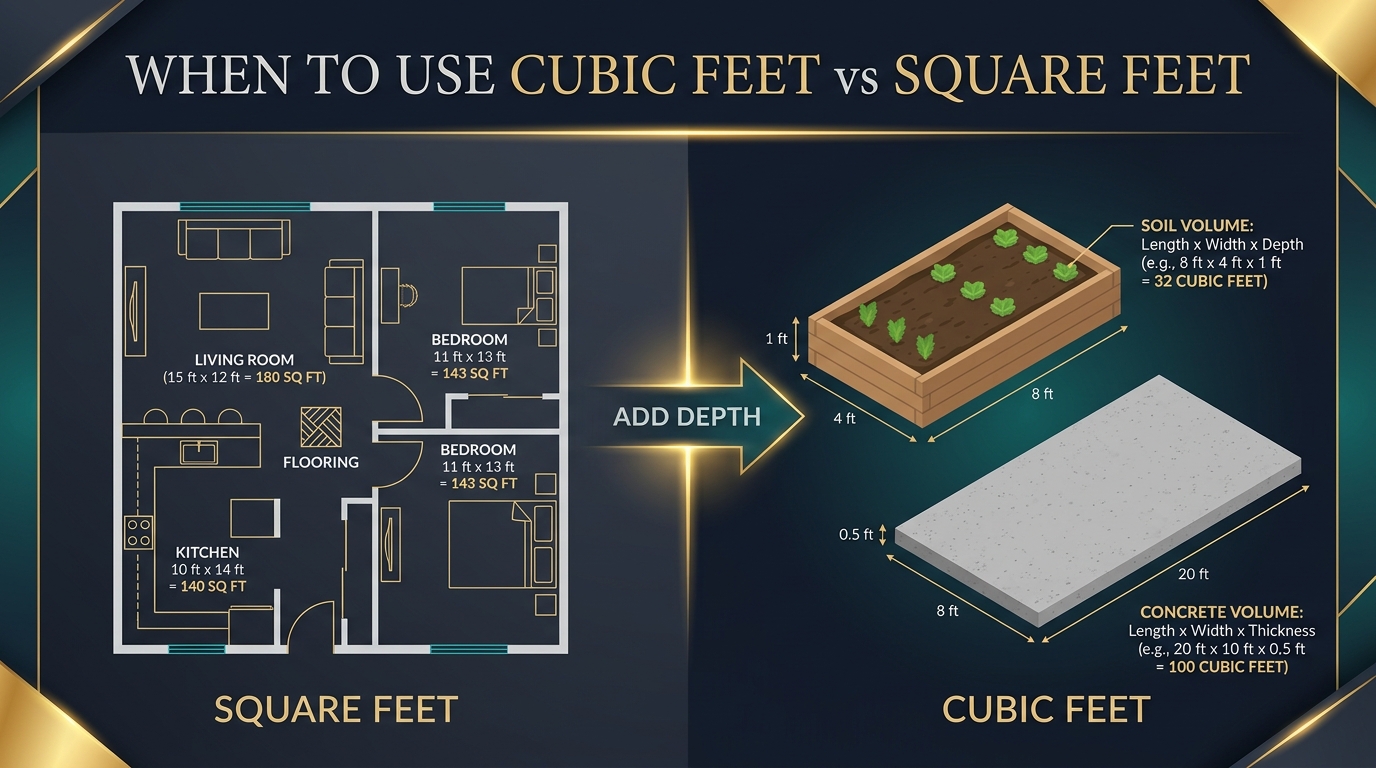
A contractor I worked with last year lost $1,400 on a patio project. He measured 300 square feet of patio surface and ordered 300 units of concrete. The problem was that he needed cubic feet, not square feet. His 4-inch slab actually required 100 cubic feet (3.70 cubic yards) of concrete. The square footage told him how big the patio was. It told him nothing about how much concrete to pour. That single measurement mistake turned a profitable job into a loss.
This confusion happens constantly on construction sites, in garden centers, and at home improvement stores. Square feet and cubic feet look similar on paper, but they measure fundamentally different things. One measures flat surfaces. The other measures three-dimensional spaces. Knowing which one your project requires prevents costly mistakes. The square footage calculator on this site handles area measurement for any shape. This guide explains when area alone falls short and when you need to bring volume into the equation.
What Does Square Feet Measure?
Square Feet Measures Area
Square feet is a unit of two-dimensional measurement in the imperial system. It captures how much flat surface a space covers using only two directions: length and width. One square foot equals the area of a square that is 1 foot long and 1 foot wide. Every area calculation in square feet builds on that fundamental unit. When you measure a floor, a wall, or a patch of lawn, you are counting how many of those 1-by-1-foot squares would tile across the entire surface. There is no height or depth involved. The measurement exists entirely on a flat plane.
Common Situations Where Square Feet Is Used
Square feet dominates surface measurement in the United States. Real estate agents describe homes and apartments by their square footage. Flooring retailers price hardwood, tile, and laminate by the square foot. Paint manufacturers rate coverage in square feet per gallon. Roofing contractors calculate shingle orders based on roof square footage. Wallpaper is sold by the roll, but each roll covers a specific number of square feet. Every one of these applications involves covering a flat surface. None of them require a third dimension. The material is thin, and the thickness has no meaningful impact on the quantity calculation.
Examples of Measurements in Square Feet
Common Area Measurements
ReferenceEach of these measurements describes a surface. The bedroom floor, the wall, the lawn, and the home footprint are all flat surfaces measured in two dimensions. The ceiling height, soil depth, and paint thickness are irrelevant to the square footage number. For a deeper look at how to calculate square feet, that guide covers rectangles, circles, triangles, and irregular shapes step by step.
What Does Cubic Feet Measure?
Cubic Feet Measures Volume
Cubic feet is a unit of three-dimensional measurement. It tells you how much space something occupies or how much material fits inside a container. One cubic foot equals the volume of a cube that is 1 foot long, 1 foot wide, and 1 foot tall. The critical difference from square feet is that third dimension. Volume captures length, width, and height (or depth) simultaneously. When a material supplier says a bag contains 2 cubic feet of mulch, they mean the bag holds enough mulch to fill two of those 1-by-1-by-1-foot cubes.
Common Situations Where Cubic Feet Is Used
Cubic feet is the standard measurement for anything you pour, fill, stack, or store. Concrete is ordered in cubic feet or cubic yards. Soil, mulch, gravel, and sand are sold by the cubic foot or cubic yard. Refrigerators and freezers list interior capacity in cubic feet. Storage units advertise usable space in cubic feet. Shipping companies charge by weight or cubic volume, whichever is greater. HVAC technicians size air conditioning systems based on the cubic footage of the rooms they serve. In every case, the third dimension makes the difference between an accurate estimate and a costly mistake.
Examples of Measurements in Cubic Feet
Common Volume Measurements
ReferenceEach example involves three dimensions. The garden bed has depth. The concrete slab has thickness. The refrigerator and storage unit have height. Remove any one of those dimensions and you cannot calculate the volume. That is exactly why square feet alone fails for these applications.
When Should You Use Square Feet?
Measuring Floors, Walls, and Ceilings
Use square feet when you need to know the size of a flat surface. Room floors, wall surfaces, and ceiling panels are all two-dimensional measurements. A 12 x 14 foot room has 168 square feet of floor area. A 10-foot-wide wall that is 8 feet tall has 80 square feet of surface. These numbers tell you how large the surface is. They do not tell you how much material fills the room or sits behind the wall. Surface size is all you need for covering projects. The wall and ceiling square footage guide covers every measurement scenario including door and window deductions.
Estimating Paint, Flooring, and Carpet
Paint, flooring, and carpet are surface materials. You buy them based on the area you need to cover. A gallon of paint covers approximately 350 to 400 square feet. Hardwood flooring is sold by the square foot with a 10 percent waste factor added. Carpet installers measure the floor area and add extra for seams and pattern matching. In each case, the thickness of the material is negligible. A coat of paint is thousandths of an inch thick. Laminate flooring is fractions of an inch thick. The surface area drives the purchase quantity, not the volume.
Measuring Land and Room Areas
Land area, lot sizes, and property boundaries are described in square feet (or acres for larger parcels). A quarter-acre lot is 10,890 square feet. A 2,400 square foot home sits on a specific amount of floor area. These measurements describe horizontal coverage. They do not account for the depth of the soil beneath the land or the height of the ceilings inside the home. When you are buying property, comparing home sizes, or calculating room dimensions, square feet is the correct and only measurement you need.
When Should You Use Cubic Feet?
Calculating the Volume of a Space
Use cubic feet when you need to know how much three-dimensional space exists inside a container, room, or excavation. A bedroom that is 12 feet long, 14 feet wide, and 8 feet tall contains 1,344 cubic feet of air volume. That number matters for HVAC sizing, air quality calculations, and heating and cooling load estimates. The floor area of 168 square feet tells you nothing about the air volume. Only the cubic footage captures the full picture.
Estimating Soil, Mulch, and Gravel
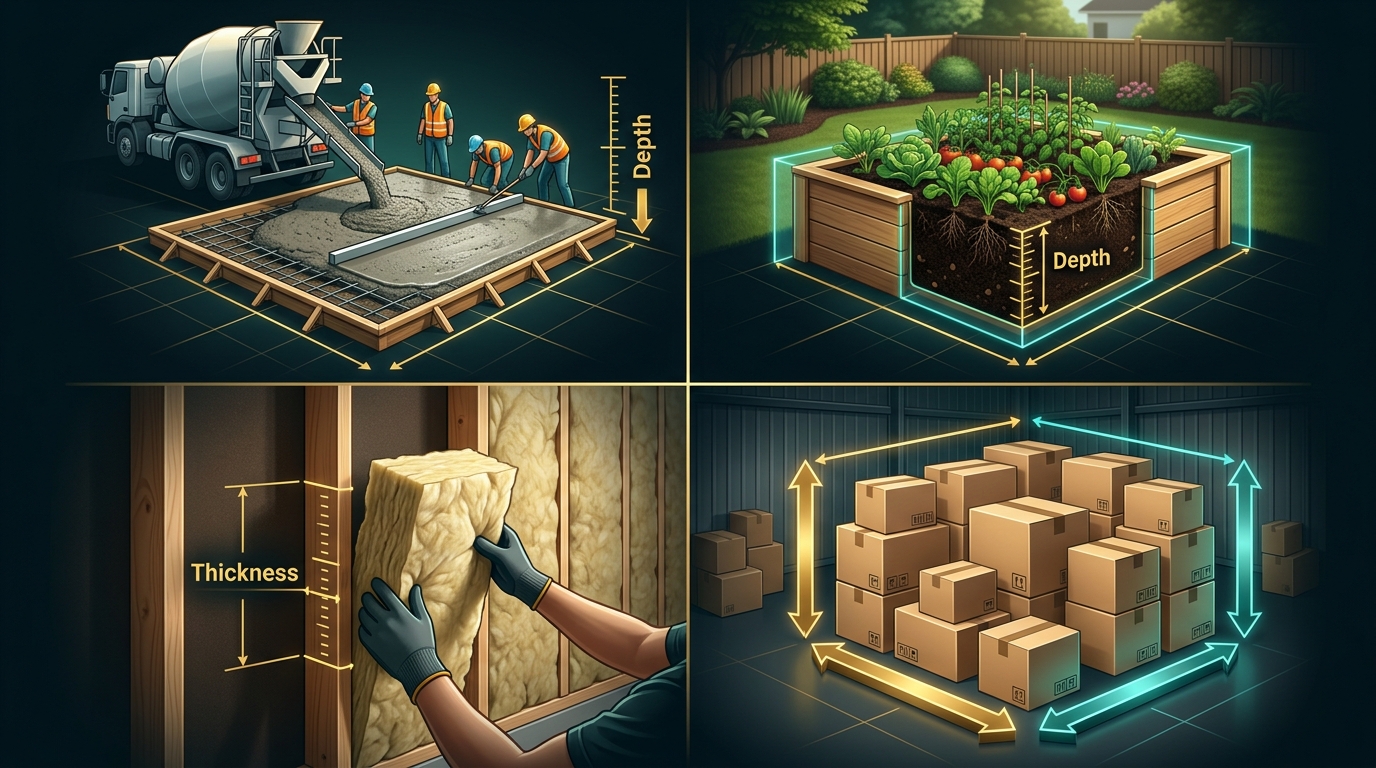
Landscaping materials are sold by volume because they fill a space with measurable depth. A 100 square foot flower bed needs different amounts of mulch depending on depth. At 2 inches deep, it needs 16.67 cubic feet. At 4 inches deep, it needs 33.33 cubic feet. At 6 inches deep, it needs 50 cubic feet. The square footage alone cannot tell you how many bags to buy. You must know the depth to calculate the volume. Garden centers sell mulch in 2 cubic foot bags and soil in 1 cubic foot bags. Without the volume calculation, you are guessing.
Calculating Concrete and Fill Materials
Concrete is the classic example of a material that requires cubic feet. Every slab, footing, and foundation has thickness. A sidewalk that is 3 feet wide and 30 feet long has 90 square feet of surface. But at 4 inches of thickness, it contains 30 cubic feet of concrete. Order based on the square footage and you will have no idea how much concrete arrives. Order based on cubic feet (and convert to cubic yards by dividing by 27) and you will have exactly 1.11 cubic yards ready for the pour. The concrete calculator automates this conversion for any slab dimensions.
Measuring Storage Capacity
Storage capacity depends on three dimensions because you stack items vertically. A 5 x 10 foot storage unit with 8-foot ceilings has 50 square feet of floor space but 400 cubic feet of total volume. A 10 x 20 unit with the same ceiling height has 200 square feet of floor but 1,600 cubic feet of volume. Moving companies estimate truck space in cubic feet to determine how many loads a move requires. The floor area alone dramatically underestimates the usable space because it ignores the vertical dimension entirely.
How Do You Know Which Measurement to Use?
Are You Measuring an Area or a Volume?
The simplest test is this: ask whether your project involves covering a surface or filling a space. If you are painting a wall, you need area (square feet). If you are pouring concrete into a form, you need volume (cubic feet). Covering requires two dimensions. Filling requires three. This single question resolves the measurement choice in most real-world situations.
Area vs. Volume Decision Guide
InteractiveDoes the Material Have a Thickness or Depth?
If the material you are working with has meaningful thickness, you need cubic feet. Concrete has thickness. Soil has depth. Mulch has depth. Gravel has depth. Insulation has thickness. All of these materials occupy three-dimensional space. On the other hand, paint has negligible thickness. Carpet is thin. Tile is thin. Wallpaper is thin. These materials effectively exist on a surface and are measured in square feet. The presence or absence of a meaningful third dimension determines which unit to use.
Are You Estimating Coverage or Quantity?
Coverage calculations use square feet. "How much wall does this gallon of paint cover?" is a coverage question answered in square feet. Quantity calculations for bulk materials use cubic feet. "How many bags of topsoil do I need for this garden bed?" is a quantity question answered in cubic feet. Coverage spreads thin across a surface. Quantity fills a space to a specific depth. Match your question to the right unit and the math works every time.
Why Does Depth Matter When Measuring Cubic Feet?
Area Alone Does Not Determine Volume
Two spaces can have identical square footage but wildly different volumes. A 200 square foot patio slab that is 4 inches thick contains 66.67 cubic feet of concrete. That same 200 square foot slab at 8 inches thick contains 133.33 cubic feet. The area is the same. The volume doubled because the depth doubled. Area captures only two dimensions. Volume requires all three. Relying on area alone for a volume calculation guarantees the wrong answer.
How Depth Changes Cubic Footage
Same Area, Different Depths
InteractiveEvery additional inch of depth on 100 square feet adds 8.33 cubic feet of volume. That relationship is perfectly linear. Going from 3 inches to 6 inches doubles the volume. Going from 4 inches to 12 inches triples it. When you understand this proportional relationship, you can estimate volume changes mentally. Double the depth always means double the material order.
Example: The Same Area at Different Depths
| Area (sq ft) | Depth (inches) | Depth (feet) | Volume (cu ft) | Volume (cu yd) |
|---|---|---|---|---|
| 200 | 2 | 0.167 | 33.33 | 1.23 |
| 200 | 4 | 0.333 | 66.67 | 2.47 |
| 200 | 6 | 0.500 | 100.00 | 3.70 |
| 200 | 8 | 0.667 | 133.33 | 4.94 |
| 200 | 12 | 1.000 | 200.00 | 7.41 |
This table shows 200 square feet of area at five common depths. At just 2 inches, you need about 33 cubic feet. At 12 inches, you need 200 cubic feet. That is a six-fold increase in material from the same footprint. Always confirm the required depth before placing any bulk material order.
What Projects Require Cubic Feet Instead of Square Feet?
Concrete and Slab Projects
Every concrete project requires cubic footage. Driveways, patios, sidewalks, garage floors, and foundations all have thickness. Standard residential slabs range from 4 to 6 inches thick. A 20 x 24 foot driveway at 4 inches thick needs 160 cubic feet (5.93 cubic yards) of concrete. At 6 inches thick, the same driveway needs 240 cubic feet (8.89 cubic yards). The 480 square feet of surface area is only the starting point. Without the thickness, no contractor can place a concrete order.
Landscaping and Gardening
Raised garden beds, flower beds, and planting areas all require volume calculations. A 4 x 12 foot raised bed that is 12 inches deep holds 48 cubic feet of soil mix. The same bed at 18 inches deep holds 72 cubic feet. Mulch spread across 500 square feet of landscaping at 3 inches deep requires 125 cubic feet (4.63 cubic yards). Gravel for a walkway base, sand for leveling pavers, and compost for amending soil all use cubic feet for ordering. The square feet to cubic feet calculator converts area to volume with any depth measurement and provides bag counts for common materials.
Insulation and Building Materials
Insulation fills the cavity between wall studs, ceiling joists, and floor joists. That cavity has depth. Blown-in insulation is measured in cubic feet to determine how much material fills the wall or attic space. Spray foam insulation requires volume calculations to estimate the number of kits needed. Even batt insulation, while sold in standard widths and lengths, has a rated thickness (R-13 is 3.5 inches thick, R-19 is 6.25 inches thick) that determines how much cavity it fills. The volume of the cavity, not just the wall area, dictates the material quantity.
Storage and Container Capacity
Shipping containers, moving trucks, and storage units are priced and described by cubic footage. A 20-foot shipping container holds approximately 1,170 cubic feet. A standard 26-foot moving truck holds about 1,611 cubic feet. Knowing the cubic footage of your belongings determines which truck or container size you need. The floor area of the truck alone does not capture its capacity. A tall truck with the same floor area holds substantially more than a short one.
How Do You Calculate Cubic Feet From Square Feet?
Cubic Feet Formula
The Core Conversion Formula
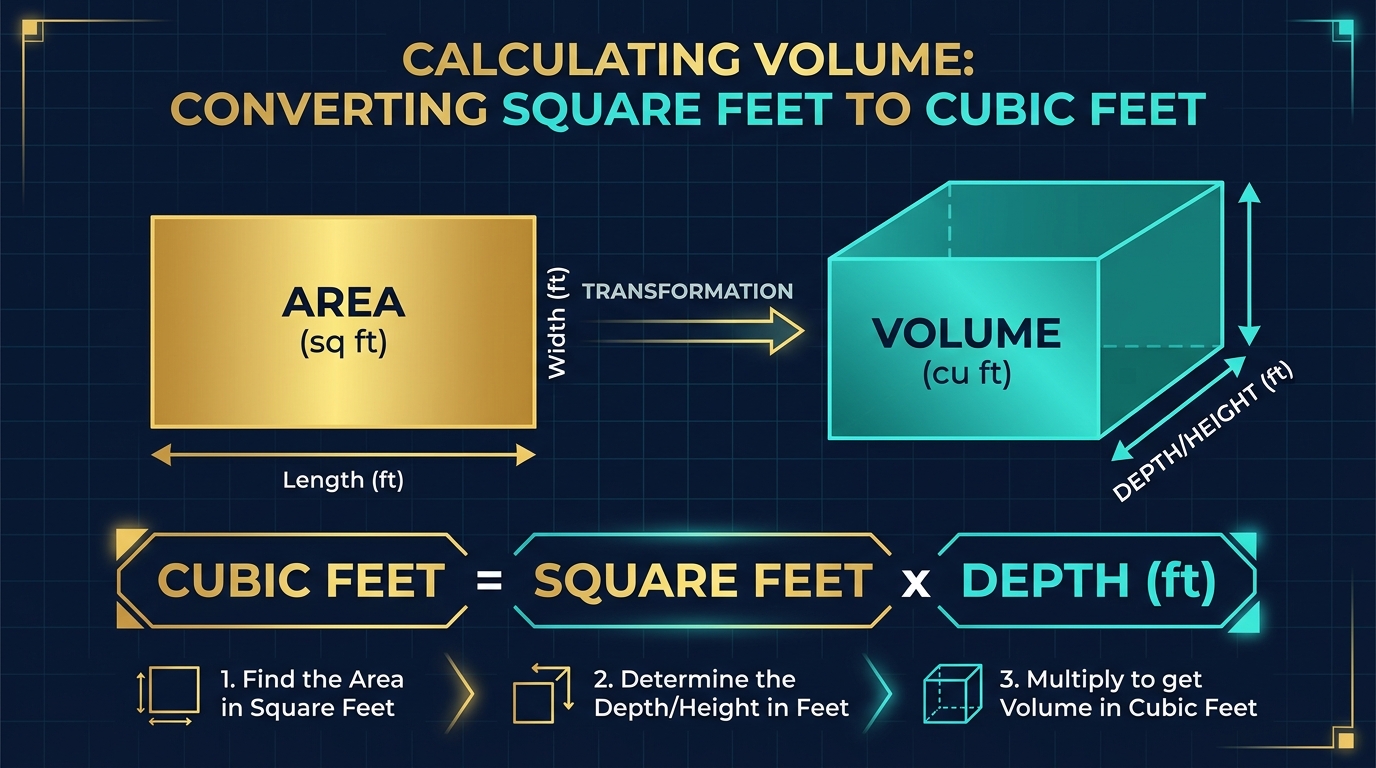
FormulaThis formula connects square feet and cubic feet through one simple multiplication. The area provides two dimensions. The depth provides the third. Together they produce volume. This is the same calculation used by every concrete supplier, landscape contractor, and building material estimator in the industry.
Calculating Volume When Depth Is in Feet
Depth in Feet
ExampleWhen the depth is already expressed in feet, the calculation is a single multiplication. A 300 square foot area at 0.5 feet (6 inches) of depth equals 150 cubic feet. No conversion step is needed.
Calculating Volume When Depth Is in Inches
Depth in Inches
ExampleMost real-world depths are stated in inches: 4-inch concrete slabs, 3-inch mulch layers, 6-inch gravel bases. Divide the inch measurement by 12 to convert it to feet before multiplying. This extra step prevents the most common volume calculation mistake.
Example Calculation
Worked Example: Patio Concrete
Step-by-StepThis example walks through the entire process from raw dimensions to a concrete order quantity. The patio is 300 square feet. But the concrete order is 3.70 cubic yards. Those two numbers come from two different types of measurement, and both are essential for the project.
What Are Common Mistakes When Choosing Between Square Feet and Cubic Feet?
Confusing Area With Volume
The most common mistake is treating square feet and cubic feet as interchangeable. They are not. Square feet measures how big a surface is. Cubic feet measures how much space something fills. Ordering "100 square feet of concrete" makes no sense because concrete has thickness. Ordering "100 cubic feet of carpet" makes no sense because carpet covers a surface. Match the unit to the measurement type and the confusion disappears.
Forgetting to Include Depth
The second most common mistake is measuring only two dimensions when three are required. A homeowner measures a garden bed at 4 feet by 10 feet and asks for "40 of soil." But 40 what? Without the depth measurement, neither the homeowner nor the garden center can determine how many bags are needed. At 6 inches deep, the bed needs 20 cubic feet. At 12 inches deep, it needs 40 cubic feet. The depth changes the order by 100 percent.
Using Inches Instead of Feet
Plugging inches directly into the cubic feet formula without converting to feet inflates the result by a factor of 12. A 100 square foot area at 4 inches deep should produce 33.33 cubic feet. But if you multiply 100 by 4 (forgetting to divide by 12), you get 400. That is twelve times too much material. Always divide inches by 12 before multiplying. This single mistake accounts for a large share of over-orders at concrete and landscape supply companies.
Estimating Material Quantity From Area Alone
Some homeowners assume that knowing the square footage is enough to order any material. It works for thin materials like paint, tile, and flooring. It fails completely for bulk materials like concrete, soil, and gravel. If a material has meaningful depth, area alone cannot determine the quantity. Always ask: "Does this material have a third dimension?" If yes, you need cubic feet.
Square Feet vs. Cubic Feet: Quick Comparison
Side-by-Side Comparison
ReferenceMeasurement Type
Square feet measures two-dimensional area on a flat surface. Cubic feet measures three-dimensional volume inside a space. They operate in different dimensional categories.
Dimensions Required
Square feet needs two dimensions: length and width. Cubic feet needs three dimensions: length, width, and depth (or height). The third dimension is the key difference between the two units.
Common Applications
| Feature | Square Feet (ft2) | Cubic Feet (ft3) |
|---|---|---|
| Type | Area (2D) | Volume (3D) |
| Dimensions | Length x Width | Length x Width x Depth |
| Flooring | Yes | No |
| Paint | Yes | No |
| Concrete | No | Yes |
| Soil / Mulch | No | Yes |
| Storage Capacity | No | Yes |
| Room Size | Yes | For HVAC sizing |
| Insulation | For coverage area | For fill volume |
Typical Units
Square feet is abbreviated as sq ft or ft2. Cubic feet is abbreviated as cu ft or ft3. Larger volume quantities often convert to cubic yards (1 cubic yard = 27 cubic feet). Larger area quantities may convert to acres (1 acre = 43,560 square feet).
Square Feet to Cubic Feet Calculator
Convert Area to Volume
CalculatorFrequently Asked Questions
No. Cubic feet measures volume, not area. Area is measured in square feet using two dimensions: length and width. Cubic feet measures how much three-dimensional space something occupies using three dimensions: length, width, and depth or height.
Use square feet when measuring flat surfaces or buying materials that cover surfaces. This includes flooring, paint, carpet, wallpaper, roofing, room sizes, and property lot areas. If the material is thin and you are covering a surface, square feet is the correct unit.
Use cubic feet when filling a space with measurable depth. This includes concrete, soil, mulch, gravel, sand, insulation, storage capacity, and shipping volume. If the material has meaningful thickness and you are filling or stacking, cubic feet is the correct unit.
Yes. Cubic feet requires three measurements: length, width, and depth (or height). Without the third dimension, you can only calculate area in square feet. The formula is Cubic Feet = Square Feet x Depth in Feet.
Only if you have the depth or height measurement. Multiply the area in square feet by the depth in feet to get cubic feet. Without a depth value, the conversion is impossible because area and volume measure fundamentally different things.
There is no fixed answer. One square foot at one foot of depth equals one cubic foot. One square foot at six inches of depth equals half a cubic foot. The depth determines the conversion ratio. Without a specific depth, the question has no definitive answer.
Related Calculators
Square Footage Calculator - Calculate area for any shape in square feet
Square Feet to Cubic Feet Calculator - Convert area to volume with any depth
Concrete Calculator - Estimate concrete volume in cubic yards for any slab
Room Square Footage Calculator - Measure room dimensions and floor area
Cost Per Square Foot Calculator - Budget materials and estimate project costs