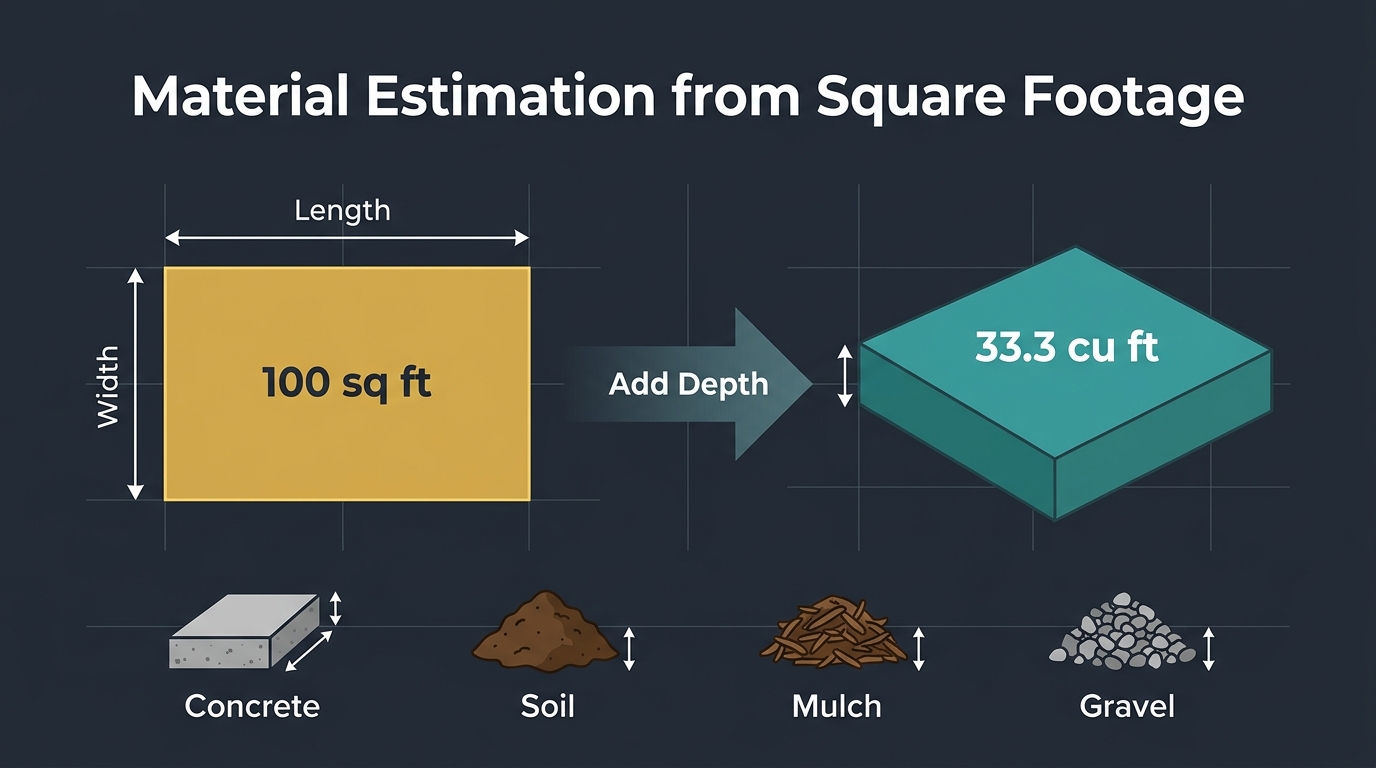
A homeowner I helped last spring measured 200 square feet of garden bed and ordered 200 bags of soil. She assumed one bag per square foot would be enough. The reality was different. Her raised beds were 8 inches deep, which meant she needed 133.33 cubic feet of soil, not 200 square feet of coverage. She ended up with far more soil than necessary and spent hours returning excess bags. The square footage told her the surface area. It told her nothing about the volume of material required to fill it.
This mistake happens every weekend at garden centers, concrete suppliers, and home improvement stores. Square footage is a starting point, not an answer. To calculate how much material a project actually needs, you must add depth to the equation and convert area into volume. The square footage calculator on this site handles the area measurement. This guide covers the next step: turning that area into an accurate material estimate for concrete, soil, mulch, gravel, sand, and any other fill material.
What Does Square Footage Tell You About Material Needs?
Square Feet Measures Surface Area
Square feet is a two-dimensional measurement. It captures the length and width of a surface. A 10 x 20 foot patio has 200 square feet. A 4 x 25 foot walkway has 100 square feet. These numbers describe how large the surface is. They tell you the footprint of the area you plan to cover or fill. For thin materials such as paint, tile, or carpet, the surface area alone determines the quantity. But for materials with measurable depth or thickness, surface area is only the first half of the calculation.
Why Square Footage Alone Is Not Enough
Bulk materials fill three-dimensional spaces. Concrete, soil, mulch, gravel, and sand all occupy volume. When you pour 4 inches of concrete across 200 square feet, you are filling a slab that is 200 square feet wide and 4 inches deep. The area only describes the top surface. The depth determines how much material goes underneath. Two projects with the same square footage can require vastly different material quantities depending on depth. A 200 square foot area at 2 inches deep needs 33.33 cubic feet. The same area at 12 inches deep needs 200 cubic feet. That is a six-fold difference from the same footprint.
The Role of Depth or Thickness
Depth is the missing dimension that converts area into volume. Without it, you cannot calculate how much material to order. Think of depth as the bridge between "how big is the area" and "how much stuff do I need." Every concrete contractor, landscape supplier, and material estimator uses this three-part formula: area times depth equals volume. The depth could be 2 inches of mulch, 4 inches of concrete, 6 inches of gravel, or 12 inches of topsoil. The specific number changes everything about the order quantity. The square feet to cubic feet calculator automates this conversion for any depth.
How Do You Calculate Material Volume From Square Footage?
Square Feet to Cubic Feet Formula
The Core Material Volume Formula
FormulaUsing Depth Measured in Feet
When the depth is already expressed in feet, the calculation is a straightforward multiplication. A 500 square foot driveway at 0.5 feet (6 inches) of depth requires 500 x 0.5 = 250 cubic feet of material. No conversion step is needed. This scenario is less common because most project depths are stated in inches, but it applies to deeper installations like raised beds at 1 foot deep or fill projects at 2 feet deep.
Using Depth Measured in Inches
Most material depths are stated in inches. Concrete slabs are typically 4 inches thick. Mulch layers run 2 to 4 inches deep. Gravel bases are commonly 4 to 6 inches deep. To use the formula, divide the inch value by 12 to convert it to feet. Then multiply by the square footage. This extra division step is critical. Skipping it inflates the result by a factor of 12, which would lead to a massive over-order.
Example: 100 Square Feet at 4 Inches Deep
Worked Example: Material Volume
Step-by-StepThis five-step process works for every fill material project. The 100 square feet of surface becomes 33.33 cubic feet of material at 4 inches of depth. Divide by 27 to convert to cubic yards for bulk supplier orders. These two conversions, inches to feet and cubic feet to cubic yards, are the entire calculation process.
How Much Material Do You Need at Different Depths?
100 Sq Ft at Various Depths
Interactive1 Inch Deep
At 1 inch deep, 100 square feet requires 8.33 cubic feet of material (0.31 cubic yards). This is a thin layer, typical for decorative top-dressing on existing mulch beds or a light sand sweep over paver joints.
2 Inches Deep
At 2 inches deep, 100 square feet requires 16.67 cubic feet of material (0.62 cubic yards). This depth works for a standard mulch refresh, a thin gravel layer over landscaping fabric, or a light top coat of decorative stone.
3 Inches Deep
At 3 inches deep, 100 square feet requires 25.00 cubic feet of material (0.93 cubic yards). Three inches is the recommended depth for a new mulch installation and provides adequate weed suppression for most planting beds.
4 Inches Deep
At 4 inches deep, 100 square feet requires 33.33 cubic feet of material (1.23 cubic yards). This is the standard thickness for residential concrete slabs including patios, sidewalks, and garage floors. It is also common for gravel base layers beneath pavers.
6 Inches Deep
At 6 inches deep, 100 square feet requires 50.00 cubic feet of material (1.85 cubic yards). Six inches is used for heavy-duty concrete slabs, deep gravel bases under driveways, and raised garden bed soil fills at a moderate depth.
12 Inches Deep
At 12 inches deep, 100 square feet requires 100.00 cubic feet of material (3.70 cubic yards). One foot of depth applies to deep raised garden beds, thick aggregate bases for commercial projects, and foundation backfill operations.
How Many Cubic Feet Does 100 Square Feet Require?
| Area (sq ft) | Depth (inches) | Depth (feet) | Cubic Feet | Cubic Yards |
|---|---|---|---|---|
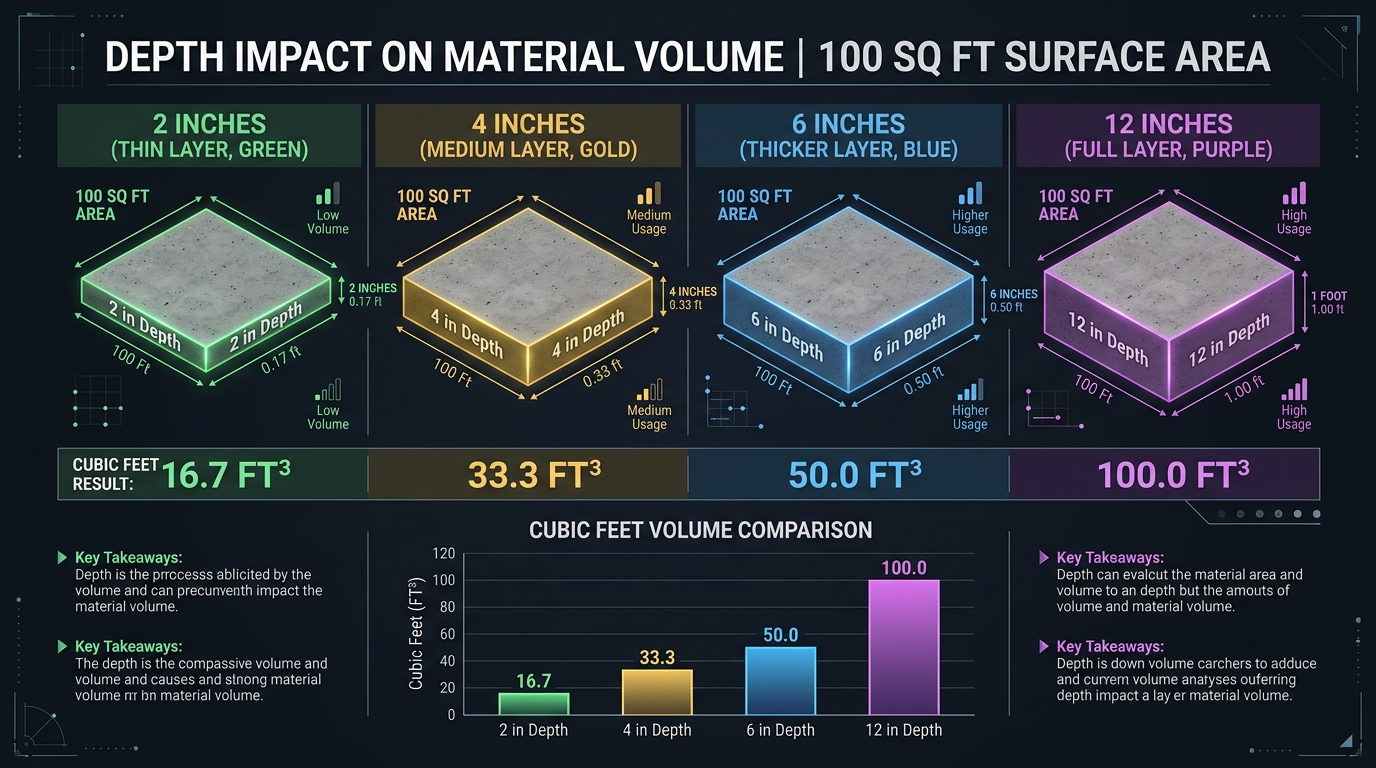
| 100 | 2 | 0.167 | 16.67 | 0.62 |
| 100 | 4 | 0.333 | 33.33 | 1.23 |
| 100 | 6 | 0.500 | 50.00 | 1.85 |
| 100 | 12 | 1.000 | 100.00 | 3.70 |
100 Square Feet at 2 Inches
Two inches of depth across 100 square feet produces 16.67 cubic feet. That equals about 8 to 9 standard 2 cubic foot bags of mulch or topsoil. This is a manageable quantity for a small garden refresh project.
100 Square Feet at 4 Inches
Four inches of depth across 100 square feet produces 33.33 cubic feet or 1.23 cubic yards. For a concrete slab this size, that is just over one cubic yard of ready-mix concrete. For bagged material, that is approximately 17 bags at 2 cubic feet each.
100 Square Feet at 6 Inches
Six inches across 100 square feet produces 50 cubic feet or 1.85 cubic yards. This volume is typical for deep gravel installations and raised planting beds. At this quantity, bulk delivery usually becomes more cost-effective than bagged material.
100 Square Feet at 12 Inches
Twelve inches across 100 square feet produces exactly 100 cubic feet or 3.70 cubic yards. At this volume, bulk delivery is the only practical option. This depth is common for deep raised garden beds and foundation fill projects.
How Many Cubic Feet Do You Need for Common Square Footages?
| Area (sq ft) | 2 in Deep (cu ft) | 4 in Deep (cu ft) | 6 in Deep (cu ft) | 12 in Deep (cu ft) |
|---|---|---|---|---|
| 10 | 1.67 | 3.33 | 5.00 | 10.00 |
| 50 | 8.33 | 16.67 | 25.00 | 50.00 |
| 100 | 16.67 | 33.33 | 50.00 | 100.00 |
| 500 | 83.33 | 166.67 | 250.00 | 500.00 |
| 1,000 | 166.67 | 333.33 | 500.00 | 1,000.00 |
10 Square Feet
Ten square feet is a small area, roughly a 2.5 x 4 foot patch. At 4 inches deep, it needs just 3.33 cubic feet. Two standard bags of material handle this project. This size applies to small repair patches, tree ring mulching, and post hole backfill.
50 Square Feet
Fifty square feet covers a modest garden bed or a short walkway section. At 4 inches deep, it requires 16.67 cubic feet (0.62 cubic yards). About 8 to 9 bags of bagged material. Still manageable in a pickup truck.
100 Square Feet
One hundred square feet is a standard reference area, roughly a 10 x 10 foot space. At 4 inches deep, it needs 33.33 cubic feet (1.23 cubic yards). This is the point where bulk delivery starts to make economic sense compared to buying individual bags.
500 Square Feet
Five hundred square feet covers a large patio or a significant portion of a yard. At 4 inches deep, it requires 166.67 cubic feet (6.17 cubic yards). This is firmly in bulk delivery territory. Most suppliers deliver by the cubic yard at this quantity. The concrete calculator handles slab estimates at this scale and converts directly to ready-mix truck orders.
1,000 Square Feet
One thousand square feet is a large project: a full driveway, a major landscaping installation, or a commercial slab. At 4 inches deep, it needs 333.33 cubic feet (12.35 cubic yards). At 6 inches deep, that jumps to 500 cubic feet (18.52 cubic yards). Projects at this scale require careful planning and multiple delivery trucks.
How Do You Estimate Material for Different Projects?
Material Estimation by Project Type
ReferenceConcrete and Slabs
Residential concrete slabs are typically 4 inches thick. Driveways and garage floors run 4 to 6 inches. Footings and foundations can be 12 inches or deeper. Always confirm the required thickness with local building codes. A 20 x 20 foot patio at 4 inches needs 133.33 cubic feet (4.94 cubic yards) of concrete. Order ready-mix by the cubic yard and add 5 to 10 percent for waste and spillage.
Soil and Garden Beds
Garden bed soil depth ranges from 6 to 12 inches depending on what you plant. Vegetables and flowers need at least 6 inches of quality topsoil. Root vegetables need 12 inches. A 4 x 12 foot raised bed at 10 inches deep requires 40 cubic feet of soil mix. Bagged garden soil comes in 1 or 2 cubic foot bags. At 40 cubic feet, buying in bulk (1.48 cubic yards) is usually cheaper.
Mulch and Landscaping
The standard mulch depth for weed control is 2 to 4 inches. A 300 square foot landscape bed at 3 inches deep needs 75 cubic feet (2.78 cubic yards) of mulch. Hardwood, cedar, and pine bark mulch all use the same volume calculation. The material type affects cost and longevity but not the quantity formula.
Gravel and Aggregate
Gravel base layers under patios and walkways are typically 4 to 6 inches deep. Driveway gravel runs 4 to 8 inches depending on traffic. A 12 x 30 foot driveway at 6 inches of gravel needs 180 cubic feet (6.67 cubic yards). Gravel is heavier than soil, so verify the delivery truck capacity. Most gravel weighs about 2,800 pounds per cubic yard.
Sand and Fill Material
Sand is used for paver bedding (1 inch layer), sandbox fill (6 to 12 inches), and leveling applications. A 200 square foot paver installation with a 1-inch sand bed requires 16.67 cubic feet (0.62 cubic yards) of sand. Sand compacts approximately 15 to 20 percent during installation, so order extra to account for compaction loss.
How Do You Convert the Required Cubic Feet Into Cubic Yards?
Cubic Feet to Cubic Yards Formula
Volume Conversion Formula
FormulaExample of Converting Cubic Feet to Cubic Yards
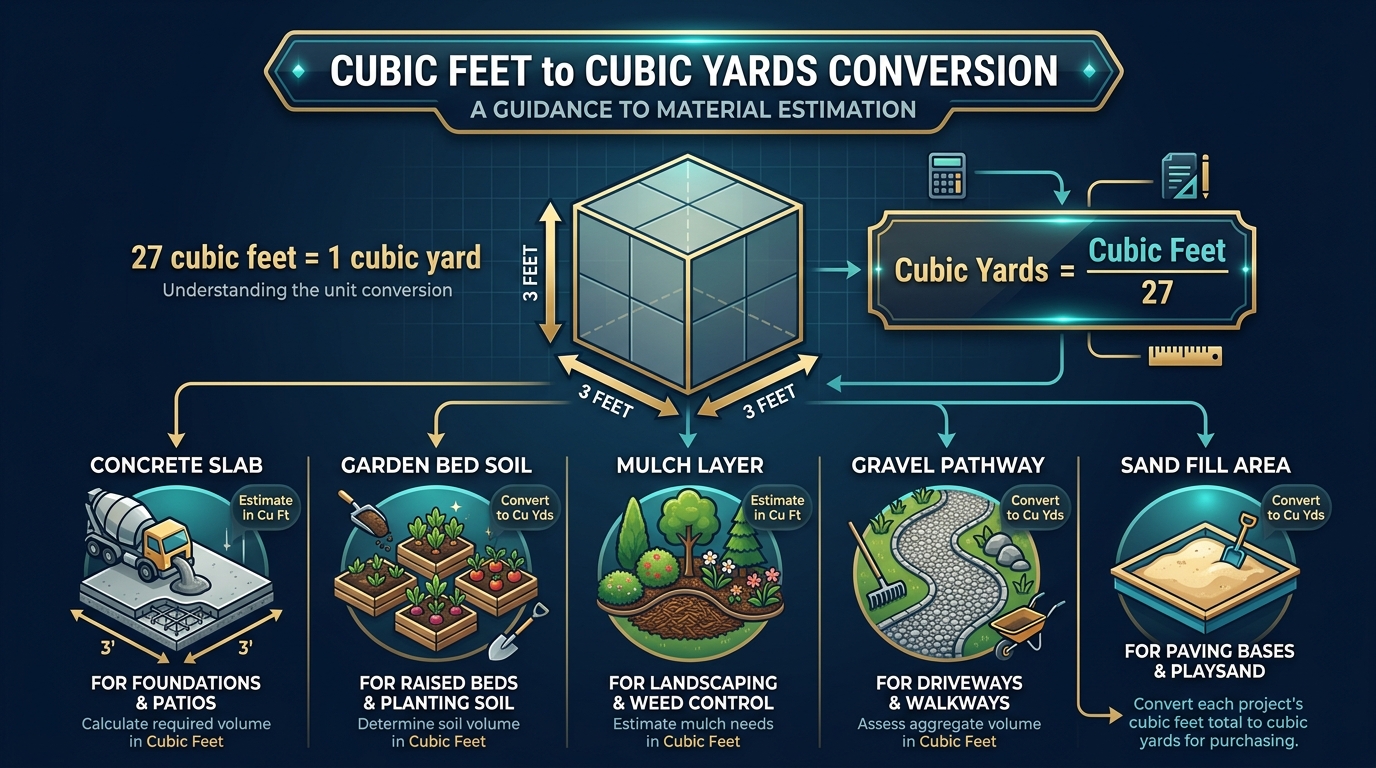
A 400 square foot patio at 4 inches deep produces 133.33 cubic feet. Divide by 27 to get 4.94 cubic yards. Round up to 5 cubic yards when placing the order. Concrete and landscape suppliers sell by the full or half cubic yard, so rounding up ensures you have enough material to finish the project without a costly short-load delivery.
When to Use Cubic Yards for Material Orders
Use cubic yards when ordering bulk material from suppliers. Concrete ready-mix trucks, landscape material deliveries, and aggregate suppliers all price and deliver by the cubic yard. For smaller projects under 1 cubic yard, bagged material sold by the cubic foot may be more convenient. The crossover point where bulk delivery becomes cheaper varies by material and supplier, but it typically falls between 1 and 3 cubic yards.
How Much Extra Material Should You Order?
Why Material Estimates Need a Small Allowance
Calculated volumes assume perfectly flat surfaces and uniform depth. Real job sites have dips, slopes, and uneven edges. Material also compacts during installation, gets displaced during placement, and spills during delivery. A precise mathematical estimate almost always falls slightly short in practice. Adding a small percentage prevents a second trip to the supplier or an expensive short-load delivery fee.
Accounting for Uneven Depths and Waste
Uneven ground causes low spots that consume extra material. Concrete spillage around forms wastes a small percentage of every pour. Mulch and gravel shift during spreading. Soil compacts 10 to 15 percent after watering. Each of these factors means the actual material consumed exceeds the mathematical calculation by a small amount.
Estimating Material With a 5% to 10% Allowance
Waste Allowance Guide
ReferenceFor a project requiring 100 cubic feet, a 10 percent allowance means ordering 110 cubic feet. That small buffer typically costs far less than a second delivery charge. Most concrete short-load fees range from $50 to $150 per partial load, making the extra material a worthwhile investment.
What Information Do You Need to Estimate Material Correctly?
Measuring the Area in Square Feet
Start by measuring the length and width of the project area. Multiply them to get the area in square feet. For rectangular areas, this is straightforward. For irregular shapes, break the area into simpler rectangles or triangles, calculate each separately, and add the results. The guide to calculating square feet for any shape covers rectangles, circles, triangles, and complex layouts step by step.
Determining the Required Depth
Check the project specifications, manufacturer recommendations, or building codes for the required depth. Concrete slabs have minimum thickness requirements. Mulch has recommended depths for weed control. Gravel bases have depth standards based on the load they support. Using the wrong depth produces the wrong volume, regardless of how accurately you measured the area.
Converting Inches to Feet
Divide the inch measurement by 12. Four inches becomes 0.333 feet. Six inches becomes 0.5 feet. Three inches becomes 0.25 feet. This conversion must happen before you multiply by the square footage. Forgetting this step is the single most common material estimation mistake.
Choosing the Correct Material Measurement
Match the measurement unit to how the material is sold. Bagged materials are sold by the cubic foot. Bulk materials are sold by the cubic yard. Concrete is ordered in cubic yards. Calculate cubic feet first, then convert to cubic yards by dividing by 27 if the supplier uses that unit. Always confirm the supplier's unit of measure before placing the order.
Common Mistakes When Estimating Material From Square Footage
Using Square Feet as a Volume Measurement
Square feet measures area, not volume. Ordering "100 square feet of concrete" is meaningless because concrete fills a three-dimensional space. You need cubic feet or cubic yards. This confusion often happens when homeowners describe their project in area terms without accounting for thickness. Always ask: does this material have depth? If yes, calculate volume.
Forgetting to Include Depth
Measuring the surface area and stopping there ignores the most important variable. A 500 square foot area could need anywhere from 41.67 cubic feet (at 1 inch deep) to 500 cubic feet (at 12 inches deep). The depth changes the material order by a factor of 12. Never submit a material order based on area alone.
Mixing Inches and Feet
Plugging inches directly into a formula that expects feet inflates the result by 12. A 100 square foot area at 4 inches deep should produce 33.33 cubic feet. But 100 times 4 (without dividing by 12) gives 400, which is twelve times too much. This single error accounts for many of the over-orders that landscape and concrete suppliers see every week.
Ordering Material Without Allowing for Waste
The mathematical calculation gives a precise number, but real projects are not precise. Skipping the 5 to 10 percent waste allowance frequently results in a shortfall that requires a costly second delivery or an extra trip to the store. The small cost of over-ordering is almost always less than the cost of under-ordering.
Square Feet to Cubic Feet Material Estimation Table
Square Footage and Depth
The table below covers the most common project sizes and depths. Find your square footage in the left column, your depth across the top, and read the cubic feet and cubic yards at the intersection.
Cubic Feet Required
| Sq Ft | 2 in (cu ft) | 3 in (cu ft) | 4 in (cu ft) | 6 in (cu ft) | 12 in (cu ft) |
|---|---|---|---|---|---|
| 25 | 4.17 | 6.25 | 8.33 | 12.50 | 25.00 |
| 50 | 8.33 | 12.50 | 16.67 | 25.00 | 50.00 |
| 100 | 16.67 | 25.00 | 33.33 | 50.00 | 100.00 |
| 200 | 33.33 | 50.00 | 66.67 | 100.00 | 200.00 |
| 300 | 50.00 | 75.00 | 100.00 | 150.00 | 300.00 |
| 500 | 83.33 | 125.00 | 166.67 | 250.00 | 500.00 |
| 750 | 125.00 | 187.50 | 250.00 | 375.00 | 750.00 |
| 1,000 | 166.67 | 250.00 | 333.33 | 500.00 | 1,000.00 |
Cubic Yards Equivalent
| Sq Ft | 2 in (cu yd) | 3 in (cu yd) | 4 in (cu yd) | 6 in (cu yd) | 12 in (cu yd) |
|---|---|---|---|---|---|
| 25 | 0.15 | 0.23 | 0.31 | 0.46 | 0.93 |
| 50 | 0.31 | 0.46 | 0.62 | 0.93 | 1.85 |
| 100 | 0.62 | 0.93 | 1.23 | 1.85 | 3.70 |
| 200 | 1.23 | 1.85 | 2.47 | 3.70 | 7.41 |
| 300 | 1.85 | 2.78 | 3.70 | 5.56 | 11.11 |
| 500 | 3.09 | 4.63 | 6.17 | 9.26 | 18.52 |
| 750 | 4.63 | 6.94 | 9.26 | 13.89 | 27.78 |
| 1,000 | 6.17 | 9.26 | 12.35 | 18.52 | 37.04 |
These reference tables eliminate the need for manual calculations on most standard projects. For custom dimensions or unusual depths, use the interactive calculator below.
Material Volume Calculator
Calculate Material Needed
CalculatorFrequently Asked Questions
Multiply the area in square feet by the required depth in feet. If depth is in inches, divide inches by 12 first. The result is cubic feet of material needed. Convert to cubic yards by dividing by 27 for bulk ordering.
It depends on the depth. At 2 inches deep, 100 square feet needs 16.67 cubic feet. At 4 inches, it needs 33.33 cubic feet. At 6 inches, it needs 50 cubic feet. At 12 inches, it needs 100 cubic feet. You must know the depth.
Depth directly multiplies the volume. Double the depth means double the material. Every additional inch of depth on 100 square feet adds 8.33 cubic feet. The relationship is perfectly linear and proportional.
Only with a depth measurement. Square feet measures flat area. Cubic feet measures three-dimensional volume. The formula is Cubic Feet = Square Feet x Depth in Feet. Without depth, the conversion is not possible.
First calculate cubic feet (Square Feet x Depth in Feet). Then divide cubic feet by 27. One cubic yard equals 27 cubic feet. For example, 100 cubic feet divided by 27 equals 3.70 cubic yards.
Yes. Order 5 to 10 percent extra to cover uneven surfaces, compaction, spillage, and waste. The cost of extra material is almost always less than a second delivery charge or return trip to the store.
Related Calculators
Square Footage Calculator - Calculate area for any shape in square feet
Square Feet to Cubic Feet Calculator - Convert area to volume with any depth
Concrete Calculator - Estimate concrete volume in cubic yards for any slab
Material Estimation Calculator - Estimate material quantities for any project
Cost Per Square Foot Calculator - Budget materials and estimate project costs