How Do You Measure Land in Square Feet and Acres?
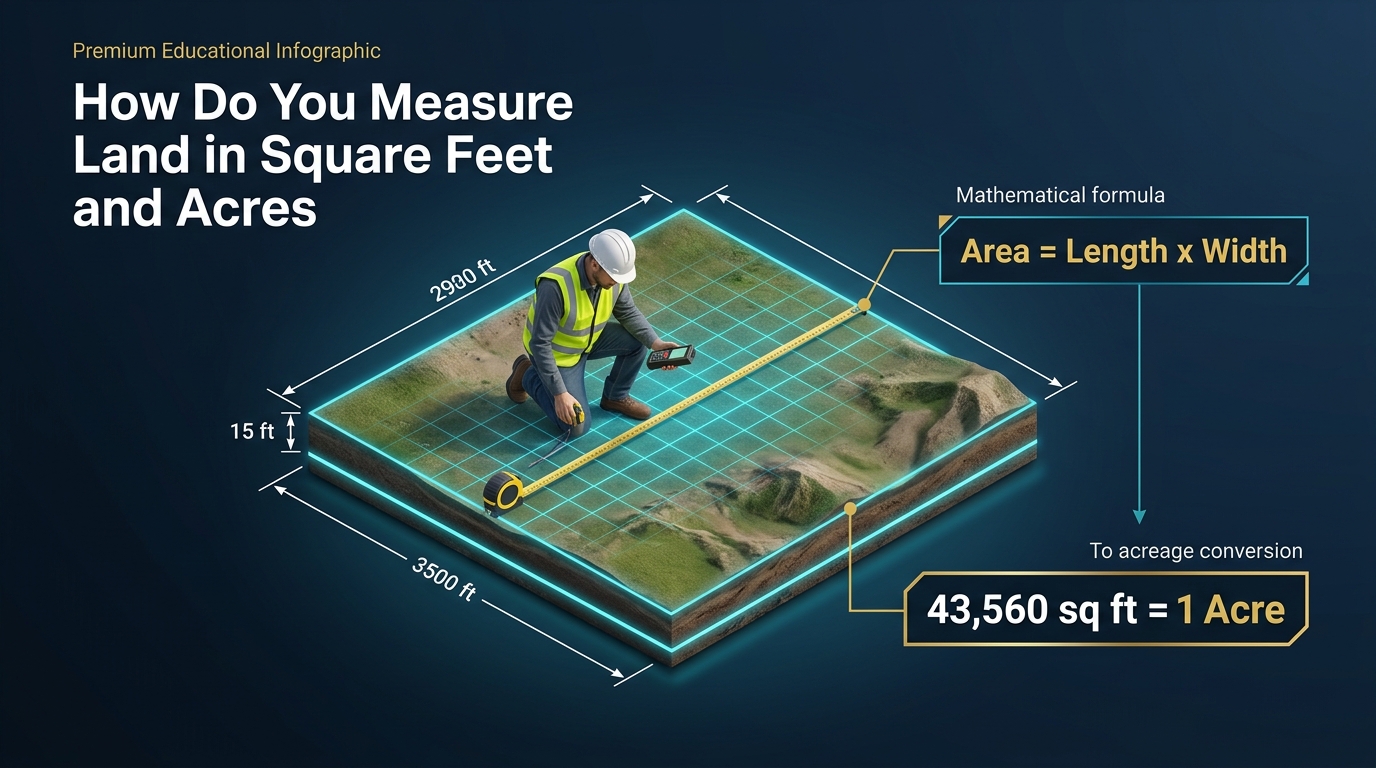
Figure 1: Measuring land accurately requires reliable boundary tools, horizontal dimensioning, and precise conversion formulas.
During a property purchase outside Austin, Texas, a buyer nearly paid for two full acres based on a tax record citing 87,000 square feet. When our survey team pulled a 300-foot fiberglass tape between the corner pins, the true horizontal dimensions enclosed only 69,450 square feet. That discrepancy represented 17,550 square feet of missing ground, or 0.403 acres. At $2.40 per square foot, confirming the actual measurements saved the buyer $42,120 before closing escrow.
Whether you plan to build a home, install fencing, or purchase rural property, knowing how to verify land area protects your capital. While formal deeds require a licensed surveyor stamp, any property owner can verify dimensions and calculate acreage. Our online square feet of land calculator delivers instant results, while understanding the underlying formulas ensures confident property decisions.
What Does Land Measurement in Square Feet and Acres Mean?
Land measurement determines the two-dimensional horizontal surface area enclosed within legal property boundaries. In real estate, area is expressed primarily in square feet and acres. Both units quantify ground surface, but each serves a distinct operational scale.
Crucially, land measurement evaluates horizontal planar area rather than slope distance. Walking a hillside covers more ground than the true horizontal boundary shown on a deed. Surveyors project parcel boundaries onto a level horizontal plane, matching an aerial satellite view.
What Is a Square Foot?
A square foot is the foundational imperial unit of area, defined as a square measuring one linear foot (12 inches) per side, equaling 144 square inches and roughly 0.0929 square meters. In property development, square feet quantify smaller parcels, building footprints, and foundation pads where precise dimensions are essential.
What Is an Acre?
An acre is a historic land unit legally standardized at exactly 43,560 square feet (approximately 4,046.86 square meters or 0.4047 hectares). An acre has no mandated shape. When arranged as a perfect square, one acre measures roughly 208.71 feet per side, providing a helpful field visualizer.
When Are Square Feet and Acres Used for Land?
Selecting between square feet and acres depends on parcel scale. Urban building lots and residential plots under one acre are marketed in square feet. Conversely, rural tracts, timberland, and farmland use acres as the primary standard. Municipal zoning authorities usually adopt 43,560 square feet as the natural dividing line.
Compare one acre visually to an American football field, a 10,000 sq ft suburban lot, and a regulation tennis court. Click the comparison buttons to highlight each footprint.
What Do You Need to Measure Land?
Measuring land boundaries accurately requires dependable equipment, official property records, and proper calculation tools. Pacing boundary lines causes substantial errors because human stride varies across uneven ground.
Measuring Tape or Laser Measure
A 100-foot or 300-foot open-reel fiberglass tape resists moisture and stretching. Pull the tape taut to eliminate sagging, which falsely increases measured length.
For open ground with clear lines of sight, an outdoor laser distance meter provides rapid accuracy. Quality units feature camera viewfinders to pinpoint targets in sunlight. On long pasture lines, a surveyor wheel offers a reliable mechanical option.
Property Dimensions
Before measuring in the field, obtain recorded dimensions from your deed or subdivision plat map. These documents list legal boundary lengths and corner monument locations, such as iron rebar pins. Use deed dimensions as your baseline control.
Calculator
A dependable calculator completes your toolkit. While rectangular lots need simple multiplication, irregular parcels and acreage conversions require decimal accuracy. Maintain four decimal places during calculations to prevent rounding drift.
How to Measure Land in Square Feet
Measuring land in square feet follows a systematic method. For rectangular plots, you need two linear dimensions: horizontal length and horizontal width. Multiplying both values in feet produces total square footage.
Measure the Length of the Land
Pull your tape along the longest property boundary between corner pins, keeping the line taut and level. Insert intermediate stakes if the line exceeds tape length. Convert inches to decimal feet by dividing by 12 (for example, 175 feet 6 inches converts to 175.5 feet).
Measure the Width of the Land
Return to your starting corner pin and measure along the perpendicular boundary to the opposite corner pin. Record this width in decimal feet, and check opposing sides to confirm the tract is truly rectangular.
Multiply Length by Width
Multiply recorded length by width. For instance, a parcel measuring 150.0 feet long by 80.0 feet wide yields 12,000 square feet (150 × 80 = 12,000 sq ft).
Square Feet Formula
The mathematical formula for rectangular land area is expressed as:
Both dimensions must be in linear feet. Multiplying feet by feet produces square feet.
If dimensions are measured in yards, multiply each by 3 before multiplying, or multiply square yards by 9. If measured in meters, multiply square meters by 10.7639.
Enter the measured horizontal boundary dimensions of your rectangular land parcel below. The calculator computes total square feet, acres, and perimeter in real time while rendering a scaled visual boundary.
How to Measure Irregular-Shaped Land
In practice, rectangular land plots are uncommon outside master-planned communities. Many rural tracts and cul-de-sac lots feature irregular boundaries with five or more sides. Measuring irregular land relies on decomposition: partitioning complex boundaries into simple geometric shapes.
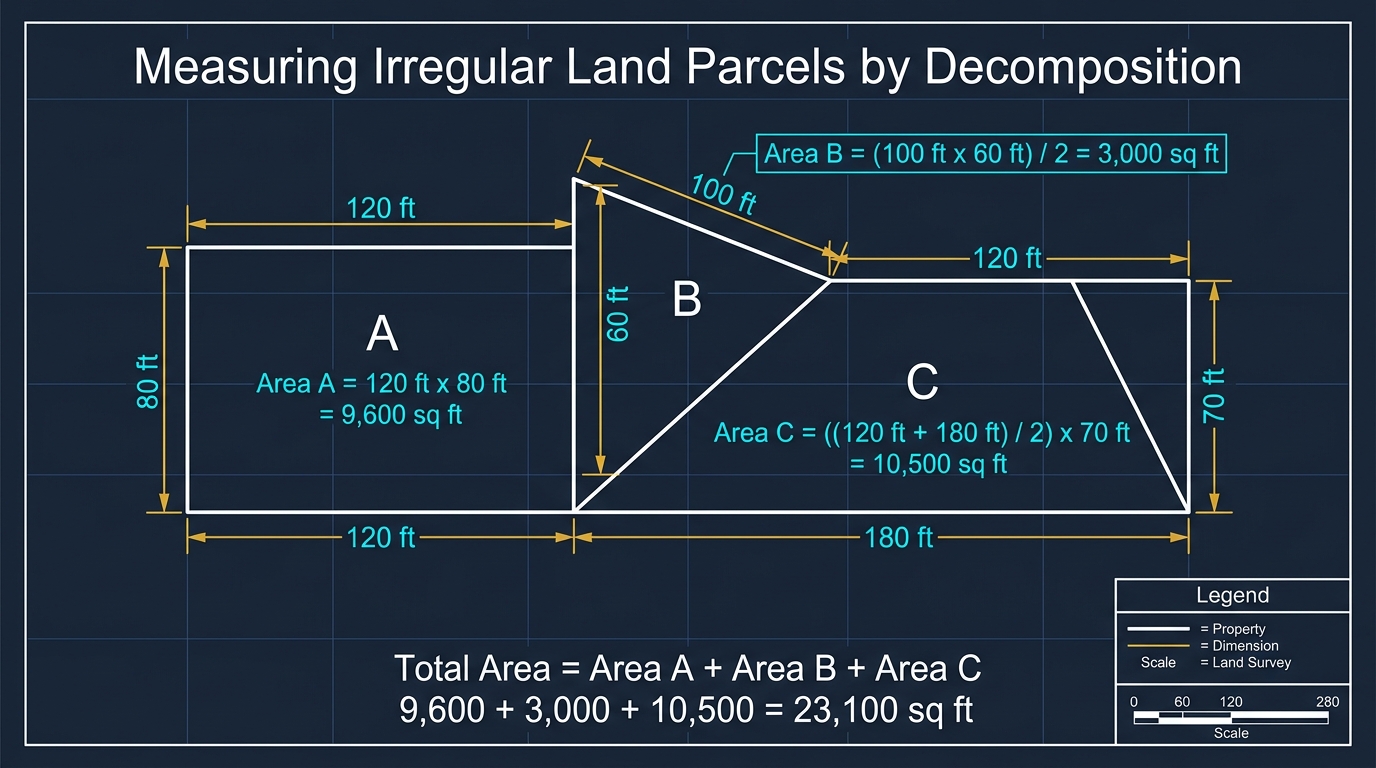
Figure 2: Dividing an irregular property boundary into standard rectangles, triangles, and trapezoids enables exact square footage calculations.
Divide the Land Into Smaller Sections
Sketch your property boundary on paper, marking all corner pins. Draw dividing lines across the plot to create standard shapes: rectangles, right triangles, and trapezoids. For an L-shaped parcel, a single dividing line creates two clean rectangles.
Measure these internal partition lines with your surveyor tape. When dealing with multi-sided irregular lots, our online irregular shape area calculator handles complex coordinates and delivers fast, accurate totals.
Calculate the Area of Each Section
Calculate the square footage of each section using standard geometric formulas:
- Rectangular Sections: Multiply length by width (80 ft × 60 ft = 4,800 sq ft).
- Triangular Sections: Multiply base by height and divide by 2 ((30 ft × 60 ft) ÷ 2 = 900 sq ft).
- Trapezoidal Sections: Add parallel sides, divide by 2, and multiply by height (((80 + 50) ÷ 2) × 40 = 2,600 sq ft).
Add the Areas Together
Sum the individual section areas to find total parcel square footage. Adding 4,800 sq ft (Section A) plus 900 sq ft (Section B) plus 2,600 sq ft (Section C) produces 8,300 square feet. Dividing 8,300 by 43,560 yields 0.1905 acres. This additive method provides high accuracy across complex property boundaries.
Click the section buttons below to highlight how an irregular 5-sided land parcel is split into three simple geometric shapes. Notice how each sub-area is computed and summed into the total parcel acreage.
How to Convert Land From Square Feet to Acres
After calculating square footage, converting to acres requires a single division. This conversion is an essential skill for analyzing real estate listings and land values.
Square Feet to Acres Formula
The mathematical equation to convert square feet to acres is simple:
Divide total square feet by 43,560. To reverse the calculation, multiply acres by 43,560.
For example, a 21,780 square foot lot equals 0.5000 acres (21,780 ÷ 43,560), representing a half-acre homesite. A 130,680 square foot tract equals exactly 3.0000 acres.
Why 43,560 Square Feet Equals One Acre
The constant 43,560 dates to English surveying history. In the seventeenth century, Edmund Gunter introduced a surveyor chain measuring 66 feet long. An agricultural furlong measured 10 chains (660 feet). An official legal acre was defined as one furlong by one chain. Multiplying 660 feet by 66 feet yields exactly 43,560 square feet.
Step-by-Step Square Feet to Acres Conversion
Follow these four steps to convert square feet to acres with precision:
- Calculate Total Square Footage: Ensure all dimensions are in feet and find total parcel square feet.
- Apply the Constant: Use the exact legal conversion factor of 43,560 without premature rounding.
- Divide: Divide total square feet by 43,560 on your calculator.
- Record the Acreage: Round the quotient to four decimal places (e.g., 65,000 sq ft ÷ 43,560 = 1.4922 acres).
How to Calculate Acres From Land Dimensions
When you have raw boundary dimensions from a deed or tape, you can calculate acres directly. This combined approach is the standard workflow for rural property owners.
Calculate Square Feet From Length and Width
Multiply horizontal length by width in feet to obtain intermediate square footage. If dimensions are in yards, multiply each by 3 first (90 yards by 40 yards equals 270 feet by 120 feet, or 32,400 sq ft). When planning fencing, our linear feet to square feet guide clarifies how perimeter length connects to area.
Convert the Square Footage to Acres
Divide the calculated square footage by 43,560. Using the 32,400 square foot parcel above, 32,400 divided by 43,560 yields 0.7438 acres. The combined formula is: Acres = (Length in feet × Width in feet) ÷ 43,560.
Example of Measuring a Rectangular Land Parcel
Consider a practical scenario. A parcel advertised as one acre measures 165 feet of road frontage by 240 feet of depth. Calculate the acreage in two steps:
- Step 1 (Square Feet): 165 feet × 240 feet = 39,600 square feet.
- Step 2 (Acres): 39,600 sq ft ÷ 43,560 = 0.9091 acres.
- Outcome: The parcel measures 0.91 acres, falling 3,960 square feet short of one acre. At $3.00 per square foot, this discrepancy justifies an $11,880 adjustment.
Land Measurement Examples in Square Feet and Acres
Reviewing common land benchmarks builds an intuitive sense of scale. The examples below illustrate how square footage translates into acres across standard property types.
1,000 Square Feet of Land
One thousand square feet represents 0.0230 acres (1,000 ÷ 43,560), or roughly 1/44th of an acre. This footprint matches a compact patio garden or a three-car parking apron.
5,000 Square Feet of Land
Five thousand square feet equals 0.1148 acres (5,000 ÷ 43,560), or approximately 1/9th of an acre. A standard 50-foot by 100-foot urban lot covers 5,000 square feet.
10,000 Square Feet of Land
Ten thousand square feet equals 0.2296 acres (10,000 ÷ 43,560), just under a quarter acre (0.25 acres equals 10,890 sq ft). A 100-foot by 100-foot suburban parcel accommodates a home, driveway, and pool.
43,560 Square Feet of Land
Forty-three thousand five hundred sixty square feet equals exactly 1.0000 acre. Shaped as a square, a one-acre parcel measures roughly 208.71 feet on each boundary line.
Square Feet to Acres Conversion Table
Use this reference table to look up equivalent values between square feet and acres across common residential and rural parcel sizes:
| Square Feet (sq ft) | Acres (ac) | Fractional Equivalent | Common Real-World Example |
|---|---|---|---|
| 1,000 sq ft | 0.0230 acres | ~1/44 acre | Urban courtyard or 3-car garage |
| 2,500 sq ft | 0.0574 acres | ~1/17 acre | Small townhome lot or tennis court |
| 5,000 sq ft | 0.1148 acres | ~1/9 acre | Standard urban residential lot (50x100) |
| 10,000 sq ft | 0.2296 acres | ~1/4.4 acre | Large suburban residential lot (100x100) |
| 10,890 sq ft | 0.2500 acres | Exactly 1/4 acre | Quarter-acre suburban homesite |
| 21,780 sq ft | 0.5000 acres | Exactly 1/2 acre | Half-acre semi-rural executive lot |
| 32,670 sq ft | 0.7500 acres | Exactly 3/4 acre | Estate parcel with outbuildings |
| 43,560 sq ft | 1.0000 acre | Exactly 1 full acre | Full acre homestead or pasture tract |
| 87,120 sq ft | 2.0000 acres | Exactly 2 full acres | Small hobby farm or horse property |
| 130,680 sq ft | 3.0000 acres | Exactly 3 full acres | Subdivided rural acreage development |
| 217,800 sq ft | 5.0000 acres | Exactly 5 full acres | Standard minimum rural homestead tract |
Common Land Measurement Mistakes to Avoid
In field surveys, property owners repeatedly make four calculation mistakes. Avoiding these errors prevents boundary disputes, permitting problems, and financial loss.
Confusing Linear Feet With Square Feet
Linear feet quantify boundary perimeter, whereas square feet quantify surface area inside that perimeter. A square property measuring 100 feet by 100 feet requires 400 linear feet of fencing, but encloses 10,000 square feet of ground (100 × 100). Ordering gravel or seeds using linear perimeter feet causes severe material shortages.
Measuring Only One Side of the Property
Some landowners measure one road frontage boundary, assume the property is square, and square that dimension. If a lot has 200 feet of frontage, squaring 200 suggests 40,000 square feet. If actual depth is 120 feet, the true area is 24,000 square feet (200 × 120), creating a 40 percent calculation error.
Using Incorrect Property Dimensions
Physical fences are frequently built off legal boundary lines due to rocky terrain or past neighbor agreements. Always locate legal boundary pins and verify dimensions against official deed records. In addition, measure horizontal distance rather than surface slope distance on hillsides.
Rounding Measurements Too Early
Rounding intermediate values prematurely compounds into significant acreage errors. Maintain at least four decimal places throughout calculations, and only round your final figure to two decimal places when writing formal contracts.
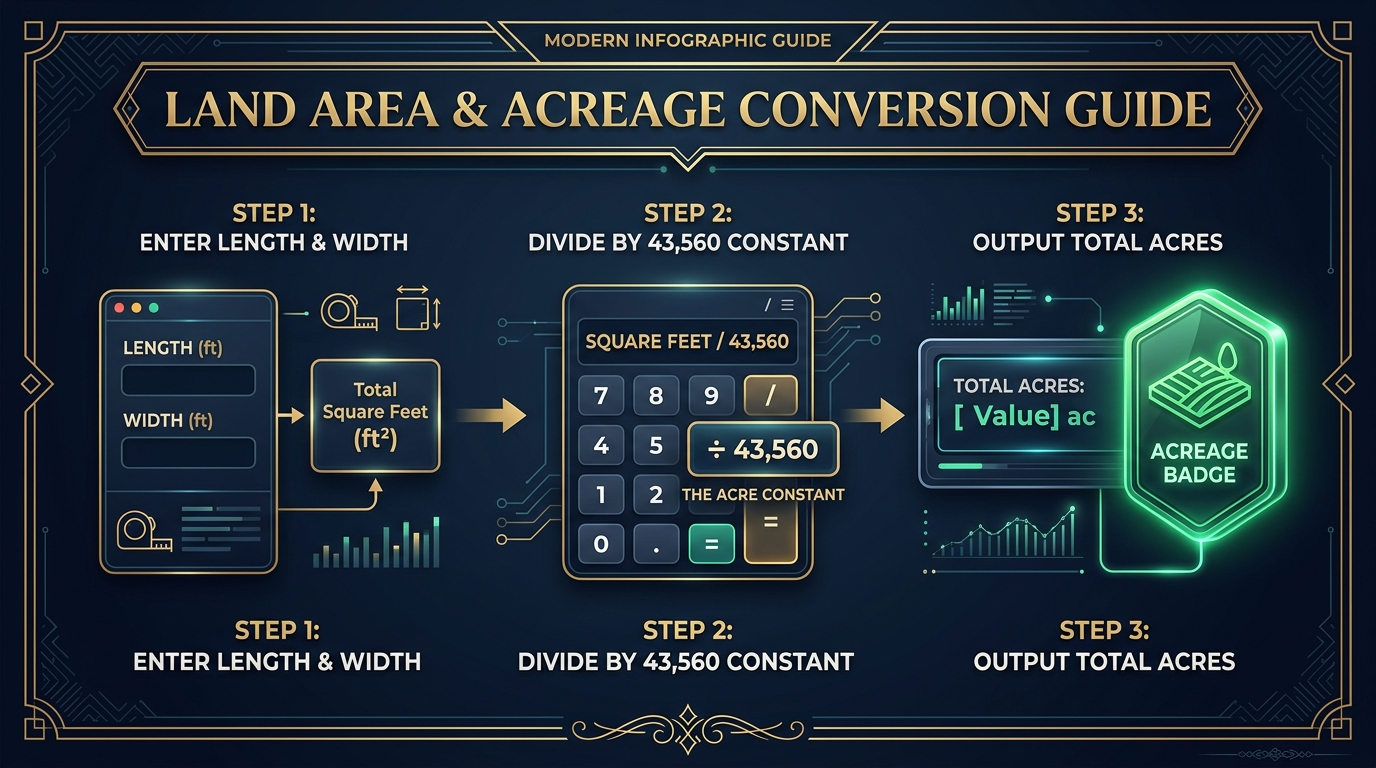
Figure 3: Following a disciplined three-step calculation process on a digital calculator eliminates common arithmetic mistakes.
How to Measure and Calculate Land Area With a Calculator
Using a digital calculator prevents arithmetic mistakes. Executing the calculation follows a disciplined three-step sequence.
Enter the Measured Dimensions
First, enter your measured horizontal length into the calculator. Convert fractional inches to decimal feet first (enter 245 feet 9 inches as 245.75). Press the multiplication key, then enter the measured width in decimal feet (180.5 feet).
Calculate the Square Footage
Press the equals key to calculate square footage. Multiplying 245.75 by 180.5 yields 44,357.875 square feet. This number represents the total ground surface of the parcel in square feet.
Convert Square Feet to Acres
Without clearing your screen, press the division key and enter 43,560. Press equals to display total acreage (44,357.875 ÷ 43,560 = 1.0183 acres). For fast double-checking in the field, use our specialized square feet to acres calculator on your mobile device.
Frequently Asked Questions
Measure horizontal boundary length and width in feet using a surveyor tape or laser meter. Multiply length by width for rectangular parcels. For irregular lots, divide the boundary into standard shapes, calculate individual areas, and add them together.
Multiply boundary length by width in feet to find total square footage, then divide by 43,560. For example, a 200-foot by 150-foot parcel equals 30,000 square feet, which equals 0.6887 acres (30,000 ÷ 43,560).
There are exactly 43,560 square feet in one acre. This historical surveyor standard comes from multiplying one furlong (660 feet) by one chain (66 feet). It remains the official legal standard in the United States and Canada.
Yes, irregular land can be measured accurately in square feet. Divide the parcel into standard rectangles, triangles, and trapezoids. Calculate the area of each shape with geometric formulas, then sum the values for total parcel square footage.
Convert square feet to acres by dividing total square footage by 43,560. For example, 87,120 square feet divided by 43,560 equals exactly 2.0 acres.
For rectangular plots, you only need horizontal length and width in feet. For irregular parcels, you need perimeter lengths plus perpendicular offset heights. On slopes, always record level horizontal ground distance.
- Core Formulas: Area (sq ft) = Length × Width. Area (Acres) = Square Feet ÷ 43,560.
- The Acre Constant: Exactly 43,560 square feet make up one acre. A 208.71-foot square parcel equals one acre.
- Horizontal Projection: Land area is measured along a level horizontal plane, never along sloped contours.
- Irregular Parcels: Divide complex boundaries into rectangles, triangles, and trapezoids, then sum individual areas.
- Field Tools: Use a fiberglass surveyor tape, outdoor laser meter, or official deed records rather than pacing.
- Digital Verifiers: Leverage our online square feet of land calculator and square feet to acres calculator for instant checks.
Understanding how to calculate land area protects your finances and guides sound property decisions. Verify your corner markers against official deed records and let accurate dimensions guide your real estate investments.