Two years ago, a homeowner I was helping ordered 150 square feet of mulch for her garden beds. She called the landscape supply yard and said she needed "150 square feet of mulch." The yard loaded up three cubic yards and charged her $165. When the mulch arrived, it was nearly triple what she needed. The problem was simple but costly: she confused square feet with cubic feet. Square feet told her how much garden bed surface to cover. Cubic feet told her how much mulch to buy. Those are two entirely different measurements, and mixing them up costs real money on real projects every single day.
Whether you are buying flooring, ordering concrete, filling raised garden beds, or estimating storage capacity, understanding the difference between square feet and cubic feet is essential. This guide breaks down both measurements with clear definitions, visual diagrams, conversion formulas, worked examples, and an interactive calculator. The square footage calculator on this site handles area measurement for any shape. This article explains when area is the right measurement and when you need volume instead.
What Are Square Feet?
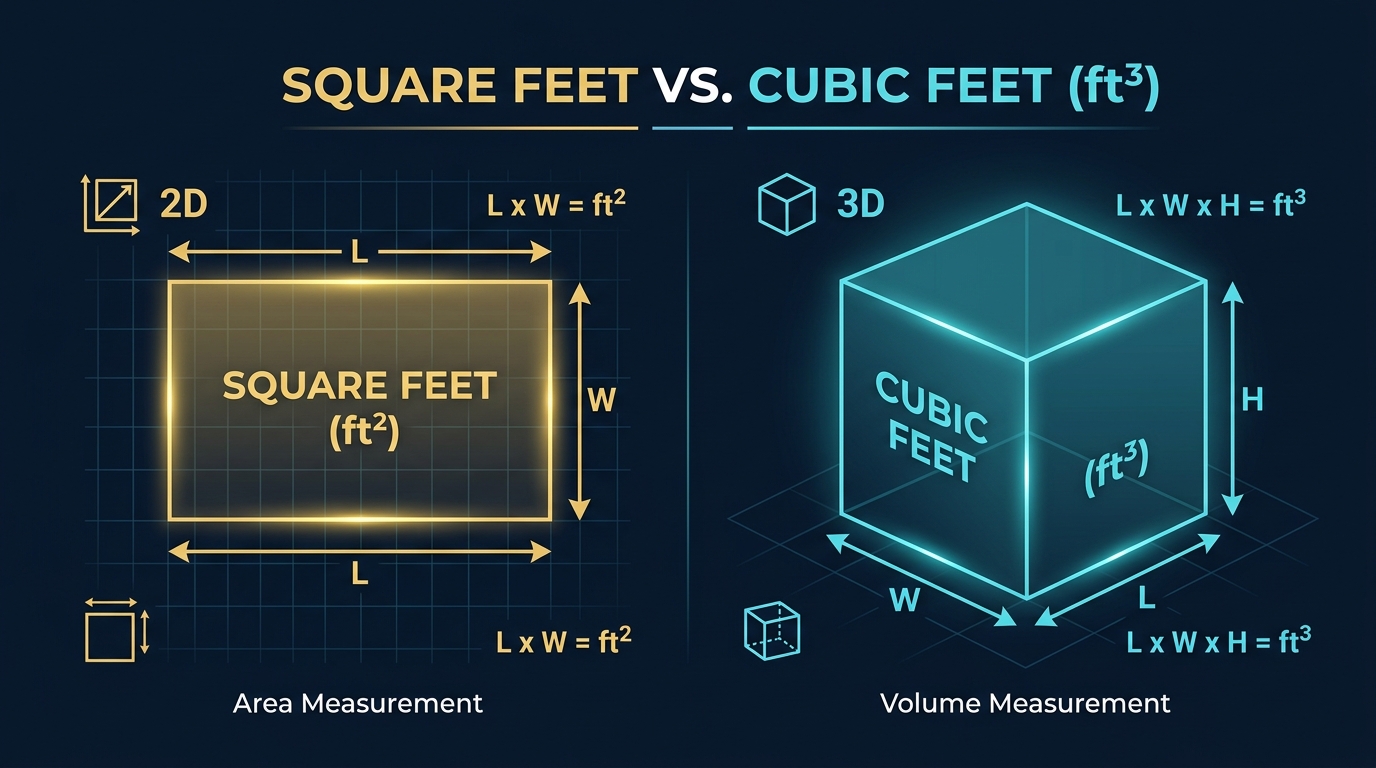
Square feet is a unit of area measurement in the imperial system. It tells you how much flat surface a space covers. Think of a square that is exactly 1 foot long and 1 foot wide. That single square is 1 square foot. Every area measurement in square feet is built from that simple concept. When you measure a room, a yard, or a piece of flooring, you are counting how many of those 1-by-1-foot squares fit inside the space.
What Does Square Feet Measure?
Square feet measures two-dimensional area. It captures only two directions: length and width. There is no height, depth, or thickness involved. When someone says a room is 200 square feet, they mean the floor covers a flat area equivalent to 200 of those 1-by-1-foot squares. The measurement describes a surface. It does not describe how much space is inside the room, how tall the ceiling is, or how much material would fill that room. Area is always flat. It lives on a single plane. That distinction matters because many real-world projects require you to measure beyond that flat surface.
How Is Square Footage Calculated?
Square Footage Formula
FormulaCalculating square footage is straightforward for rectangles. Measure the length and width in feet, then multiply. A room that is 10 feet long and 12 feet wide has 120 square feet. For irregular shapes, break the area into rectangles, triangles, or circles, calculate each section, and add the results together. The step-by-step square feet guide covers every shape you might encounter.
Where Are Square Feet Commonly Used?
Square feet is the standard measurement for floor area, room size, lot size, paint coverage, and material surface coverage in the United States. Real estate listings describe homes in square feet. Flooring is sold by the square foot. Paint coverage is rated in square feet per gallon. Roofing materials are priced per square (which equals 100 square feet). Carpet, tile, hardwood, and laminate are all purchased based on the square footage of the floor you plan to cover. Whenever you are measuring a flat surface, you are working in square feet.
What Are Cubic Feet?
Cubic feet is a unit of volume measurement in the imperial system. It tells you how much three-dimensional space an object occupies or how much material fits inside a container. Think of a box that is exactly 1 foot long, 1 foot wide, and 1 foot tall. That box contains 1 cubic foot of space. Every volume measurement in cubic feet counts how many of those boxes would fill the space.
What Does Cubic Feet Measure?
Cubic feet measures three-dimensional volume. It captures three directions: length, width, and height (or depth). When someone says a refrigerator has 25 cubic feet of capacity, they mean the interior space holds the equivalent of 25 of those 1-by-1-by-1-foot cubes. Volume describes the amount of space inside something or the amount of material needed to fill a space. Soil bags at the garden center are labeled in cubic feet. Shipping boxes list their volume in cubic feet. HVAC systems are sized by the cubic footage of the rooms they serve.
How Is Cubic Footage Calculated?
Cubic Footage Formula
FormulaCalculating cubic footage adds one step beyond square footage. You measure the length, width, and height (or depth) in feet, then multiply all three numbers. A room that is 10 feet long, 12 feet wide, and 8 feet tall has 960 cubic feet of volume. If the depth is in inches, divide by 12 first to convert to feet. A garden bed that is 10 feet long, 4 feet wide, and 6 inches deep contains 10 x 4 x 0.5 = 20 cubic feet of soil.
Where Are Cubic Feet Commonly Used?
Cubic feet is the standard for measuring volume in shipping, storage, HVAC, concrete, soil, mulch, gravel, and appliance capacity. Moving companies estimate truck space in cubic feet. Refrigerators and freezers list interior capacity in cubic feet. Concrete suppliers sell by the cubic yard (27 cubic feet). Soil and mulch bags are sold in 1, 2, or 3 cubic foot quantities. Air conditioning capacity is calculated based on the cubic footage of the space being cooled. Whenever you are filling a space or measuring capacity, you are working in cubic feet.
What Is the Difference Between Square Feet and Cubic Feet?
The fundamental difference is dimension. Square feet measures flat area using two dimensions. Cubic feet measures volume using three dimensions. They answer different questions entirely. Square feet answers "how much surface does this cover?" Cubic feet answers "how much space does this fill?" Confusing them leads to ordering errors, budget overruns, and wasted material.
Square Feet Measure Area
Square feet captures only the surface. A 10 x 10 floor is 100 square feet whether the ceiling is 8 feet tall or 20 feet tall. The area does not change. It measures the footprint. When you buy flooring or carpet, you buy by square feet because you only need to cover the flat surface. The height of the room is irrelevant to the amount of flooring you need.
Cubic Feet Measure Volume
Cubic feet captures the entire enclosed space. That same 10 x 10 floor with an 8-foot ceiling has 800 cubic feet of volume. With a 20-foot ceiling, it has 2,000 cubic feet. The area stayed the same, but the volume changed dramatically. When you order concrete for a slab, you need cubic feet (or cubic yards) because you are filling a three-dimensional space, not just covering a surface.
Two Dimensions vs. Three Dimensions
2D Area vs. 3D Volume
InteractiveTwo dimensions means length and width. Three dimensions means length, width, and depth (or height). Area lives on a flat surface. Volume fills a space. A sheet of paper has area in square inches. A shoebox has volume in cubic inches. The third dimension is what separates the two measurements. Every time you add depth or height to a flat measurement, you move from area to volume.
Can Square Feet and Cubic Feet Be Compared Directly?
No. Comparing square feet to cubic feet is like comparing apples to oranges. They measure fundamentally different properties. You cannot say that 100 square feet equals a certain number of cubic feet without knowing how deep or tall the space is. The two units exist in different dimensional worlds. One is flat. The other is three-dimensional. A direct comparison between them is mathematically impossible without a third measurement.
Why Square Feet Cannot Represent Volume
Square feet has no concept of depth or height. It is purely a surface measurement. When you say a floor is 200 square feet, that number tells you nothing about how much space exists above or below that floor. You could stack 1 inch of concrete on it or 12 inches of concrete on it and the square footage stays the same at 200. But the volume changes from 16.67 cubic feet to 200 cubic feet. Area and volume are different categories of measurement, and one cannot substitute for the other.
Why an Additional Depth or Height Is Needed
The third dimension is the bridge between area and volume. Without it, you are stuck on a flat plane. A garden bed that is 4 feet by 8 feet has 32 square feet of surface. But how much soil does it hold? You cannot answer that question until you know how deep the bed is. At 6 inches deep, it holds 16 cubic feet of soil. At 12 inches deep, it holds 32 cubic feet. The depth doubled, so the volume doubled. That third measurement is never optional when calculating volume.
How the Third Dimension Changes the Measurement
Adding the third dimension transforms the math from multiplication of two numbers to multiplication of three. Area uses two factors (length times width). Volume uses three factors (length times width times depth). The result changes from square units to cubic units. The symbol changes from the superscript 2 to the superscript 3. And the practical meaning changes from "how much surface" to "how much space." Every real-world project that involves filling, pouring, or stacking material requires that third dimension.
How Are Square Feet Related to Cubic Feet?
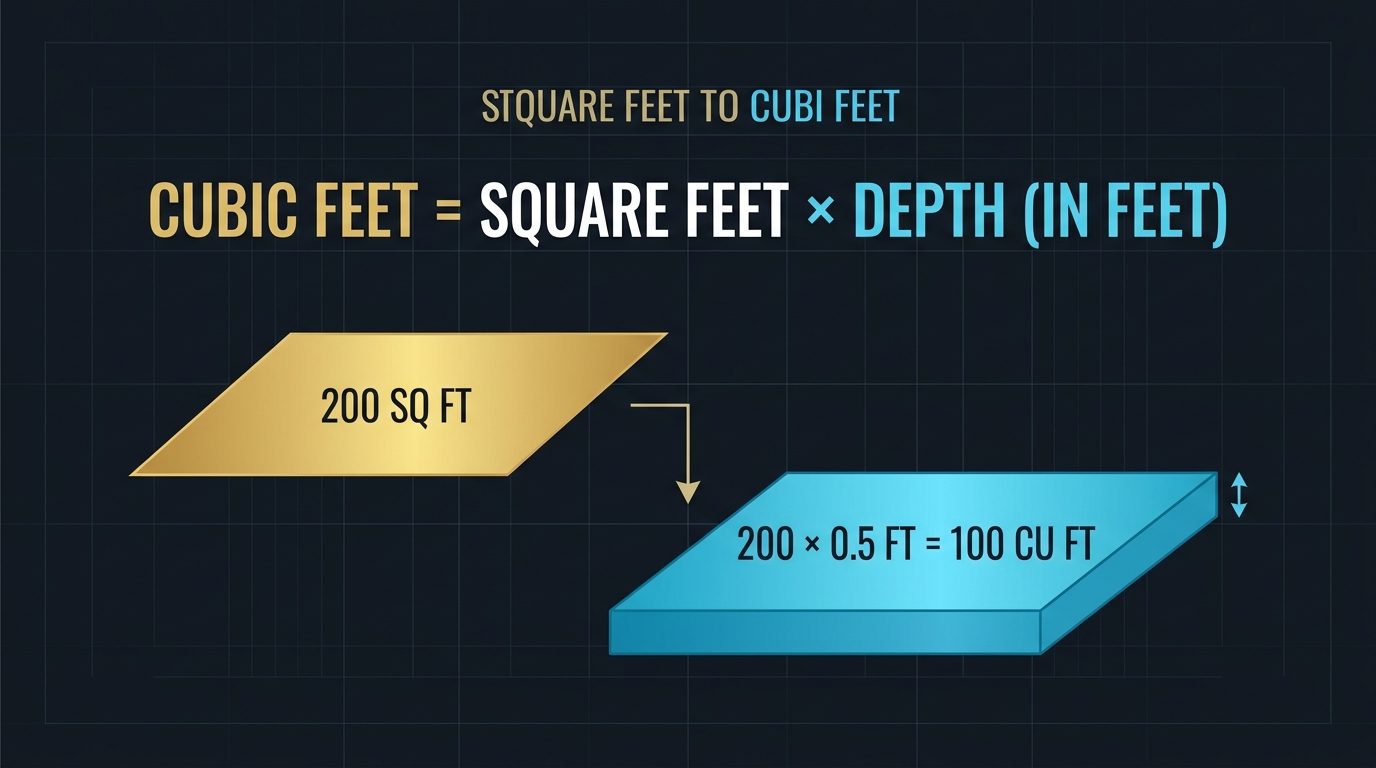
Square feet and cubic feet are related through depth. Cubic feet equals square feet multiplied by depth in feet. If you already know the area of a surface in square feet, you only need one more measurement to find the volume in cubic feet. That relationship is the foundation of every material estimation in construction, landscaping, and home improvement.
The Relationship Between Area and Volume
Area is a building block of volume. Every volume calculation starts with an area calculation. When you compute cubic feet for a concrete slab, you first find the area (length times width) and then multiply by the thickness. When you estimate soil for a garden bed, you first calculate the bed area and then multiply by the depth. Volume is area extended into the third dimension. Think of it as stacking layers of area on top of each other. Each layer is 1 foot thick. The number of layers equals the depth in feet. The total volume equals the area times the number of layers.
Square Feet x Depth = Cubic Feet
Area to Volume Relationship
Key FormulaThis formula is the entire connection between square feet and cubic feet. It is the same formula used by concrete contractors, landscapers, and material suppliers every day. The square feet to cubic feet calculator automates this conversion and also provides cubic yard equivalents and bag counts for common materials.
What Happens When the Depth Changes?
When depth changes, volume changes proportionally. Double the depth and the volume doubles. Triple the depth and the volume triples. The area stays constant. This proportional relationship makes it easy to compare material quantities at different depths. A 100 square foot area at 3 inches deep needs 25 cubic feet of fill. At 6 inches deep, it needs 50 cubic feet. At 12 inches deep, it needs 100 cubic feet. Each time the depth doubled, the volume doubled. The area never moved from 100 square feet.
What Is the Formula for Finding Cubic Feet From Square Feet?
Two versions of the formula exist depending on whether your depth is measured in feet or in inches. Both give you the same result. The only difference is an extra division step when working with inches.
Formula Using Depth in Feet
When Depth Is in Feet
FormulaWhen the depth is already in feet, the calculation is a single multiplication. A 200 square foot patio with a 0.5-foot (6-inch) concrete slab needs 100 cubic feet of concrete. Divide by 27 to get cubic yards: 100 / 27 = 3.70 cubic yards.
Formula Using Depth in Inches
When Depth Is in Inches
FormulaWhen depth is in inches, divide by 12 first. Most real-world depths are stated in inches (4-inch slab, 3-inch mulch layer, 6-inch gravel base). Dividing by 12 converts inches to feet so all units match. The most common mistake is forgetting this conversion and plugging inches directly into the formula, which multiplies the result by 12.
Example of Area and Volume With the Same Footprint
Same Area, Different Volumes
ComparisonA 10 x 10 area is always 100 square feet. But the cubic feet change based on depth. At 2 inches deep, it contains 16.67 cubic feet. At 4 inches, 33.33 cubic feet. At 6 inches, 50 cubic feet. At 12 inches, 100 cubic feet. The area never changes, but the volume scales linearly with depth. This is why depth matters so much when ordering materials.
How Do Square Feet and Cubic Feet Differ in Real-World Projects?
Different projects demand different measurements. Knowing which one to use for each task prevents ordering mistakes and budget surprises. Here are the most common scenarios where the distinction matters.
Flooring and Carpet
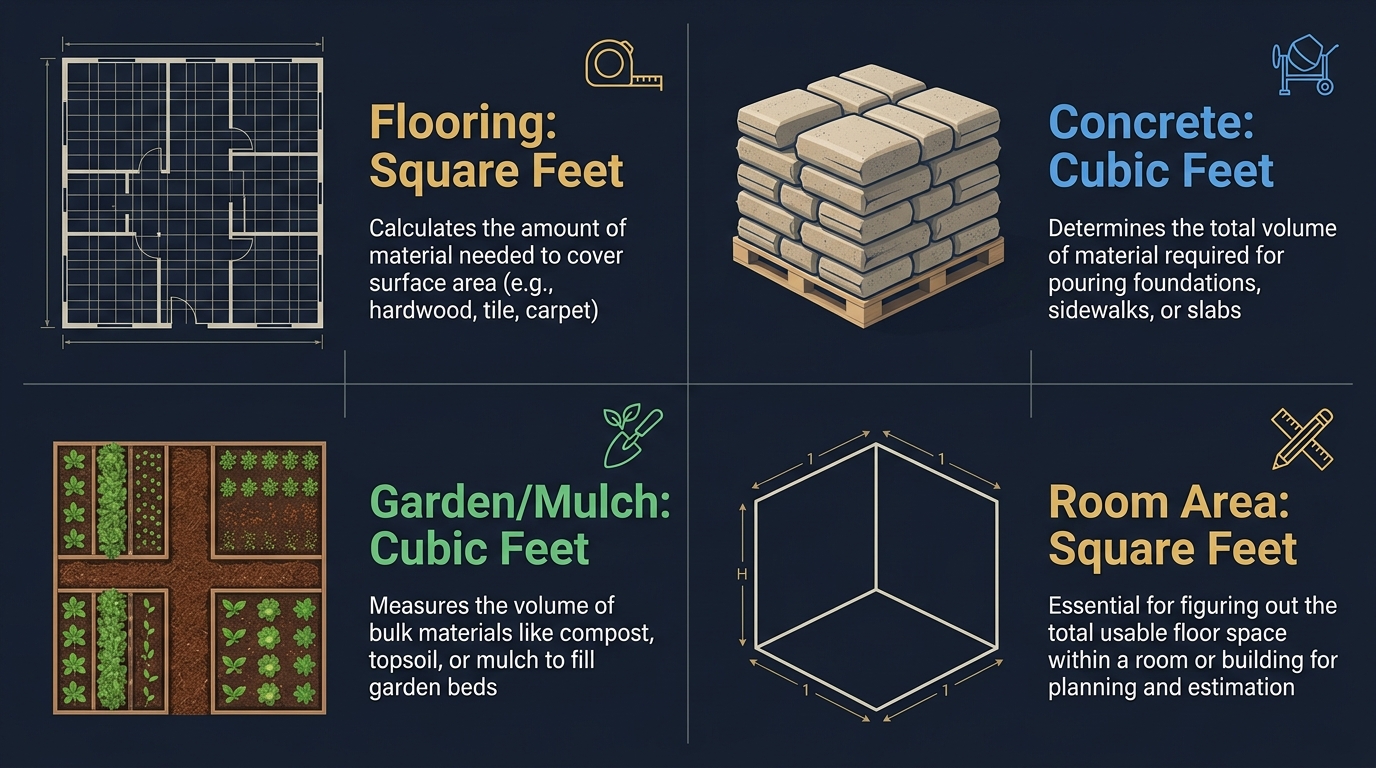
Flooring is purchased by the square foot because you are covering a flat surface. Hardwood, tile, laminate, vinyl, and carpet are all measured in square feet. You need to know the floor area, not the room volume. A 12 x 15 room needs 180 square feet of flooring (plus 10 percent for waste). The ceiling height does not matter. The wall height does not matter. Only the floor area matters. For a detailed flooring guide, the flooring and carpet square footage guide covers measurement and waste calculations.
Concrete and Slabs
Concrete is ordered in cubic feet or cubic yards because you are filling a three-dimensional space. A driveway slab is not just a surface measurement. It has thickness. A 20 x 20 driveway at 4 inches thick requires 133.33 cubic feet (4.94 cubic yards) of concrete. If you only measured the 400 square feet of surface area and forgot the thickness, you would have no idea how much concrete to order. The third dimension is what makes the order possible.
Soil, Mulch, and Gravel
Landscaping materials are sold by cubic feet or cubic yards because they fill a space with depth. A 500 square foot garden bed needs different amounts of mulch depending on how deep you spread it. At 2 inches deep, you need 83.33 cubic feet. At 4 inches deep, you need 166.67 cubic feet. The square footage of the bed alone tells you nothing about the volume of mulch to buy. You always need the depth to calculate the order.
Storage and Room Capacity
Storage capacity is measured in cubic feet because you stack items in three dimensions. A 10 x 10 storage unit with 8-foot ceilings has 800 cubic feet of usable space. The floor is 100 square feet, but the volume is what determines how much furniture and boxes fit inside. Refrigerators, freezers, ovens, and shipping containers all list capacity in cubic feet. When you are filling a space vertically, volume is the measurement that matters.
Why Does Depth Matter When Measuring Cubic Feet?
Depth is the variable that controls volume when the area stays constant. The same square footage can produce wildly different volumes depending on how deep or thick the material is. Underestimating depth is the single most common cause of material shortages on home improvement and landscaping projects.
The Same Square Footage Can Have Different Volumes
A 200 square foot patio has 200 square feet of area no matter what. But at 4 inches of concrete thickness, it needs 66.67 cubic feet. At 6 inches, it needs 100 cubic feet. At 8 inches, it needs 133.33 cubic feet. The area did not change, but the concrete order doubled from the thinnest to the thickest option. That difference translates to real dollars and real truck loads of material.
How a Change in Depth Changes Cubic Footage
Every additional inch of depth adds a predictable amount of volume. For every 100 square feet of area, each additional inch of depth adds 8.33 cubic feet. Going from 4 inches to 6 inches on a 100 square foot slab adds 16.67 cubic feet (2 inches x 8.33 cubic feet per inch). That linear relationship makes it easy to estimate volume changes mentally. The concrete calculator handles these depth adjustments automatically.
Example: 100 Square Feet at Different Depths
| Area (sq ft) | Depth (inches) | Depth (feet) | Volume (cu ft) | Volume (cu yd) |
|---|---|---|---|---|
| 100 | 2 | 0.167 | 16.67 | 0.62 |
| 100 | 3 | 0.250 | 25.00 | 0.93 |
| 100 | 4 | 0.333 | 33.33 | 1.23 |
| 100 | 6 | 0.500 | 50.00 | 1.85 |
| 100 | 8 | 0.667 | 66.67 | 2.47 |
| 100 | 12 | 1.000 | 100.00 | 3.70 |
This table demonstrates how dramatically volume changes with depth. At 2 inches, 100 square feet holds just 16.67 cubic feet. At 12 inches, the same area holds 100 cubic feet. That is a six-fold increase in material volume from the same footprint. Always confirm your required depth before placing any material order.
Square Feet vs. Cubic Feet Conversion Examples
These worked examples show cubic feet at common depths for popular area sizes. Use them as a quick reference when estimating materials for your next project.
10 Square Feet vs. Cubic Feet
| Area | Depth | Cubic Feet |
|---|---|---|
| 10 sq ft | 3 inches | 2.50 cu ft |
| 10 sq ft | 6 inches | 5.00 cu ft |
| 10 sq ft | 12 inches | 10.00 cu ft |
50 Square Feet vs. Cubic Feet
| Area | Depth | Cubic Feet |
|---|---|---|
| 50 sq ft | 3 inches | 12.50 cu ft |
| 50 sq ft | 6 inches | 25.00 cu ft |
| 50 sq ft | 12 inches | 50.00 cu ft |
100 Square Feet vs. Cubic Feet
| Area | Depth | Cubic Feet |
|---|---|---|
| 100 sq ft | 3 inches | 25.00 cu ft |
| 100 sq ft | 6 inches | 50.00 cu ft |
| 100 sq ft | 12 inches | 100.00 cu ft |
500 Square Feet vs. Cubic Feet
| Area | Depth | Cubic Feet | Cubic Yards |
|---|---|---|---|
| 500 sq ft | 3 inches | 125.00 cu ft | 4.63 cu yd |
| 500 sq ft | 6 inches | 250.00 cu ft | 9.26 cu yd |
| 500 sq ft | 12 inches | 500.00 cu ft | 18.52 cu yd |
When Should You Use Square Feet or Cubic Feet?
Choosing the right measurement depends on whether your project involves covering a surface or filling a space. Here is a clear breakdown of when each unit applies.
When to Use Square Feet
Use square feet when you are measuring a flat surface or buying material that covers a surface. This includes flooring (hardwood, tile, carpet, laminate), paint, wallpaper, roofing shingles, siding, drywall, and lot or room sizes. If the material is thin and you are wrapping or covering a surface, square feet is the correct unit. Real estate and property descriptions always use square feet for floor area.
When to Use Cubic Feet
Use cubic feet when you are measuring a space with depth or buying material that fills a space. This includes concrete, soil, mulch, gravel, sand, compost, storage capacity, shipping volume, refrigerator capacity, and HVAC air volume. If the material has meaningful thickness and you are filling or stacking, cubic feet (or cubic yards) is the correct unit.
Choosing the Right Measurement for Materials
Quick Reference: Which Unit to Use
GuideWhen in doubt, ask yourself this question: "Am I covering a surface or filling a space?" If covering, use square feet. If filling, use cubic feet. For projects that involve both (like a concrete patio where you need the surface area for the form dimensions and the volume for the concrete order), calculate both measurements separately and use each one for its intended purpose.
Square Feet to Cubic Feet Calculator
Convert Area to Volume
CalculatorFrequently Asked Questions About Square Feet and Cubic Feet
No. A square foot measures two-dimensional area (length times width). A cubic foot measures three-dimensional volume (length times width times height or depth). One square foot is a flat surface that is 1 foot by 1 foot. One cubic foot is a box that is 1 foot by 1 foot by 1 foot. They are fundamentally different measurements for different purposes.
There is no fixed number because square feet and cubic feet measure different things. You need a depth or height to connect them. One square foot at 1 foot deep equals 1 cubic foot. One square foot at 6 inches deep equals 0.5 cubic feet. The formula is cubic feet equals square feet times depth in feet.
No. Square feet is a two-dimensional measurement and cubic feet is three-dimensional. Without knowing the depth, height, or thickness, there is no way to calculate volume from area alone. You must always have a third dimension to make the conversion.
Cubic feet measures volume. It tells you how much three-dimensional space an object or material occupies. Area is measured in square feet. Volume is measured in cubic feet. They are fundamentally different types of measurement used for different purposes.
Cubic feet is a three-dimensional measurement that requires three dimensions: length, width, and height (or depth). Square feet only provides two of those three dimensions. The third dimension is the missing piece that turns a flat area into a volume. Without it, the conversion is impossible.
The symbol ft squared (written as ft2) represents square feet and measures flat area. The symbol ft cubed (written as ft3) represents cubic feet and measures volume. The superscript number tells you how many dimensions are involved: 2 for area and 3 for volume.
Related Calculators
Square Footage Calculator - Calculate area for any shape in square feet
Square Feet to Cubic Feet Calculator - Convert area to volume with depth
Concrete Calculator - Estimate concrete in cubic yards for any slab
Room Square Footage Calculator - Measure room area and dimensions
Cost Per Square Foot Calculator - Budget materials and project costs