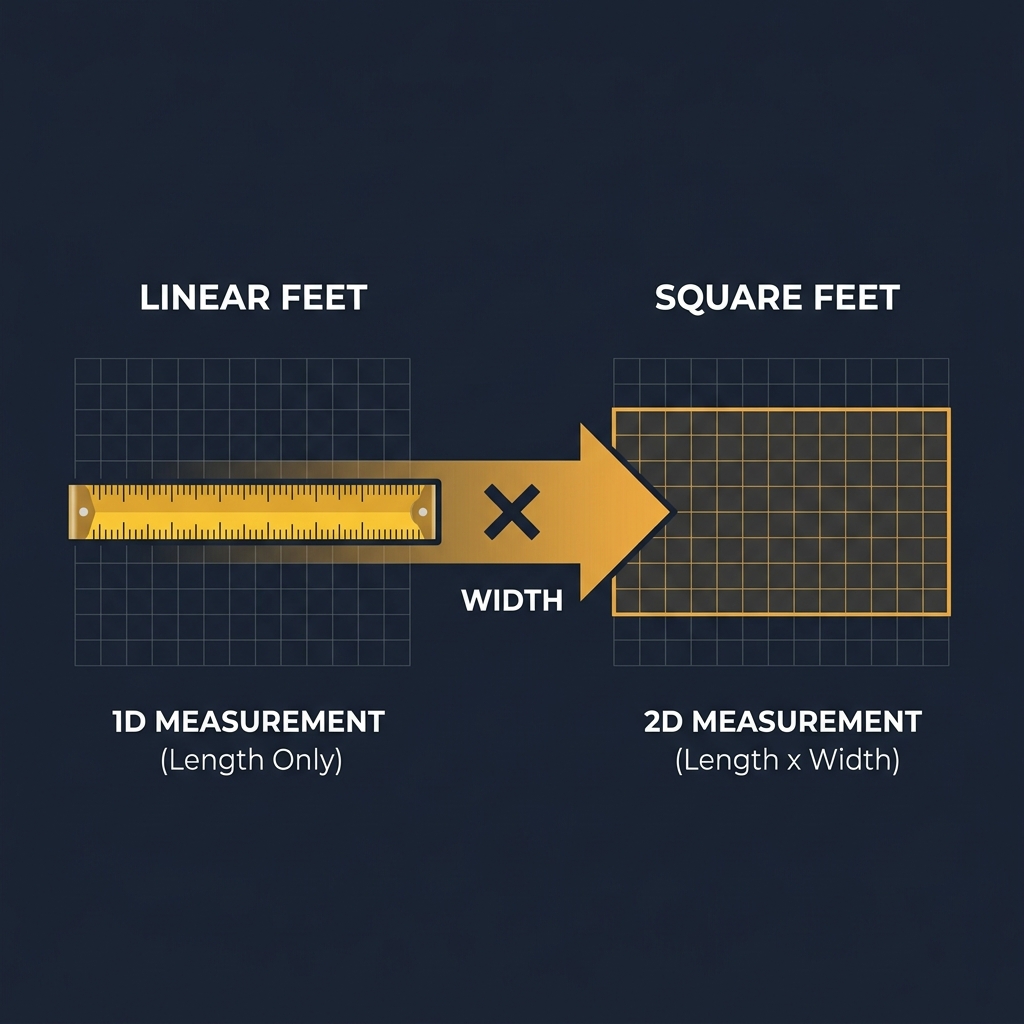
Last spring, I ordered 200 linear feet of 6-inch-wide cedar fence boards for a backyard project. When the boards arrived and I laid them out, I had exactly 100 square feet of coverage, not the 200 square feet I was expecting. That mistake cost me a second trip to the lumber yard, an extra delivery fee, and a full weekend of delays. The root cause was simple: I confused linear feet with square feet. These two units measure completely different things, and converting between them requires one additional piece of information that most people overlook, the width of the material.
If you have ever bought flooring planks, lumber, carpet from a roll, or decking boards, you have encountered linear feet pricing. Understanding exactly how to convert those linear feet into the square feet of coverage they provide is an essential skill for every homeowner, contractor, and DIY builder. This guide covers the formula, step-by-step instructions, worked examples, a ready-to-use conversion table, and material-specific advice.
What Is the Difference Between Linear Feet and Square Feet?
Before tackling the conversion, you need to understand what each unit actually measures. They are fundamentally different, and treating them as interchangeable is where costly errors begin.
What Is a Linear Foot?
A linear foot is a straight-line measurement of length. It is exactly 12 inches, or one foot, measured in a single direction. When a store sells lumber "by the linear foot," they are telling you the price for each foot of length, regardless of how wide or thick the board is. A 10-foot-long board is 10 linear feet whether it is 4 inches wide or 12 inches wide.
What Is a Square Foot?
A square foot is a unit of area. It describes a flat surface that is one foot long and one foot wide. When you measure a room and say it is 120 square feet, you are describing the total floor area, the two-dimensional space the room occupies. Calculating area always requires two measurements: length and width.
Linear Feet vs. Square Feet: The Key Difference
The core difference is dimension. Linear feet measure in one dimension (length). Square feet measure in two dimensions (length multiplied by width). You cannot compare them directly, just as you cannot compare miles to acres. A mile is a distance. An acre is an area. Linear feet and square feet have the same fundamental relationship.
Linear vs. Square Foot Visualizer
InteractiveAdjust the width to see how the same 10 linear feet produce different square footage.
Coverage: 25% of a 4-ft wide surface
Why Do You Need Width to Convert Linear Feet to Square Feet?
This is the question that trips up most people. You cannot simply type "20 linear feet to square feet" into a calculator and get a meaningful answer. The conversion is impossible without one critical measurement: the width of the material.
How Length and Width Determine Area
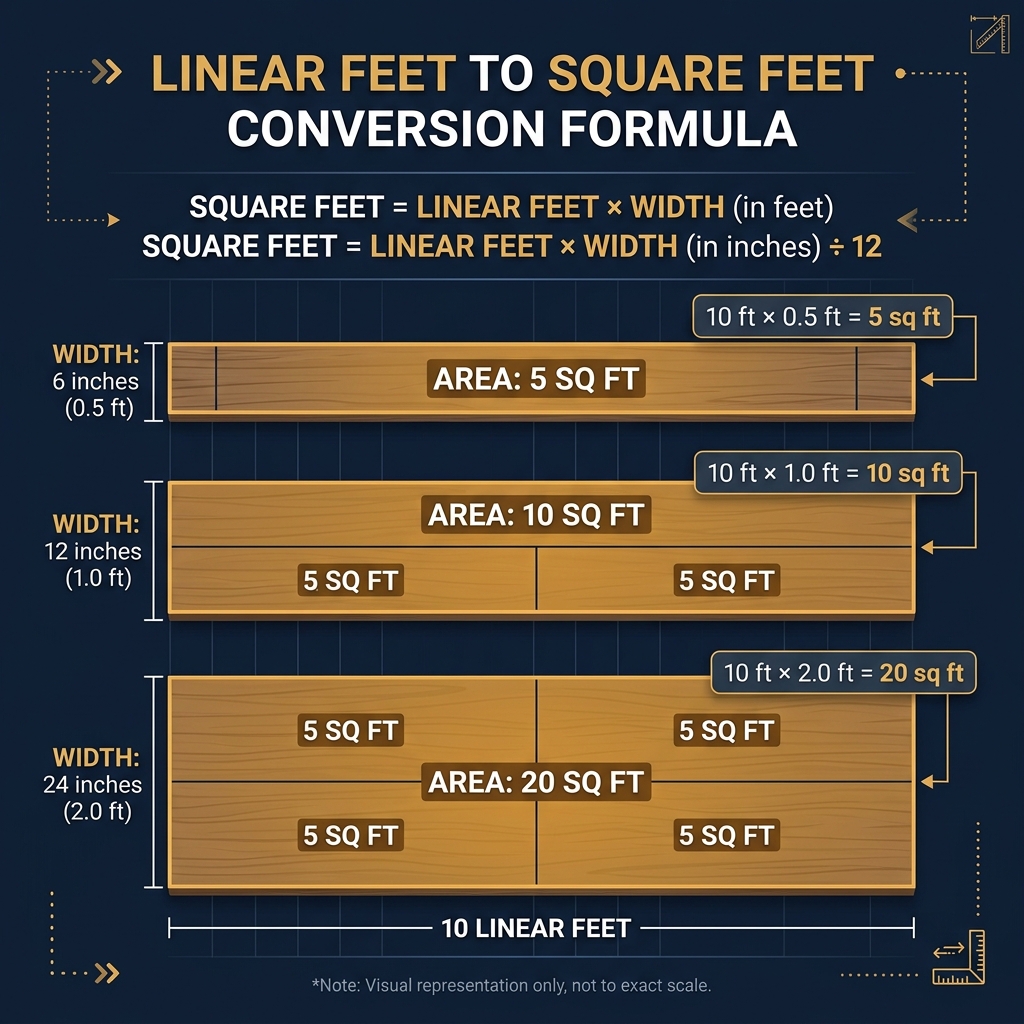
Area equals length multiplied by width. That is the foundational rule of geometry. A board that is 10 feet long and 1 foot wide covers 10 square feet. A board that is 10 feet long and 0.5 feet wide covers only 5 square feet. The length stayed the same, but the area changed because the width changed. Width is not optional information; it is half the equation.
Why Linear Feet Alone Cannot Be Converted to Square Feet
Think of it this way: knowing someone drove for 2 hours tells you the time, but not the distance, because you also need the speed. Similarly, knowing you have 20 linear feet tells you the length, but not the area, because you also need the width. One piece of information is missing, and without it, the answer can be anything.
What Is the Formula for Converting Linear Feet to Square Feet?
The formula is straightforward once you understand the concept.
Linear Feet to Square Feet Formula
That is the entire formula. Multiply the length in linear feet by the width in feet, and the result is the area in square feet.
Converting Width from Inches to Feet
Most building materials list their width in inches, not feet. A standard deck board is 5.5 inches wide. A common fence picket is 5.5 or 3.5 inches wide. Flooring planks are often 5, 7, or 8 inches wide. Before using the formula, you must convert inches to feet by dividing by 12.
Understanding Each Part of the Formula
The formula has three components. First, the linear feet value is the total length of material you are buying or already have. Second, the width in feet is how wide each piece is, converted from inches if necessary. Third, the result in square feet tells you the actual surface area that material will cover. Every part must be in feet for the formula to work correctly.
How to Convert Linear Feet to Square Feet Step by Step
Follow these five steps for an accurate conversion every time.
Measure the Material Length in Linear Feet
Determine the total length of material. If you have four boards, each 8 feet long, your total linear footage is 32 linear feet. If you are reading a product label, the length is usually printed on the packaging or listed in the product description.
Measure the Material Width
Measure the face width of the material. For a deck board, measure across the top face. For carpet, check the roll width on the label. Write down whether the measurement is in inches or feet.
Convert the Width to Feet
If the width is in inches, divide by 12. A 6-inch width becomes 0.5 feet. A 9-inch width becomes 0.75 feet. A 3.5-inch width becomes approximately 0.292 feet. Always do this conversion before multiplying.
Multiply Length by Width
Multiply the total linear feet by the width in feet. For example: 32 linear feet multiplied by 0.5 feet equals 16 square feet.
Check the Result in Square Feet
Verify the result makes sense. If the width is less than one foot, the square footage should be less than the linear footage. If the width is exactly one foot, the numbers should be equal. If the width is greater than one foot, the square footage should exceed the linear footage.
Linear Feet to Square Feet Conversion Examples
Real numbers make the formula click. Here are four common scenarios you are likely to encounter when working with building materials.
Example Using a 12-Inch-Wide Material
You buy 25 linear feet of 12-inch-wide shelf board. The width in feet is 12 / 12 = 1 foot. The area is 25 x 1 = 25 square feet. When the material is exactly 12 inches (1 foot) wide, linear feet and square feet are equal.
Example Using a 6-Inch-Wide Material
You purchase 40 linear feet of 6-inch-wide tongue-and-groove flooring. The width in feet is 6 / 12 = 0.5 feet. The area is 40 x 0.5 = 20 square feet. Notice the square footage is exactly half the linear footage because the board is half a foot wide.
Example Using a 24-Inch-Wide Material
You order 15 linear feet of 24-inch-wide countertop material. The width in feet is 24 / 12 = 2 feet. The area is 15 x 2 = 30 square feet. Here, the square footage is double the linear footage because the material is two feet wide.
Example Using a Width Measured in Feet
You buy 50 linear feet of carpet from a roll that is 12 feet wide. No inch-to-foot conversion is needed. The area is 50 x 12 = 600 square feet. Carpet rolls are one of the few materials where width is already stated in feet.
Linear Feet to Square Feet Conversion Table
This reference table covers the most common material widths. Bookmark it for quick lookups on your next project.
Conversion Table for Common Material Widths
| Linear Feet | 3.5 in Wide | 5.5 in Wide | 6 in Wide | 8 in Wide | 12 in Wide | 24 in Wide |
|---|---|---|---|---|---|---|
| 1 | 0.29 | 0.46 | 0.50 | 0.67 | 1.00 | 2.00 |
| 5 | 1.46 | 2.29 | 2.50 | 3.33 | 5.00 | 10.00 |
| 10 | 2.92 | 4.58 | 5.00 | 6.67 | 10.00 | 20.00 |
| 20 | 5.83 | 9.17 | 10.00 | 13.33 | 20.00 | 40.00 |
| 50 | 14.58 | 22.92 | 25.00 | 33.33 | 50.00 | 100.00 |
| 100 | 29.17 | 45.83 | 50.00 | 66.67 | 100.00 | 200.00 |
| 200 | 58.33 | 91.67 | 100.00 | 133.33 | 200.00 | 400.00 |
| 500 | 145.83 | 229.17 | 250.00 | 333.33 | 500.00 | 1000.00 |
How to Convert Square Feet to Linear Feet
Sometimes you need to work the formula in reverse. You know the area you need to cover and the width of the material, and you need to figure out how many linear feet to purchase.
Square Feet to Linear Feet Formula
Square Feet to Linear Feet Example
You need to cover 150 square feet of floor with planks that are 8 inches wide. First convert the width: 8 / 12 = 0.667 feet. Then divide: 150 / 0.667 = 224.9 linear feet. You would order approximately 225 linear feet of 8-inch-wide planking, plus 10 percent for waste and cuts during installation.
How to Convert Linear Feet to Square Feet for Common Materials
Different materials have standard widths, and knowing them saves you time at the store.
Flooring and Decking
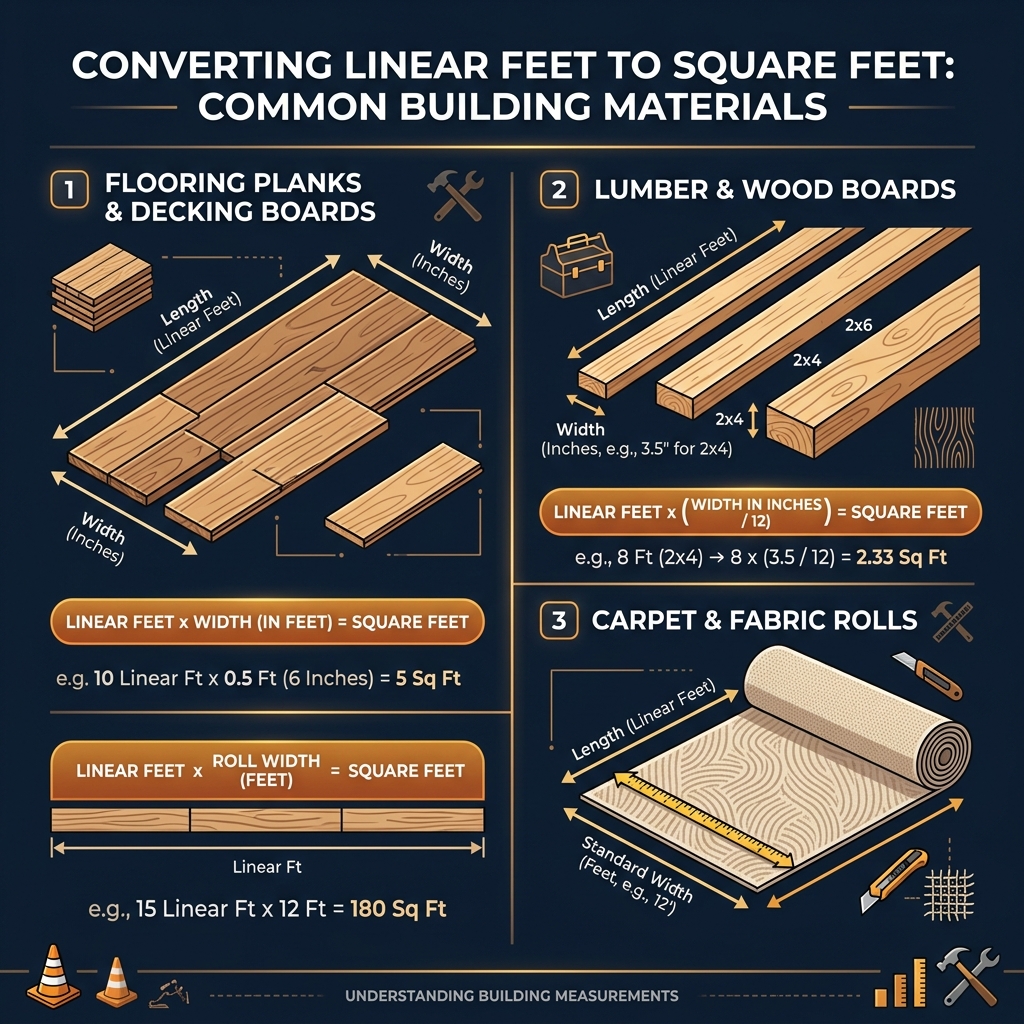
Hardwood flooring planks typically range from 2.25 to 7 inches wide. Composite deck boards are usually 5.5 inches wide for standard boards or 11.25 inches for wide-format boards. Always check the actual face width after milling, as nominal dimensions differ from actual dimensions. For a 500-square-foot deck using 5.5-inch-wide boards, you would need 500 / 0.458 = approximately 1,092 linear feet.
Lumber and Wood
Dimensional lumber uses nominal sizing. A "1x6" board is actually 0.75 inches thick and 5.5 inches wide. A "1x12" is actually 11.25 inches wide. When converting linear feet to square feet for lumber projects, always use the actual measured width, not the nominal label. A 10-foot "1x6" provides 10 x (5.5/12) = 4.58 square feet, not 5 square feet.
Carpet, Fabric, and Other Roll Materials
Carpet rolls come in standard widths of 12 feet or 15 feet. Fabric bolts are typically 45, 54, or 60 inches wide. Vinyl sheet flooring usually comes in 6-foot or 12-foot widths. Since these widths are large, even a few linear feet covers significant area. Ten linear feet of 12-foot-wide carpet covers 120 square feet.
Common Mistakes When Converting Linear Feet to Square Feet
After years of working with these conversions on construction and renovation projects, I have seen the same errors repeated constantly. Each one leads to ordering too much or too little material.
Trying to Convert Without Knowing the Width
This is the most fundamental error. People search for "convert 100 linear feet to square feet" and expect a single answer. The answer depends entirely on the width. Without it, the question has no solution. Always identify the material width before attempting any conversion.
Using Inches Instead of Feet in the Formula
If you multiply 20 linear feet by 6 inches (instead of 0.5 feet), you get 120, a number with no meaningful unit. The result must be in square feet, and for that, both inputs must be in the same unit: feet. This mistake inflates results by a factor of 12 and leads to massive overordering of materials.
Confusing Linear Feet with Square Feet
Some people assume linear feet and square feet are the same thing. They are not. Ordering 200 square feet of material when the supplier sells in linear feet, or vice versa, creates a guaranteed mismatch. Always confirm which unit the seller is using before placing an order.
Rounding Measurements Too Early
Rounding a 5.5-inch width to 6 inches before converting seems harmless, but it creates a 9 percent error that compounds across large orders. If you are buying 500 linear feet of material, that rounding error translates to over 20 extra square feet of phantom coverage. Keep the full decimal until the final calculation is complete.
Frequently Asked Questions
There is no fixed number. One linear foot only measures length. To find the square footage, you must multiply that one linear foot by the width of the material. For example, one linear foot of 12-inch-wide board equals 1 square foot, but one linear foot of 6-inch-wide board equals only 0.5 square feet.
No. Linear feet measure only length. Square feet measure area, which requires both length and width. Without a known width, the conversion is mathematically impossible.
Yes. A linear foot is simply one foot measured in a straight line. The word linear just clarifies that the measurement refers to length only, not area or volume.
Divide the width in inches by 12 to convert it to feet. Then multiply the length in linear feet by the width in feet. For example, 20 linear feet of a 6-inch-wide board: 6 divided by 12 equals 0.5 feet, then 20 times 0.5 equals 10 square feet.
Absolutely. The square footage depends entirely on the width. Ten linear feet of a 12-inch-wide plank gives 10 square feet, but 10 linear feet of a 24-inch-wide plank gives 20 square feet. The width changes everything.
Final Thoughts
Converting linear feet to square feet comes down to one simple formula: multiply the length in linear feet by the width in feet. The critical step most people skip is converting the width from inches to feet first. Once you master that step, you will never overspend on materials or underestimate coverage again. Whether you are pricing hardwood flooring, estimating deck boards, or calculating how much carpet to order from a 12-foot roll, the math stays exactly the same. Measure carefully, convert your units, multiply, and you will have the accurate square footage every time.