Last spring, a colleague closed on a half-acre residential lot listed at 21,780 square feet. After moving in, a licensed surveyor measured 19,420 square feet. The seller had used rough pacing instead of a tape measure, inflating the area by 12 percent. That 2,360 square foot difference changed the per-square-foot price from $18.36 to $20.60 and cost my colleague over $4,300 in overpayment. Every land transaction begins with one question: how many square feet does this plot actually cover?
Knowing how to calculate the area of land in square feet protects your budget whether you are buying, selling, building, or simply fencing a property. A 5 percent measurement error on a 10,000 square foot commercial lot at $25 per square foot equals $12,500 in mispriced value. This guide walks through every formula, every shape, and every pitfall. By the end, you will measure any plot with confidence and catch errors before they become expensive problems. The land square footage calculator on this site handles the math instantly for any shape.
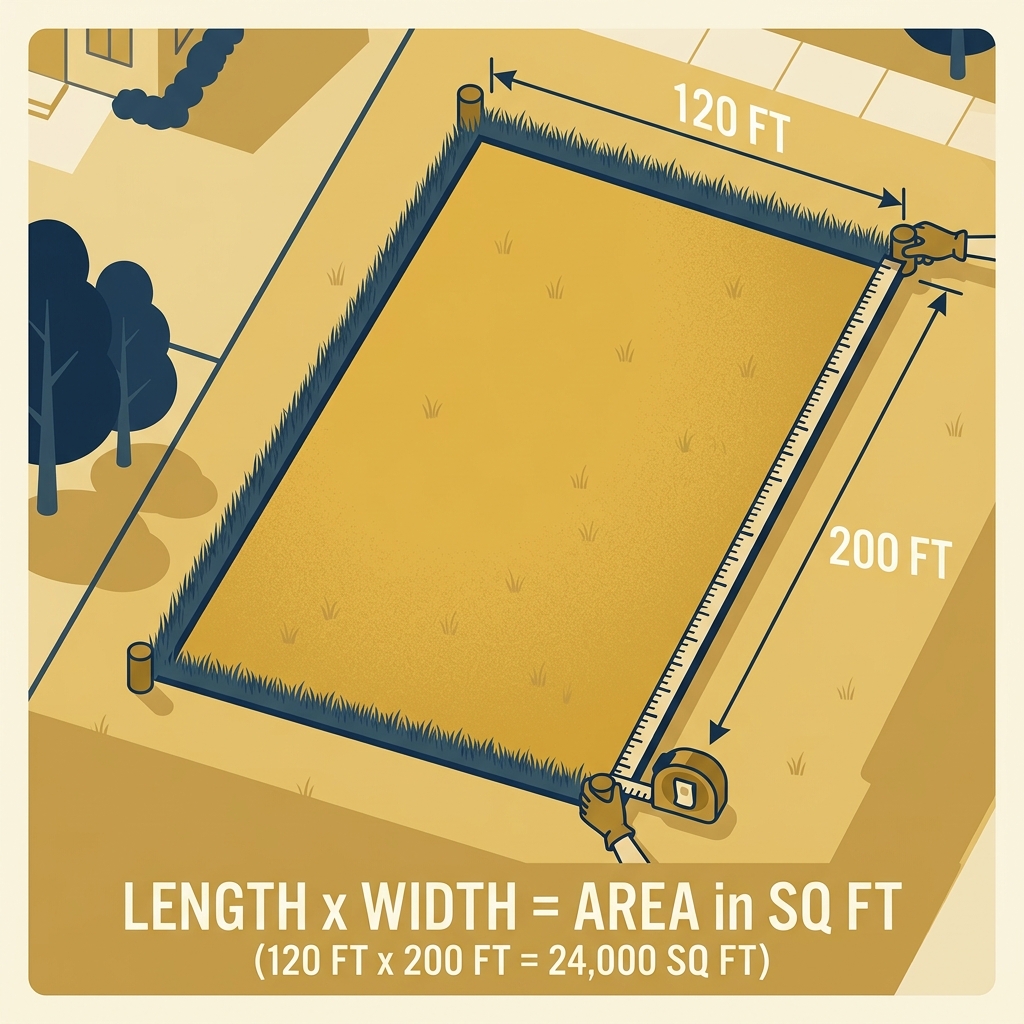
Measuring land area starts with identifying the shape and taking accurate dimensions.
What Does Square Feet of Land Mean?
Square feet of land tells you how much ground surface a plot covers. It is the universal currency of property measurement in the United States. Builders, realtors, appraisers, and zoning officials all rely on this single number. Understanding what it represents gives you control over negotiations, construction planning, and material estimates from day one.
What Is a Square Foot?
One square foot is a flat surface measuring 12 inches long by 12 inches wide. Picture a standard floor tile. When a property listing says a lot is "5,000 square feet," it means 5,000 of those one-foot-by-one-foot tiles would cover the entire ground without overlapping or leaving gaps. The abbreviation is "sq ft" or "ft2." This unit connects directly to costs: fencing is priced per linear foot of perimeter, but land value and construction costs are priced per square foot of area.
Visualizing a Square Foot of Land
VisualEach tile represents 1 square foot (12 in x 12 in). A 10x5 plot covers 50 sq ft.
Why Is Land Measured in Square Feet?
Square feet became the standard in the United States because the foot was already the primary unit of everyday measurement. Property deeds, zoning codes, building permits, and real estate listings all use square feet for consistency. Contractors price excavation at $1.50 to $4 per square foot. Sod installation runs $1 to $2 per square foot. Concrete driveways cost $4 to $10 per square foot. When everyone speaks the same measurement language, comparing bids and verifying costs is straightforward. The square footage calculator converts your measurements into the number every contractor and agent expects.
Difference Between Length and Area
Length measures distance in one direction. It answers "how far?" Area measures surface coverage. It answers "how much ground?" A fence runs along the perimeter, measured in linear feet. A lawn covers the interior, measured in square feet. Confusing the two is a common and costly mistake. A 100-foot by 100-foot lot has a perimeter of 400 linear feet but an area of 10,000 square feet. Ordering fencing based on area or sod based on perimeter wastes money every time.
Length (Perimeter) vs. Area
DiagramHow Do You Calculate Square Feet of Land?
Calculating square feet of land follows a four-step process that works for every plot, regardless of shape. Master these four steps and you will handle residential lots, commercial parcels, and agricultural fields with the same reliable approach.
Step 1: Identify the Shape of the Land
Walk the perimeter and sketch the outline. Most residential lots are rectangles or squares. Corner lots may be triangles or trapezoids. Rural properties often have irregular boundaries that follow roads, rivers, or fence lines. Identifying the shape determines which formula you need. If the lot looks like a combination of shapes, plan to split it into sections. The irregular shape calculator handles multi-section plots automatically.
Step 2: Measure the Required Dimensions
Use a 100-foot tape measure or a laser distance meter for accuracy. For rectangles, measure the length and width. For triangles, measure the base and the perpendicular height. For circles, measure from the center to any edge for the radius. Record every measurement immediately with its unit. Mark corners with stakes for reference. Measure each side twice. If readings differ by more than 2 inches over 100 feet, measure a third time.
Step 3: Apply the Correct Area Formula
Select Your Land Shape
InteractivePlug your measurements into the formula for your shape. For rectangles, multiply length by width. For triangles, multiply base by height and divide by 2. For circles, multiply pi (3.14159) by the radius squared. Convert all measurements to the same unit before calculating. If your tape reads in feet and inches, convert the inches to decimal feet first. Six inches equals 0.5 feet, not 0.6. This single conversion error accounts for roughly 30 percent of all amateur measurement mistakes.
Step 4: Verify Your Calculation
Compare your result against known benchmarks. A standard residential lot in a suburban subdivision runs 5,000 to 15,000 square feet. A quarter-acre lot is 10,890 square feet. A half-acre is 21,780. If your number falls far outside these ranges, investigate. Recalculate with your original measurements. Cross-check against property tax records or deed descriptions. A 10 percent error on a $200,000 lot changes the value by $20,000. Verification takes two minutes and prevents five-figure mistakes.
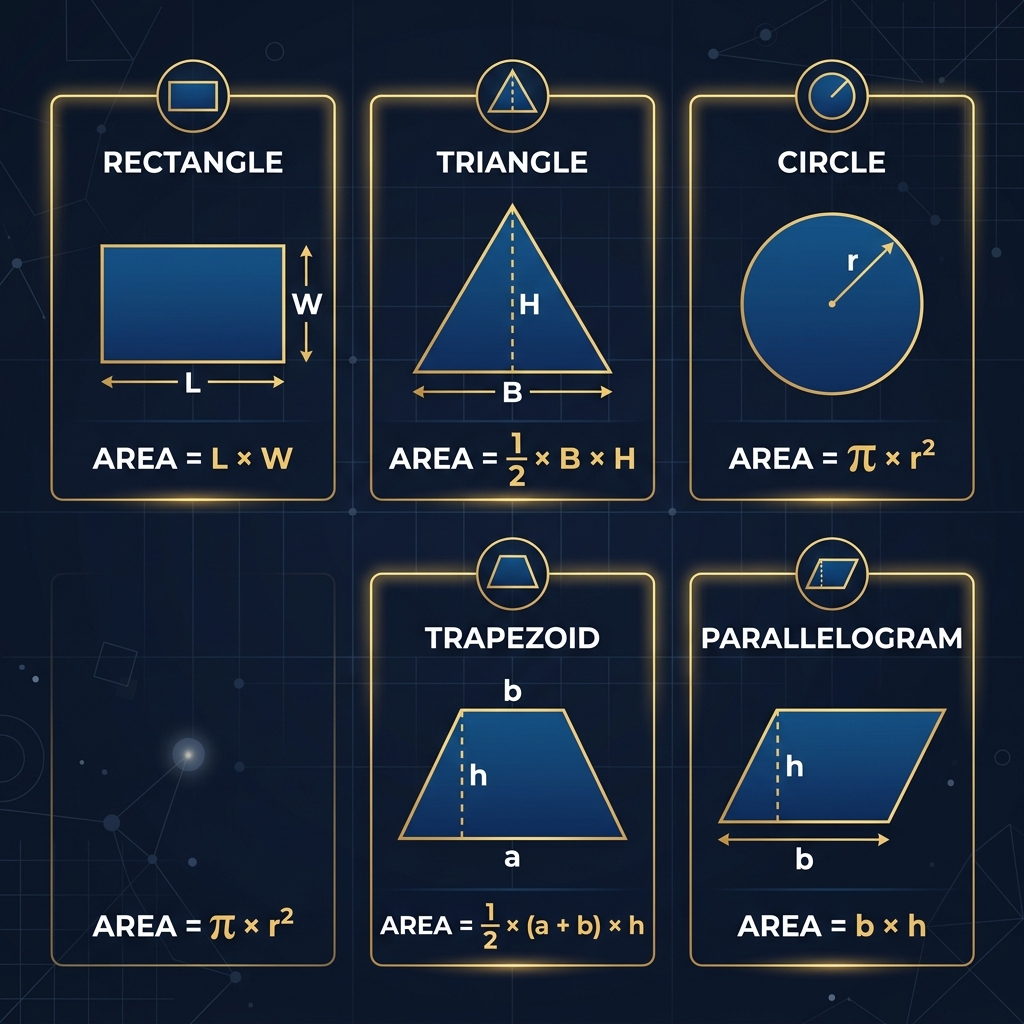
Each land shape requires a different formula. Match the shape to the correct equation before calculating.
Square Feet Formulas for Different Land Shapes
Every land shape has a dedicated formula. Using the wrong one produces an incorrect area. Here is the complete reference for every shape you will encounter in residential, commercial, and agricultural land measurement.
Rectangle
Formula
Example
A residential lot measures 120 feet long and 60 feet wide. Area equals 120 times 60, which is 7,200 square feet. This is about one-sixth of an acre. Most city residential lots fall in the 5,000 to 10,000 square foot range and are nearly always rectangles.
Square
Formula
Example
A square lot with 75-foot sides covers 75 times 75, which is 5,625 square feet. Squares are rectangles where all four sides are equal. You only need one measurement. This shape appears most often in planned subdivisions where lots follow a uniform grid.
Triangle
Formula
Example
A corner lot shaped like a triangle has a 90-foot base and a 50-foot perpendicular height. Area equals 90 times 50 divided by 2, which is 2,250 square feet. The height must be perpendicular to the base, not along a slanted side. Triangular lots commonly appear at street intersections and cul-de-sac corners. The triangle square footage calculator handles acute, right, and obtuse triangles.
Circle
Formula
Example
A circular clearing in a wooded lot has a diameter of 80 feet. The radius is 40 feet. Area equals 3.14159 times 40 times 40, which is 5,026.55 square feet. Circular or semicircular plots appear in cul-de-sacs, roundabout properties, and agricultural irrigation pivot areas. Measure the diameter and divide by 2 for the radius.
Trapezoid
Formula
Example
A lot fronts a curved road. The front measures 80 feet, the back measures 110 feet, and the depth between them is 65 feet. Area equals the sum of 80 plus 110, divided by 2, times 65. That gives 95 times 65, which is 6,175 square feet. Trapezoids appear wherever a property faces a curve, an angled road, or a widening boundary.
Parallelogram
Formula
Example
A farm parcel has a base of 200 feet along a road and a perpendicular depth of 150 feet. The sides run at an angle, but the perpendicular height is what matters. Area equals 200 times 150, which is 30,000 square feet. The slanted sides do not change the area. Only the base and the perpendicular height determine the result.
Irregular Land or Polygon
Common Calculation Methods
For land with curved boundaries, angled property lines, or multiple segments, break the plot into simple shapes. Sketch the outline, draw lines to divide it into rectangles, triangles, and trapezoids. Calculate each piece, then add them together. For plots defined by GPS coordinates, the Shoelace Formula provides an exact answer. Professional surveyors use total stations that measure angles and distances to produce sub-centimeter accuracy.
When to Use an Online Calculator
Use an online calculator whenever your plot has more than four sides, when you need to account for curved boundaries, or when you want to double-check hand calculations. The irregular shape area calculator lets you enter each vertex or section and computes the total area with no arithmetic errors.
Common Land Sizes at a Glance
VisualWorked Examples of Square Feet Calculation
Concrete numbers turn abstract formulas into practical tools. Here are four real-world land calculations covering different property types, each with complete step-by-step arithmetic you can follow.
Quick Land Area Calculator
InteractiveExample 1: Residential Plot
A suburban home lot measures 75 feet across the front and 130 feet deep. This is a standard rectangle. Area equals 75 times 130, which is 9,750 square feet. At $22 per square foot in a mid-range neighborhood, the land alone is valued at $214,500. A 5 percent error would swing the value by $10,725. Always verify by measuring opposite sides. If the back width differs from the front, you have a trapezoid, not a rectangle.
Example 2: Commercial Plot
A small retail lot fronts a highway. The front along the road is 150 feet, the back is 150 feet, and the depth is 200 feet. Area equals 150 times 200, which is 30,000 square feet, or about 0.69 acres. Commercial lots are often priced per acre or per square foot depending on the market. At $35 per square foot, this lot costs $1,050,000. The square feet to acres converter translates between these units instantly.
Example 3: Agricultural Land
A farm parcel measures 660 feet by 330 feet. Area equals 660 times 330, which is 217,800 square feet. Divide by 43,560 to get acres: exactly 5 acres. Agricultural land is almost always discussed in acres, but the underlying calculation still starts in square feet. Crop yield estimates, irrigation coverage, and fence material all depend on accurate area measurement.
Example 4: Irregular Plot
A lakefront property has an irregular shape. You break it into a rectangle (100 x 80 = 8,000 sq ft) and a triangle at one end (base 40 feet, height 80 feet, area = 1,600 sq ft). Total area equals 8,000 plus 1,600, which is 9,600 square feet. Without splitting the lot into sections, you would have guessed an average and likely been off by 10 to 20 percent. The any-shape calculation guide walks through more complex combinations.
Common Mistakes When Calculating Square Feet
After reviewing hundreds of property measurements and helping neighbors verify lot sizes, I see the same five errors come up repeatedly. Each one is preventable with simple awareness.
Mixing Different Measurement Units
The Impact of Mixed Units
VisualMixing feet and inches produces a result 12 times smaller than the actual area.
The most dangerous mistake is mixing feet with inches, meters, or yards in the same calculation. One dimension in feet and the other in inches produces a result off by a factor of 12. Always convert both measurements to the same unit before multiplying. Write the unit abbreviation next to every number.
Using Incorrect Dimensions
Measuring along a fence line instead of along the true boundary gives you the wrong number. Fences are often set inside the property line by 6 to 12 inches. Over 200 feet, that adds up to a 1 to 2 foot discrepancy on each side, shrinking or inflating the calculated area by 200 to 400 square feet. Always measure from survey markers or pins, not from structures built on the lot.
Applying the Wrong Formula
A trapezoidal lot calculated with the rectangle formula (length times width) gives you an inflated or deflated number. If the front is 80 feet and the back is 110 feet but you use just one of those as the "width," your result will be wrong by hundreds of square feet. Always identify the shape first, then choose the matching formula. The common mistakes guide covers eight more errors and how to fix them.
Confusing Area with Perimeter
Area and perimeter are fundamentally different measurements. A 100 by 50 foot lot has a perimeter of 300 feet and an area of 5,000 square feet. If you quote the perimeter when someone asks for the area, every downstream calculation from material orders to property value is wrong. Perimeter tells you how much fencing to buy. Area tells you how much sod, seed, or gravel to order.
Ignoring Irregular Boundaries
Treating an irregular lot as a simple rectangle by averaging the sides always produces an inaccurate result. A lot with a 100-foot front, an 80-foot back, and 120-foot sides is a trapezoid, not a rectangle. The correct area is 10,800 square feet, but rounding to a "90 by 120 rectangle" gives 10,800 as well. That works in this specific case, but with asymmetric shapes, the error compounds quickly. Splitting the plot and calculating each section gives a reliable answer every time.
How to Check If Your Square Feet Calculation Is Correct
Verification separates a good measurement from a guess. Three methods catch errors before they become problems.
Recalculate Using the Formula
Redo the math with your original measurements. If the second result matches the first within 1 percent, your arithmetic is sound. If not, check each step for transposed digits or unit conversion errors. I redo every calculation at least once, even on simple rectangles. One reversed digit in a 150 by 120 calculation turns 18,000 into 12,000 or 15,000.
Verify with an Online Calculator
Enter your dimensions into the land area calculator and compare the output to your hand calculation. If the numbers match, you have confidence. If they disagree, identify which input is different. Online calculators eliminate arithmetic errors, but they rely on you entering accurate measurements.
Compare with Property Documents
Your deed, plat map, or tax assessment card lists the official lot area. Compare your calculated number to the recorded number. A discrepancy of less than 2 percent usually means minor measurement variation. A larger gap means either the recorded number is outdated or your field measurements need adjustment. County assessor offices provide lot dimensions and area records, often available online.
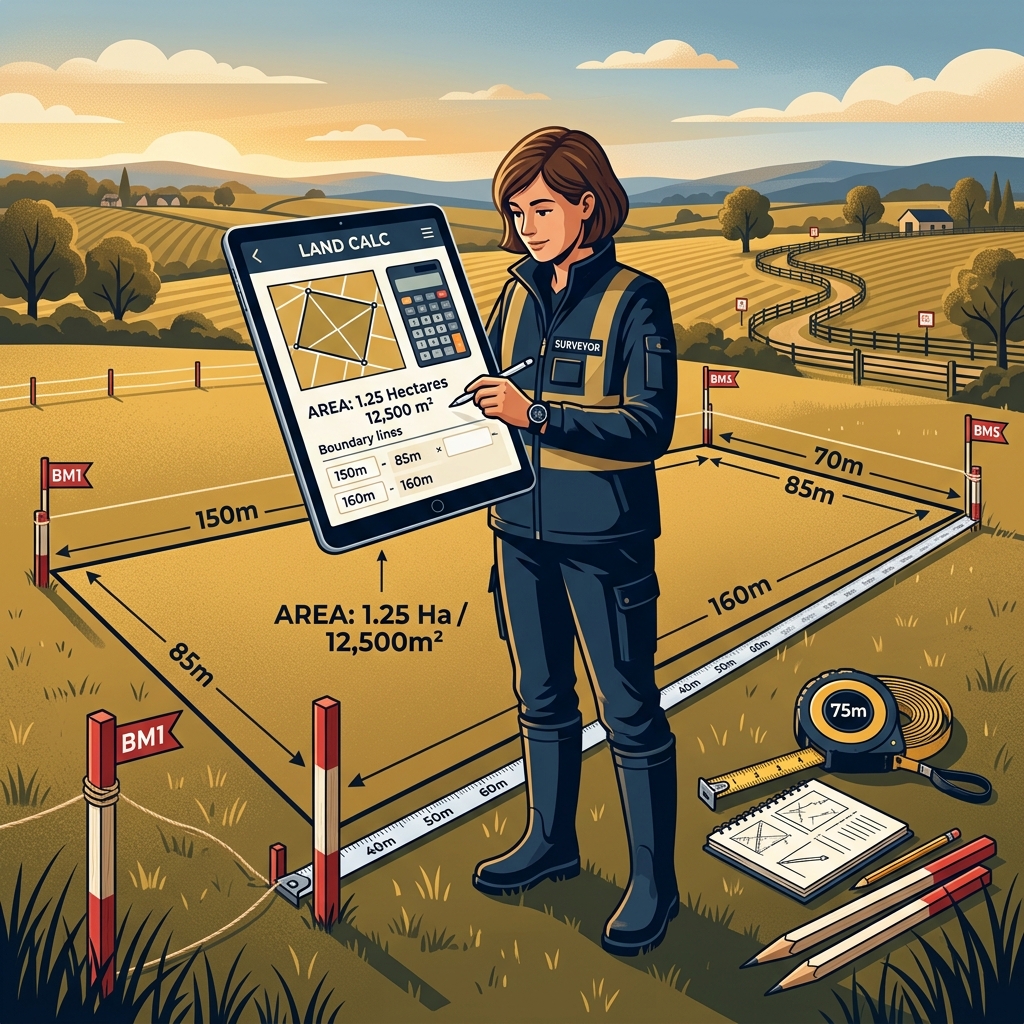
Combining digital calculators with physical measurements produces the most reliable results.
Benefits of Calculating Land Area in Square Feet
Accurate land measurement drives financial decisions across four major categories.
Property Buying and Selling
Buyers pay per square foot. Sellers price per square foot. Both parties need the same accurate number to negotiate fairly. A 10 percent measurement error on a $300,000 property represents $30,000. Verifying the area before signing protects both sides and prevents disputes after closing.
Construction Planning
Building permits require site coverage ratios. Most residential zones allow 30 to 40 percent lot coverage. On a 10,000 square foot lot at 35 percent coverage, the maximum building footprint is 3,500 square feet. Calculating the lot area wrong means either under-building and wasting potential or exceeding coverage limits and facing permit violations.
Material Estimation
Sod costs $0.30 to $0.80 per square foot. Gravel runs $1 to $3 per square foot at 2 inches thick. Concrete averages $5 to $10 per square foot. On a 5,000 square foot project, a 10 percent area error equals 500 square feet, which adds $150 to $5,000 in wasted or missing material depending on the product. The cost per square foot calculator ties area measurements directly to budgets.
Property Valuation
Appraisers use area as a primary input. Comparable sales are adjusted by price per square foot. Lenders require accurate square footage for mortgage calculations. Tax assessors base property taxes partly on lot area. Every link in the valuation chain depends on the same accurate area measurement.
When Should You Use an Online Square Feet Calculator?
Knowing when to calculate by hand and when to use a tool saves time and prevents errors.
Manual Calculation vs. Calculator
| Factor | Manual Calculation | Online Calculator |
|---|---|---|
| Speed | 1-3 minutes per shape | Under 10 seconds |
| Accuracy | Depends on arithmetic skill | Eliminates math errors |
| Complex Shapes | Requires splitting and adding | Handles automatically |
| Unit Conversion | Requires manual conversion | Built-in conversion |
| Best For | Simple rectangles, quick checks | Multi-shape plots, verification |
When a Calculator Saves Time
Use a calculator when your plot has more than one shape, when you need unit conversions, or when you are comparing multiple properties. Irregular lots with five or more sides take 10 to 15 minutes by hand but 30 seconds with an online tool. Use the square footage calculator for any situation where arithmetic complexity could introduce errors.
Situations That Require Professional Measurement
Hire a licensed land surveyor for property transactions above $100,000, boundary disputes, subdivision plats, and construction on steeply sloped terrain. Surveyors use total station instruments accurate to one-tenth of an inch. Their legal documents hold up in court. DIY measurements are sufficient for landscaping estimates and personal reference, but never for legal boundary determinations.
Frequently Asked Questions
Measure the length and width of the land in feet. Multiply them together to get square feet. For a rectangular plot that is 80 feet long and 60 feet wide, the area is 80 times 60, which equals 4,800 square feet. For non-rectangular land, identify the shape and apply the correct formula.
The basic formula is Length times Width for rectangles. Triangles use half of base times height. Circles use pi times radius squared. Trapezoids use half of the sum of both parallel sides times the height. Choose the formula that matches your land shape.
Yes. Break the irregular plot into smaller standard shapes such as rectangles, triangles, and trapezoids. Calculate each section separately and add the areas together. For complex boundaries, use the Shoelace Formula with GPS coordinates or hire a licensed surveyor.
No. Each shape has its own formula. Rectangles use length times width. Triangles use half base times height. Circles use pi times radius squared. Using the wrong formula will produce an incorrect area and could lead to costly errors in property transactions.
No. One square yard equals 9 square feet because 1 yard is 3 feet and 3 times 3 is 9. To convert square feet to square yards, divide by 9. A 2,700 square foot lot is 300 square yards.
For rectangles, you need the length and width. For triangles, the base and perpendicular height. For circles, the radius or diameter. For trapezoids, both parallel sides and the height. Always measure in the same unit before calculating.
Yes. For simple shapes, basic multiplication is all you need. A 50 by 40 foot plot is 2,000 square feet. For triangles or circles, a pen and paper works fine. Complex or irregular plots benefit from an online calculator to avoid arithmetic errors.
Property documents often use measurements from a licensed survey that accounts for easements, setbacks, and legal boundaries. Your tape measurement covers physical boundaries that may differ. Survey-grade GPS is accurate to within one centimeter, while a tape measure can vary by several inches over long distances.
Appraisers use comparable sales, lot size, location, zoning, and improvements. They calculate price per square foot from recent sales of similar properties in the same area, then adjust for differences in lot size, shape, access, and topography. Accurate square footage is the foundation of every appraisal.
Final Thoughts
Calculating square feet of land comes down to three steps: identify the shape, measure accurately, and apply the right formula. Rectangles take 30 seconds. Irregular plots take a few minutes of sketching and splitting. The math itself is simple multiplication. The discipline is in measuring carefully, recording with unit labels, and verifying your result against at least one independent source.
Identify the shape of the land before choosing a formula.
Convert all measurements to the same unit before multiplying.
Split irregular plots into rectangles, triangles, and trapezoids.
Verify results against property documents or an online calculator.
Hire a licensed surveyor for transactions above $100,000 or boundary disputes.
What land are you measuring right now? Whether it is a backyard for a fence estimate, a vacant lot for a purchase offer, or farmland for crop planning, the process starts with the same tape measure and the same simple formulas. Get the square footage right, and every cost, every bid, and every decision that follows will be grounded in accurate numbers.